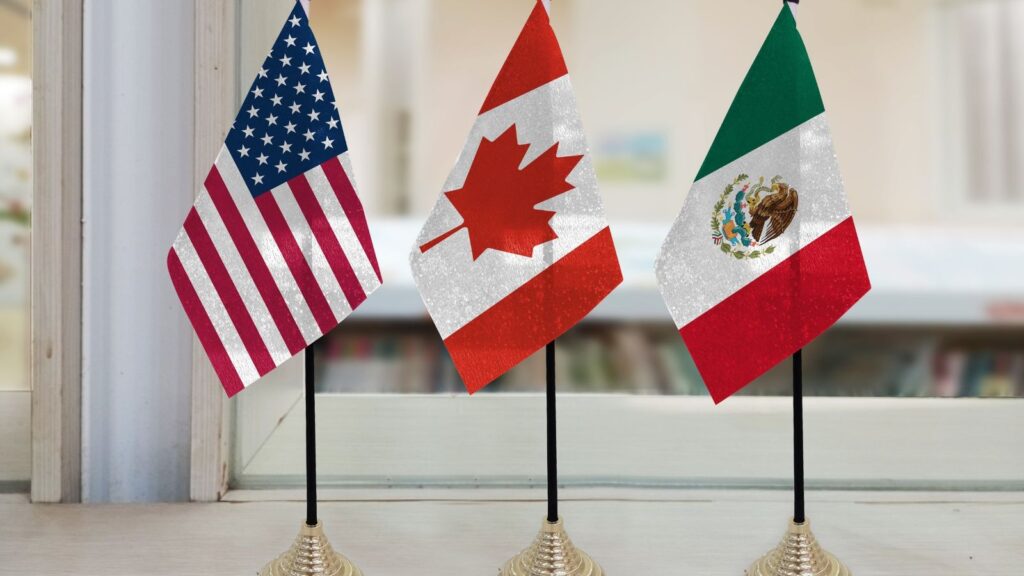
Mexico has put another meeting with Donald Trump on the calendar, raising the prospect of tariff relief before the year ends. Mexican President Claudia Sheinbaum says the two leaders will meet again in Florida in December after discussing trade at an Asia-Pacific summit in China. Her foreign minister reaffirmed that plan on November 23, with an agreement still the goal rather than an accomplished fact.
For Canada, the contrast is uncomfortable but not quite as simple as being left out. Prime Minister Mark Carney also met Trump in China, and their governments remain in contact. What Ottawa does not yet have is a deal that eases the pressure on Canadian exporters. The difference between a scheduled conversation and signed tariff relief now matters across North American factories, mills and boardrooms.
Mexico Secures Another Meeting With Trump
The next encounter is a milestone for Mexico’s negotiators. Sheinbaum and Trump spoke for roughly 20 minutes on November 18 at the Asia-Pacific Economic Cooperation summit in Shenzhen. Mexico’s presidency said trade dominated the discussion, which included senior U.S. trade officials. Mexican Economy Secretary Marcelo Ebrard reported 56 technical meetings with American counterparts, showing they were discussing work already underway. The conversation was brief, but the groundwork was extensive.
On November 23, Mexican Foreign Minister Roberto Velasco reaffirmed that the presidents expect to meet again at Mar-a-Lago in Florida around the December 14–15 G20 gathering. Their objective is to see whether a commercial agreement can be announced there. That remains an ambition, not a guarantee. No jointly signed tariff package or detailed list of concessions accompanied the announcement. For businesses planning next year’s production, however, a specific opportunity for another presidential conversation is more useful than an indefinite promise to keep talking.
Mexico Says Trade Talks Are Advanced, Not Finished
Sheinbaum says talks with Washington are advanced, including U.S. complaints about non-tariff barriers. After Shenzhen, she identified reduced U.S. duties on Mexican vehicles, steel, aluminum and related products as a central objective. These are sectors where a change in tariff treatment can alter the economics of an export order, even when the products and customers remain exactly the same.
Yet the public account leaves significant questions unanswered. Mexico has not publicly announced the tariff rates it expects to secure, products that would qualify or the conditions Washington may attach. Trump has also emphasized his concern about the U.S. trade deficit with Mexico, a reminder that the two governments do not necessarily define success in the same way. The language of progress understandably carries political value for both sides, but manufacturers cannot calculate savings from goodwill. Until the terms are published, Mexico’s prospective advantage is negotiating momentum rather than confirmed tariff relief. A deal’s legal scope will matter just as much as its advertised tariff rate.
Carney Met Trump Too, but Canada Has No Breakthrough
Canada was also on Trump’s diplomatic schedule in China. Carney met Trump on November 18, the same day as Sheinbaum’s conversation with the American president. Ottawa’s official account said the leaders discussed a mutually beneficial trade arrangement intended to protect Canadian jobs and affordability while respecting the country’s languages, culture and sovereignty. Both sides agreed to continue working and remain in contact. No agreement or immediate tariff reduction was announced then.
That distinction matters. Mexico can point to a planned December follow-up, but Canada has also had direct presidential access. The difference is the clarity of each government’s next publicly stated milestone, not proof that Washington has formally excluded Ottawa. Carney has characterized U.S. negotiations as unusually complicated and has argued against signing an arrangement that does not make economic sense. A meeting alone cannot answer the question facing exporters: when will the cost of reaching American customers actually fall?
Ottawa Wants an Interim Agreement Before the Bigger Review
Canada first wants relief, not a complete trade overhaul. Trade Minister Dominic LeBlanc said on November 19 that Ottawa wants an interim arrangement to reduce U.S. tariffs on Canadian goods that could help launch formal talks on the Canada-United States-Mexico Agreement, known as CUSMA. He acknowledged that discussions had advanced but not enough to produce terms the Canadian government considered acceptable. An advisory committee briefing also suggested little movement from Washington.
The government is aiming for relief as soon as it can secure an acceptable agreement, with year-end a goal, not a deadline. LeBlanc indicated work could still continue into January or February if necessary. He has also distinguished between lowering sector-specific duties, some of which may remain, and seeking to eliminate the separate Section 338 tariffs. LeBlanc acknowledged that some tariffs could remain at reduced levels, provided Canadian industries could remain economically viable. That is a harder message than promising every tariff will disappear, but it gives businesses a clearer picture of the compromises Ottawa is weighing.
The Auto Sector Is Where Delay Becomes Expensive
Automotive tariffs remain a major obstacle. Government guidance describes a 25% Section 232 tariff on imported vehicles and trucks, with the U.S.-origin portion of qualifying CUSMA-compliant vehicles excluded from that charge. Qualifying parts currently receive broader exemptions. That matters in an industry sourcing components across the border every day; the headline tariff rate does not apply identically to every vehicle or part.
But businesses still face uncertainty. Reuters reported in November that the U.S. tariff on Canadian autos was scheduled to increase to 50% in January, and industry groups warned that escalating costs could threaten established supply chains, jobs and plants. Consider a parts supplier asked to quote a multiyear contract: a changing border charge can affect whether the customer commits to a Canadian facility. The warning is about future decisions as much as current invoices. A negotiated exception or lower rate could influence where the next investment lands.
Steel, Aluminum and Lumber Face Different Tariff Layers
No single percentage captures Canada’s tariff dispute. Federal guidance lists varying Section 232 duties on steel, aluminum and copper, while softwood timber and lumber face a separate 10% Section 232 charge. Canadian softwood exporters may also pay separate, longstanding anti-dumping and countervailing duties. In October, Ottawa listed a 24.75% combined duty for the “all others” category in a U.S. administrative review. Those layers can dilute any relief. Exporters must therefore examine the treatment of each product rather than rely on a single headline tariff percentage.
A different authority, Section 338, has been used to impose additional 50% duties on specified Canadian goods. Government guidance says those charges can apply even to CUSMA-compliant products and, for covered items, can stack with other tariffs. That complexity helps explain why Ottawa is pursuing both sectoral reductions and the removal of Section 338 measures. For an aluminum producer or lumber mill, the meaningful outcome is not the headline attached to a summit; it is the total border cost that remains on an actual shipment.
CUSMA Is Under Pressure, but It Has Not Disappeared
The regional pact remains in force. CUSMA began on July 1, 2020, and its first joint review took place on July 1, 2026. The United States declined to extend the existing agreement; Canada and Mexico favoured renewal. That decision did not immediately terminate the pact. Under its review provisions, annual discussions can continue, and the term runs to July 2036 unless the countries reach an extension or another legal development changes its status.
This is why separate talks with Mexico do not automatically amount to replacing a three-country agreement. Washington can negotiate bilateral tariff relief while CUSMA continues to govern qualifying North American trade. The U.S. Trade Representative has already launched consultations for the 2027 annual review, with written comments due January 12. The treaty also has a separate withdrawal mechanism, which should not be confused with the annual review process. For companies considering factories that may operate for decades, those legal timelines are more consequential than a single month’s diplomatic calendar. They determine the durability of trade preferences.
Canada and Mexico Still Have Reasons to Work Together
The two North American neighbours negotiate separately with Washington but continue working closely together. Carney and Sheinbaum met on November 17 in Shenzhen and publicly reaffirmed their support for renewing CUSMA. Their governments reported Canada-Mexico merchandise trade rose 19% in the first nine months of 2026 year over year. They also pointed to more than 130 initiatives launched under their bilateral action plan.
Those figures complicate the idea of a simple race in which Mexico’s gain must become Canada’s loss. Automakers, food producers and investors benefit from reliable rules linking all three economies, even when each capital seeks its own short-term tariff concessions. Ottawa and Mexico City also share an interest in avoiding a review that fragments established North American supply chains. There will be commercial competition between them, but the leaders’ meeting shows a parallel diplomatic track: cooperation with one another while bargaining with the same vast U.S. market.
Trade Diversification Gives Ottawa Options, Not Instant Relief
Canada still depends heavily on its nearby American buyers. Statistics Canada says 71.7% of the country’s merchandise exports went to the United States in 2025, down from 75.9% in 2024. Other exports increased despite the uncertainty, but tariffs still ripple through Canadian communities. A mill or manufacturer cannot simply replace a nearby American customer with an overseas buyer at the same cost or speed.
Carney’s government is nevertheless working to widen those options. On November 14, Ottawa announced that negotiations for a free trade agreement with the Philippines had concluded and talks with ASEAN were substantially complete. The government aims to sign both in 2027; neither announcement meant the agreements were already in force. ASEAN represents a market of nearly 700 million people, with Ottawa projecting long-term economic gains from improved access. Government estimates suggest the ASEAN agreement alone could eventually add nearly $2 billion to Canadian GDP and support about 14,000 jobs once implemented. Diversification strengthens Canada’s negotiating position over time, but it is not an immediate substitute for predictable cross-border commerce.
The Real Test Will Be Signed Terms, Not Summit Optimism
The next negotiating checkpoints are increasingly clear. Mexico hopes its December Trump meeting will produce a commercial agreement. Ottawa is seeking an interim arrangement of its own, while LeBlanc has cautioned that reaching an acceptable deal may take beyond the calendar year. Neither timetable guarantees lower U.S. duties, and any announcement will need to be examined for exclusions, implementation dates and remaining charges.
For Canadian businesses under pressure, three developments would matter more than another expression of goodwill: an agreed set of concrete tariff changes, the binding legal steps putting those changes into effect and a credible path through the next CUSMA review. Negotiation promises do not lower export invoices. Mexico has secured a clearer opportunity to make its case in Florida, but its deal is still prospective. Canada has a seat in the conversation, yet continues to wait for terms it can sign—and that its exporters can actually use.
