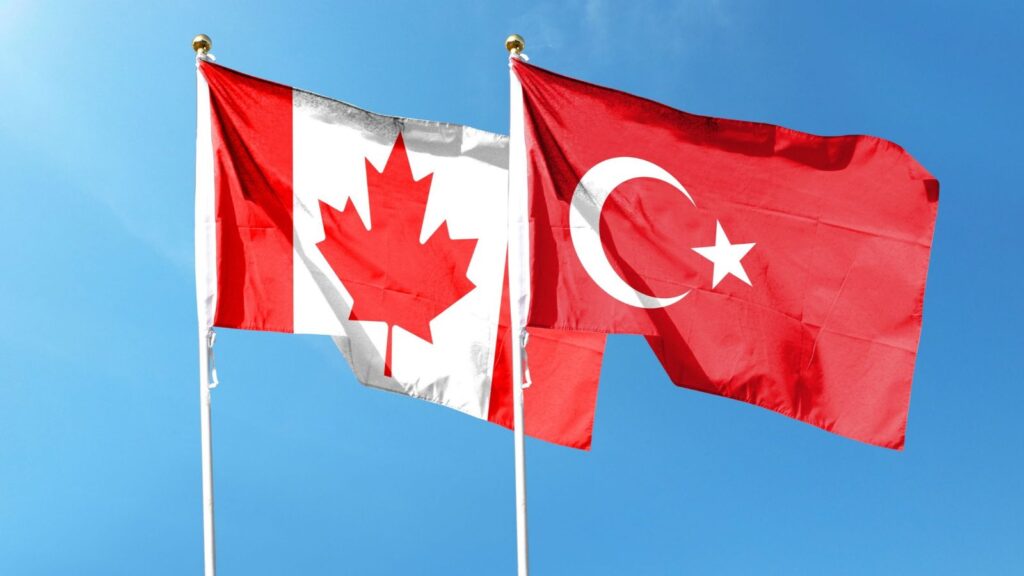
Canada’s search for more dependable overseas partners is bringing nuclear technology, natural gas and defence manufacturing into the same diplomatic conversation. Prime Minister Mark Carney’s planned visit to Turkey comes as Ottawa tries to widen its economic options during a prolonged trade dispute with Washington.
The two NATO allies are pursuing closer cooperation, with a joint declaration reportedly expected during the trip. For Canadian businesses, the attraction is practical: new customers, industrial partners and opportunities beyond the U.S. border. Yet the distinction between diplomatic ambition and commercial reality remains essential. A partnership framework could open doors without immediately producing a reactor contract, an LNG sale or a military equipment order.
A Broader Partnership Is Taking Shape
Carney’s October 21–24 visit is being presented by his office as the first dedicated bilateral trip to Turkey by a Canadian prime minister. His itinerary includes Ankara and Istanbul, combining talks with President Recep Tayyip Erdoğan and meetings with business leaders. Ottawa has identified energy, mining, defence, aerospace and advanced technologies among the areas where it wants deeper cooperation. The approach brings security and economic policy together rather than treating them as separate diplomatic files.
Reuters reported on October 20 that the countries were expected to sign a declaration and establish committees to develop action plans. Canadian officials, however, declined to confirm specific agreements ahead of the visit. That leaves an important boundary around the headline: Canada is pursuing a pact, not announcing a completed package of purchases. The practical question is whether the meetings establish clear responsibilities and a timetable for decisions. For an exporter considering a new market, sustained follow-through matters more than the language of a ceremonial announcement.
The U.S. Trade Dispute Gives the Visit Urgency
The economic backdrop is more than diplomatic frustration. The Bank of Canada’s October 19 business report found that responses collected after Canada–U.S. trade negotiations broke down on August 21 showed weaker sentiment and softer export expectations. New American tariffs and Canadian countermeasures were weighing on investment plans while adding pressure to costs and prices. That combination helps explain why finding additional markets has become a business priority, not simply a foreign-policy slogan.
The timing of the evidence matters. Roughly three-quarters of the central bank’s main interviews occurred before the breakdown, when conditions had been improving; later responses captured renewed strain. The bank nevertheless described a moderation rather than a return to the worst conditions of 2025. For a manufacturer deciding whether to replace equipment or hire another shift, uncertainty can make postponement attractive. A Turkish customer would not remove U.S. tariffs, but a broader order book could reduce dependence on decisions made by one trading partner.
A C$4.3-Billion Relationship Offers a Starting Point
Canada and Turkey already trade considerably more than diplomatic goodwill. Two-way merchandise trade exceeded C$4.3 billion in 2025, according to Global Affairs Canada. Canadian exports accounted for approximately C$1.1 billion, while imports from Turkey reached C$3.2 billion. Canadian sales included C$287 million in agri-food products, C$273 million in aircraft and transportation equipment, and C$151 million in industrial machinery. Those figures show an existing commercial relationship that extends well beyond the defence and energy proposals now attracting attention.
Canada’s direct investment stock in Turkey stood at C$3.3 billion in 2025. That measures accumulated investment, not new spending promised during Carney’s visit. The opportunity is to build on companies and supply relationships already established rather than start from nothing. An equipment manufacturer that has found Turkish customers, for example, could benefit from simpler trade rules or stronger local partnerships. The figures also establish a useful benchmark: future claims of success should be judged against actual export growth and investment, not the number of memorandums signed.
Free-Trade Negotiations Began Before This Visit
The proposed partnership is not the beginning of Canada–Turkey trade negotiations. Carney and Erdoğan formally announced the launch of talks toward a comprehensive free-trade agreement on July 7, 2026, during the Canadian leader’s earlier visit to Ankara for the NATO summit. Global Affairs Canada then sought public input from July 31 to September 14. Businesses, provincial governments, labour organizations, Indigenous Peoples and other interested groups were invited to identify opportunities and concerns.
That process matters because a broad diplomatic declaration and a free-trade agreement do different jobs. The first can set priorities and organize cooperation; the second requires negotiated commitments about how trade will operate. The July announcement said technical teams would define the agreement’s scope and prepare for an initial negotiating round. It did not create immediate tariff-free access. For smaller exporters, the eventual value will depend on practical details such as customs procedures, product requirements and access to customers. The October meetings can help maintain momentum, but they should not be mistaken for the completion of those negotiations.
Nuclear Power Provides a Concrete Canadian Opening
One of the clearest opportunities already has a corporate foundation. On March 3, AtkinsRéalis announced that its subsidiary Candu Energy had signed a memorandum of understanding with Türkiye Nuclear Energy Company, known as TUNAS, to explore deploying CANDU reactor technology. That gives the October discussions an established company-to-company channel rather than merely a political aspiration. It also creates a potential route for Canadian engineering expertise and specialized suppliers to participate in a major overseas energy development.
Turkey is considering additional nuclear plants at Sinop and in the Thrace region. Its energy minister, Alparslan Bayraktar, said on October 18 that discussions involved Canada, South Korea, China and Russia. Canada therefore faces competition, not an exclusive invitation. A successful proposal would need to satisfy Turkey on cost, financing, technical performance and the role of local industry. The March memorandum supports further work; it does not award construction. For engineers and manufacturers watching the talks, the meaningful breakthrough would be a funded project with a defined Canadian share of the work.
LNG Could Broaden the Energy Relationship
Liquefied natural gas is another potential part of the discussions. Reuters reported that Ankara anticipated talks about purchasing Canadian LNG. Canada now has a large-scale export operation to support such conversations: LNG Canada loaded its first cargo at Kitimat, British Columbia, on June 30, 2025. Its initial two processing units have combined annual capacity of 14 million tonnes. That represents a tangible export capability, although it does not establish how much gas, if any, Turkey would buy.
Commercial arrangements remain central. LNG Canada’s joint-venture partners supply and market their own shares of production, so Ottawa would not simply allocate cargoes to a foreign government. Any purchase would need willing buyers and sellers, agreed pricing, delivery arrangements and available volumes. Shipping costs would also matter when comparing Canadian supply with alternatives. For Canadian gas producers, an additional customer could broaden the market; for Turkish utilities, another supplier could offer flexibility. Those potential benefits explain the interest, but the reported discussions do not establish a delivery schedule or a guaranteed stream of export revenue.
Defence Cooperation Has an Existing Framework
The defence relationship also has groundwork already in place. At the July 2026 NATO summit, Canada’s Defence Minister David McGuinty and his Turkish counterpart, Yaşar Güler, signed a statement of intent to strengthen bilateral cooperation. Canada’s defence department said it covered military dialogue, operational support and the possible development of a defence industrial cooperation agreement. The current discussions are expected to include drones and naval cooperation, according to Reuters, but that is not an announcement that Canada has selected a Turkish aircraft or ship.
The practical test is whether equipment and partnerships meet Canadian needs. An October analysis from the Canadian Global Affairs Institute highlighted possible Turkish drone capabilities while cautioning that their suitability for Canada remained unproven, particularly in Arctic conditions. Cold-weather performance, communications, maintenance and integration with existing systems would require scrutiny. This makes the talks potentially valuable without making a purchase inevitable. More suppliers could give Ottawa additional options, but a useful defence partnership must deliver reliable capability and support—not simply an alternative flag on the equipment.
The Defence Reset Still Carries Export Safeguards
The relationship has a difficult recent history. Canada reviewed evidence concerning Canadian-made surveillance and targeting sensors exported to Turkey and subsequently used by Azerbaijan during the 2020 Nagorno-Karabakh conflict. Ottawa cancelled relevant export permits in 2021. The episode remains important because it illustrates a central problem in defence trade: equipment sold to one government can become part of a weapons system transferred to another. A renewed partnership does not erase those concerns.
On January 29, 2024, Canada ended its policy of presumptively denying applications to export military items to Turkey. It did not abolish export controls. Applications returned to case-by-case assessment under Canadian law and Arms Trade Treaty criteria. For controlled items destined for Turkish military or government end users, exporters must obtain assurances addressing whether the goods will be transferred to a non-NATO country, with an exception for Ukraine. Those requirements make oversight part of the commercial relationship. Canadian suppliers may gain opportunities, but they still need authorization and clarity about where their technology will ultimately go.
Canadian Workers Need Contracts, Not Just Committees
The employment stakes extend beyond the largest contractors. Canada’s 2026 defence industry report, using 2024 data, estimates that the sector directly employed 37,700 people. Including Canadian suppliers and employment supported by workers’ spending, its economic footprint reached 81,800 jobs and more than C$11.1 billion in gross domestic product. Those are existing industry-wide estimates—not a forecast of employment from an agreement with Turkey—and should not be presented as new jobs created by this visit.
The distinction between importing equipment and sharing industrial work is therefore crucial. A partnership could involve Canadian design, components, testing or maintenance, but those opportunities depend on the contracts eventually negotiated. A machinist or electronics technician gains little certainty from a general promise to cooperate. More meaningful evidence would include named suppliers, production responsibilities, training commitments and arrangements for servicing equipment over its working life. Similarly, Canadian participation in a nuclear project would depend on which tasks remain here and which are performed in Turkey. The value of the partnership will be partly measured in that distribution of work.
Turkey Cannot Simply Replace the American Market
The scale of Canada’s U.S. relationship sets a limit on expectations. Global Affairs Canada’s account of trade in 2025 shows that approximately 72% of Canadian goods exports went to the United States. Services were more diversified, with 47% sold to markets outside the U.S. Those proportions help explain both the urgency and the difficulty of Ottawa’s strategy. Expanding business with Turkey can create opportunities, but it cannot quickly substitute for Canada’s largest export destination.
Nor does cooperation with Ankara necessarily amount to an anti-American alliance. Canada and Turkey already work together within NATO, and the defence statement signed in July explicitly linked closer cooperation to the alliance’s security. The more realistic objective is to widen Canada’s choices while maintaining relationships it still needs. That could mean securing another market for engineering services, another customer for energy, or another partner for industrial development. Success would be incremental and spread across several countries, rather than achieved through a single dramatic pivot away from the United States.
The Real Test Comes After the Visit
The next stage should show whether the diplomatic effort produces measurable progress. The March nuclear memorandum and July defence statement already provide starting points; another broad announcement would need to move those processes forward. In nuclear energy, useful milestones would include a defined feasibility study, financing arrangements and decisions about Canadian participation. For LNG, the evidence would be purchase agreements specifying volumes and delivery terms. Defence cooperation would require clearly identified projects, technical evaluations and procurement decisions.
The trade negotiations offer a separate test: whether businesses see obstacles reduced and new customers reached. None of those outcomes would immediately end the dispute with Washington, and some major energy projects would involve years of planning. But a lasting partnership could still matter to the exporter seeking a second market or the supplier competing for a long-term contract. Canada’s opportunity is not to exchange dependence on one country for dependence on another. It is to create more choices—and ensure that diplomatic promises become dependable business.
