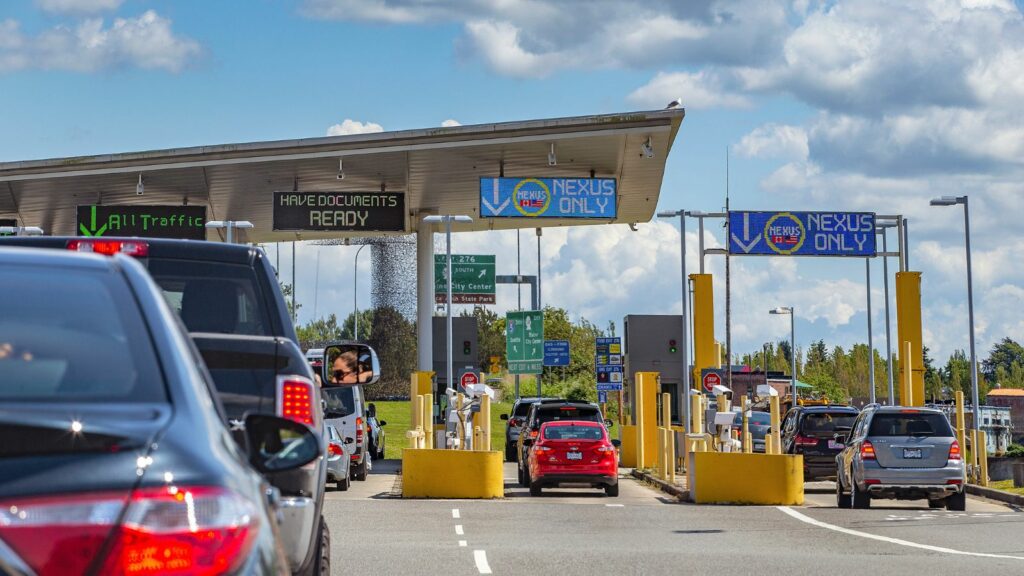
The Canada–U.S. border is beginning to look busier again after the sharp travel retreat that accompanied the trade confrontation of 2025. Statistics Canada’s preliminary September figures show Canadian return trips from the United States rising for a sixth straight month on a year-over-year basis, while U.S.-resident trips into Canada increased for an eighth consecutive month. That is a meaningful change from last year’s prolonged slump, when many Canadians redirected holidays and discretionary spending away from the United States.
Yet the rebound is incomplete. Canadian automobile returns from the U.S. remained 31.1% below September 2024 levels, and air returns were still 18.7% lower. The border is recovering, but the old pattern of effortless, frequent cross-border travel has not fully returned.
September Delivers the Clearest Rebound Signal Yet
September produced the strongest headline evidence that cross-border movement is climbing out of its 2025 trough. Canadian residents returned from about 1.89 million U.S. trips by automobile and air, up 6.8% from September 2025. U.S. residents made about 1.81 million trips to Canada by the same modes, a 17.2% increase and the eighth consecutive month of year-over-year growth. The two-way improvement was a sharp contrast with the persistent declines seen a year earlier.
Road traffic drove much of the momentum. U.S. residents made roughly 1.3 million automobile trips to Canada, up 19.5%, while air arrivals rose 12.2% to 537,400. Canadian automobile returns from the U.S. increased 5.6%, while air returns rose 11.6%. Statistics Canada cautioned that September’s U.S. increase was boosted by a Labour Day calendar shift, but the broader multi-month streak suggests the improvement is not confined to one holiday weekend or a single unusually busy travel period.
Canadian Travel South Is Still Far Below the Old Baseline
The year-over-year gains can make the rebound look stronger than it is because the comparison is against an unusually weak 2025. In September 2026, Canadian automobile return trips from the United States were still 31.1% below September 2024, while air returns remained 18.7% lower. August showed a similar gap: Canadian residents made 2.14 million automobile return trips from the U.S., compared with 2.94 million two years earlier. The direction is improving, but the distance from the old baseline remains large.
The annual picture explains why. Canadian-resident return trips from the United States fell to 29.1 million in 2025, down 25.4% from 2024. That total was only 66.4% of the 2019 level. So the current recovery is best understood as movement off a depressed base rather than a full normalization. Cross-border habits are rebuilding, but millions of trips that formed part of the Canada–U.S. travel routine have not yet come back.
Americans Are Returning to Canada Faster
The recovery is noticeably stronger in the northbound direction. U.S.-resident travel to Canada has posted year-over-year gains through 2026, and by September trips by air and automobile were up 17.2% from a year earlier. In August, Americans made 1.80 million automobile trips to Canada, slightly above the 1.79 million recorded in August 2025 and much closer to the 1.87 million seen in August 2024. That suggests U.S. demand is recovering faster than Canadian travel south overall.
July’s complete counts tell a similar story. U.S. residents made 3.5 million trips to Canada, up 9.1% year over year. Automobile arrivals climbed 7.5% to 2.1 million, and 56.5% of those were overnight visits; air arrivals rose 5.3% to 832,100. The high overnight share also shows that the rebound is not limited to same-day border hops, an important distinction when assessing whether travel patterns are broadening beyond quick shopping runs or short visits.
Why 2025 Was More Than a Normal Travel Downturn
The 2025 slump was exceptional by historical standards. Statistics Canada found that Canadian-resident return border crossings from the United States fell 25.4% from 2024. The decline deepened through the year, bottoming out in July at nearly one-third below the level of a year earlier before stabilizing late in 2025 at roughly one-quarter below 2024 volumes. That scale made the downturn far more severe than an ordinary seasonal or economic soft patch.
Excluding the pandemic, the resulting 11-month streak of year-over-year declines was the deepest and most sustained on record in the Frontier Counts series. Since digital records began in 1972, Statistics Canada said a decline of more than 30% had been recorded on only one other occasion: September 2001 after the 9/11 attacks. May 2025 captured the pullback particularly clearly, with Canadian automobile returns down 38.1% year over year; same-day returns fell 40.3%, while overnight automobile travel declined 34.3%.
Trade Tensions Redirected Canadian Vacation Dollars
The border decline was accompanied by a large shift in where Canadians travelled and spent money. Statistics Canada found that Canadian visits to the United States fell by 7.1 million in 2025 compared with 2024. That reduction was almost fully offset by 5.0 million additional domestic visits and 1.3 million more visits to overseas destinations, showing that many travellers did not simply stop travelling; they chose somewhere else.
Spending moved with them. Canadian travel spending in the United States fell by $3.3 billion to $18.8 billion in 2025, while leisure-related spending in the U.S. dropped by $2.2 billion to $12.1 billion. Overseas leisure spending rose by $3.6 billion to $22.8 billion, and domestic tourism expenditures increased 8.7% to $81.3 billion. Bank of Canada research also found that consumers continued to favour vacations within Canada and expected some of those preferences to persist regardless of what happened to the trade relationship.
Border States Have a Strong Incentive to See Canadians Return
The recovery matters well beyond customs booths. The U.S. National Travel and Tourism Office counted 10.5 million Canadian overnight land visitors in 2024, with average spending of $855 per visitor. New York received 3.1 million of those travellers, Washington 1.2 million, Michigan 678,000 and Maine 639,000. Nearly four in five said vacation or holiday was their main purpose, underlining how important discretionary Canadian travel is to border-state tourism and businesses near major crossings.
An industry estimate from the U.S. Travel Association put the broader 2024 Canadian market at 20.4 million visits and $20.5 billion in spending, supporting about 140,000 American jobs. It estimated that a 10% drop in Canadian travel could reduce visitor spending by $2.1 billion. Those figures help explain why even a partial recovery can matter quickly to hotels, restaurants, retailers and attractions in communities that depend heavily on travellers arriving by car from Canada.
Land Crossings Remain the Best Early Barometer
Road trips reacted faster than air travel when Canadian sentiment shifted, and the same mode is now providing clear recovery signals. Statistics Canada notes that nearly three-quarters of Canadian travel to the United States historically occurs by car. Automobile trips require less planning and lower upfront costs than flights, making them easier to cancel when political or economic sentiment changes.
That flexibility helps explain the dramatic 2025 movements. In May of that year, automobile returns from the U.S. fell 38.1%, while Canadian air returns were down 24.2%. By September 2026, both modes were growing again year over year: automobile returns rose 5.6% and air returns increased 11.6%. Even so, neither had recovered its 2024 level. U.S. Commerce data also show Canadian air visitors typically decided on a U.S. trip more than two months ahead and booked flights nearly two months before departure, reinforcing why air traffic often adjusts more slowly.
Windsor’s New Bridge Arrived as Traffic Began to Heal
The recovery is unfolding alongside major new border infrastructure change. The Gordie Howe International Bridge opened to traffic on July 27, 2026, creating a direct Highway 401-to-Interstate 75 connection between Windsor and Detroit. The Windsor-Detroit Bridge Authority says the corridor carries about $300 billion in annual trade between Ontario and Michigan, making the crossing important for travellers and commercial traffic.
August was the bridge’s first full month of operation. Statistics Canada recorded 134,900 Canadian-resident automobile returns from the United States through the new bridge and 101,000 U.S.-resident automobile trips into Canada. Another 34,800 commercial trucks entered Canada there. At the same time, combined Canadian and U.S. automobile entries through the Ambassador Bridge and Windsor-Detroit Tunnel fell 35.4% from August 2025, showing that the new crossing is redistributing traffic and adding capacity. Its opening gives a recovering border a new outlet at one of its busiest cross-border corridors.
The Recovery Is Real, but Still Fragile
September’s data support the case that cross-border traffic is recovering, but Statistics Canada has two important cautions. First, the sharp September increase in U.S.-resident trips was partly boosted by the timing of Labour Day, which fell one week later in 2026 than in 2025. Second, the agency began integrating more NEXUS Highway traveller information into the leading indicator and advised caution when comparing September 2026 onward with earlier years.
The political backdrop also remains unsettled. The Bank of Canada reported that Canada–U.S. trade talks broke down on August 21 and that new U.S. tariffs and Canadian counter-tariffs subsequently weighed on business sentiment, export expectations and investment plans. That makes the travel rebound notable, but still vulnerable. The next test is whether gains continue through the quieter autumn and winter months. Complete September travel counts are scheduled for November 23, offering a fuller check on whether the preliminary recovery signal holds.
