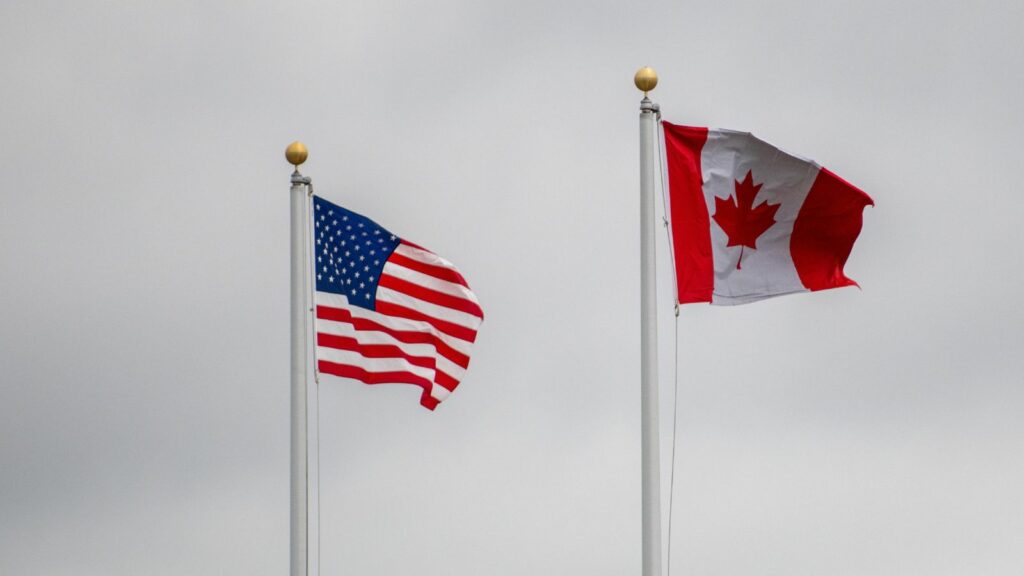
Canada is trying to turn an increasingly hostile continental trade environment into an investment opportunity. As Donald Trump uses tariffs, procurement restrictions and pressure on manufacturers to bring more production into the United States, Prime Minister Mark Carney is making the opposite pitch: global capital should move north. Ottawa wants to catalyze $1 trillion in investment over five years, with energy, mining, artificial intelligence, transportation, defence and advanced manufacturing at the centre of the strategy. The wager is enormous. Canada must convince investors that access to resources, political stability and global markets can outweigh the uncertainty now surrounding its traditional U.S. relationship. The money being discussed is measured in hundreds of billions. The more difficult question is how much of it will ultimately become factories, mines, data centres and infrastructure on Canadian soil.
The $1 Trillion Pitch Is Bigger Than One Summit
Toronto became the centre of Canada’s investment push on September 14 and 15, when the federal government convened its first Canada Investment Summit. The gathering brought together global money managers, Canadian business leaders and public-sector officials, with participants representing institutions overseeing more than $100 trillion in assets. A prospectus containing more than 160 Canadian opportunities offered investors everything from energy and mining developments to ports, artificial-intelligence infrastructure and transportation projects. Ottawa’s calculation is straightforward: only a relatively small shift in the portfolios of the world’s largest institutions could translate into an enormous amount of capital for Canada.
The trillion-dollar figure, however, should not be mistaken for money already committed. Ottawa’s plan is to catalyze more than $1 trillion in total public, private and institutional investment over five years. The federal government says roughly $280 billion in government capital investment and incentives is intended to help mobilize that broader total. Some projects may advance quickly, while major institutional investments can require months of technical reviews, negotiations and due diligence. Government officials have cautioned that many of the summit’s most important outcomes could take 12 to 18 months to become visible.
Trump Has Turned Geography Into a Cost Question
Trump’s trade strategy gives the Canadian campaign an urgency it would not have had several years ago. Washington has imposed 50% tariffs on selected Canadian products and has moved toward banning some Canadian imports beginning September 29. The White House has also directed U.S. officials to remove Canadian-origin products from federal procurement schedules covering tens of billions of dollars in government purchasing. The administration openly describes tariffs as a way to encourage companies to relocate jobs and production to American soil. For an executive deciding where the next assembly line should go, the border is increasingly becoming a financial variable rather than simply a line on a map.
The auto industry shows how quickly that pressure can reach workers. Stellantis redirected planned Jeep Compass production away from its idled Brampton, Ontario, assembly plant and toward Illinois after the escalation in U.S. tariffs. The Brampton facility is now the subject of a possible sale to Canadian armoured-vehicle manufacturer Roshel. General Motors, meanwhile, has proposed more than $1 billion in Canadian investments through its latest agreement with Unifor. Those contrasting cases underline Canada’s challenge: manufacturing has not universally fled south, but investment decisions are being recalculated under rules that increasingly reward U.S.-based production.
Canada Is Selling Stability, Resources and Market Access
Ottawa’s counteroffer is built around advantages that cannot easily be recreated through tariffs. Canada has enormous reserves of energy and critical minerals, established electricity and transportation networks, a highly educated workforce and preferential trade relationships that reach far beyond North America. The federal government says its 16 free-trade agreements across 51 countries provide preferential access to about 1.5 billion consumers representing roughly two-thirds of global GDP. That gives Canadian projects a potential selling point at a moment when companies are trying to build supply chains that can serve several markets instead of relying exclusively on the United States.
There is also evidence that investors have not abandoned Canada. Foreign direct investment inflows reached $96.8 billion in 2025, the strongest annual result since 2007. Statistics Canada measured the total stock of foreign direct investment in the country at approximately $1.6 trillion at the end of that year, up 6.9%. Manufacturing itself received $11.2 billion in inward investment during 2025. Still, the headline numbers require context: mergers and acquisitions accounted for $43.6 billion of annual FDI flows, meaning Canada’s task is not simply attracting money. Ottawa wants more capital devoted to new productive capacity that physically expands the economy.
Ottawa Is Trying to Make Big Projects Easier to Finance
Investors repeatedly care about something less dramatic than tax rates or political speeches: whether a project can move from presentation deck to construction site within a predictable timeframe. Ottawa has therefore begun changing some of the machinery around major investment. The Canada Revenue Agency announced this week that advance income-tax ruling requests connected to Canadian investments of $1 billion or more will receive priority. These rulings can give investors binding clarity on how tax law will apply before billions of dollars are committed, reducing one source of uncertainty during financing and structuring.
The Major Projects Office is intended to attack another problem — the time and complexity involved in getting large projects built. Federal initiatives referred through that process already span nuclear energy, LNG, critical minerals and transportation. Earlier groups of projects represented more than $125 billion in potential investment. Construction has begun on developments including the Contrecœur container terminal expansion near Montréal and Nouveau Monde Graphite’s Matawinie mine in Quebec. The Saskatchewan announcement made during the investment summit showed the scale Ottawa is chasing: Bell’s proposed AI infrastructure expansion could eventually involve as much as $52.5 billion in capital and create a pathway to a 1.2-gigawatt computing hub.
Domestic Capital Is Starting to Line Up
Ottawa is not relying entirely on foreign investors to make the numbers work. Some of Canada’s biggest financial institutions entered investment-summit week with their own unusually large commitments. TD Bank announced a five-year, $150-billion program covering lending, underwriting, advisory work and other financing activity in energy, critical minerals, defence, aerospace, digital infrastructure and transportation. TD Economics estimates that more than 300 proposed or approved projects across major strategic sectors could represent roughly $1 trillion of investment through 2035, with the potential for an even larger cycle if projects move ahead.
Other institutions are making similar bets. BMO plans to mobilize up to $70 billion over a decade for sectors that include electricity, pipelines, transportation, mining, AI computing and defence. Sun Life separately announced plans to deploy $5 billion over five years into Canadian infrastructure investments. These figures cannot simply be added together and treated as construction spending; bank commitments include financing and advisory activity rather than only direct equity. Still, they matter because megaprojects normally require layers of debt, institutional capital, public support and private equity. Canada is trying to assemble that entire financing ecosystem at once.
Airports Show How Far the Strategy Could Reach
The investment drive is also moving into infrastructure Canadians encounter every day. Carney said Canada will seek private investment in the country’s four largest airports — Toronto, Montréal, Calgary and Vancouver — using long-term concession structures while retaining public ownership of the underlying land and infrastructure. Airports require enormous amounts of capital to expand terminals, modernize systems and accommodate passenger and cargo growth. Pension funds and infrastructure investors, meanwhile, often favour assets capable of producing predictable cash flows over decades, making airports a natural place for the two sides to meet.
The proposal also illustrates why the trillion-dollar strategy will generate political resistance as well as excitement. Labour organizations and other groups protesting the Toronto summit have warned about privatization, higher costs and the consequences of allowing private investors deeper access to major public assets. The government argues that outside capital can accelerate improvements without surrendering public ownership. Those two positions will collide repeatedly if Ottawa attempts to unlock investment from airports, energy systems and other infrastructure. For travellers, the eventual debate will become more tangible than discussions about institutional capital: whether private financing produces better terminals and greater capacity without simply producing higher fees.
The Hard Part Is Canada’s Old Investment Problem
Canada’s investment campaign is partly a response to Trump, but its deeper economic problem predates the current trade war. The federal government acknowledged when launching its investment strategy that business investment had been essentially flat for about a decade, while productivity growth averaged only about 0.3% annually over that period. A Statistics Canada study examining regulatory accumulation between 2006 and 2021 estimated that business-sector investment would have been 9% higher in 2021 if the number of regulatory requirements had remained at its 2006 level. Regulations also provide public benefits, including environmental, health and safety protections, making the policy challenge more complicated than simply eliminating rules.
There are encouraging signals. The Bank of Canada’s second-quarter 2026 Business Outlook Survey found investment intentions remained relatively strong, with more companies planning productivity-enhancing spending such as equipment upgrades and AI adoption. But trade uncertainty continues to hold back some businesses, and the Bank says investment remains below the path it expected before U.S. tariffs. That is why meetings with BlackRock, Blackstone and other global investors are only a first step. Canada’s performance will ultimately be judged by permitting times, electricity availability, transportation capacity, Indigenous partnerships, tax certainty and whether projects can earn competitive returns once ceremonial announcements are over.
The Real Test Is Whether Diversification Becomes Permanent
Canada cannot realistically replace the United States as an economic partner, nor is Ottawa claiming that it should. Roughly 70% of Canadian exports still go south of the border, reflecting supply chains and commercial relationships built over generations. What has changed is the level of political risk attached to that dependence. Ottawa has adopted a goal of doubling non-U.S. exports over the next decade while expanding investment relationships with Europe, Asia and the Middle East. Carney is heading from the Toronto summit into deeper negotiations with Europe, where Canada wants investment to become a central part of a broader strategic relationship.
Success would therefore mean more than reaching an accounting target of $1 trillion. It would mean a mine in northern Canada can obtain financing because overseas buyers want its minerals; an AI campus in Saskatchewan can find customers beyond the Canadian market; and ports, railways and energy corridors can move products toward Europe and Asia as easily as factories once moved them south. Trump is attempting to make the United States the unavoidable destination for new industrial investment. Canada is trying to prove that predictability, resources and diversified market access can pull capital in the opposite direction. The answer will emerge not from this week’s speeches, but from where investors actually put their next trillion dollars.
