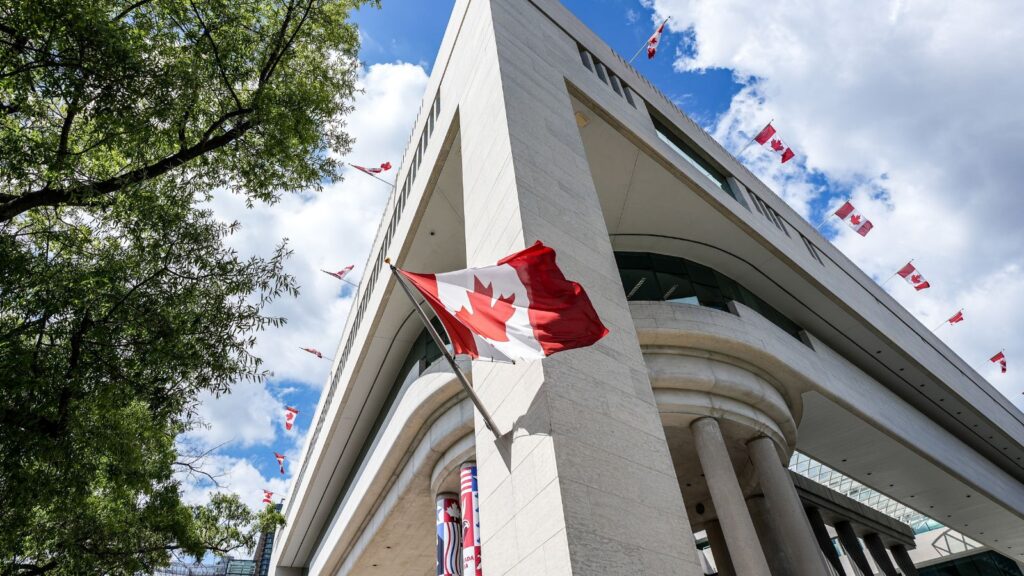
Canada’s long economic relationship with the United States was built around an assumption that became almost invisible: whatever political disputes emerged, deeply integrated trade would endure. Former Canadian ambassador Kirsten Hillman is warning businesses that this assumption is no longer safe enough to build a strategy around.
Speaking at the Global Business Forum in Banff on September 24, Hillman said she has been surprised by business leaders who still expect cross-border relations to eventually settle back into their old pattern. Her message was not that Canada and the United States will stop trading. It was that companies need to prepare for a relationship that may remain more transactional, unpredictable and politically contested than the one they became accustomed to over decades.
The Warning Is About Planning, Not Predicting a Breakup
Hillman’s central argument was striking because of how familiar she is with the machinery of Canada-U.S. trade. She served as Canada’s ambassador in Washington from 2020 to 2026 after previously serving as deputy ambassador and holding senior trade-policy roles. She was also closely involved in the negotiations that produced the Canada-United States-Mexico Agreement, giving her experience with both the political and technical sides of continental trade. At Banff, however, her advice was aimed less at negotiators than at executives deciding where to invest, source materials and seek customers.
Hillman said some Canadian business leaders continue to believe the current turmoil will eventually pass and the old relationship will reassert itself. Her response was essentially that businesses should not make that their base-case assumption. She urged Canada to rely more heavily on its own resilience and cautioned against assuming that the historically close North American trading relationship will always be available in the same form. That is a strategic warning rather than a prediction that cross-border commerce will disappear.
Canada and the U.S. Built an Exceptionally Integrated Economy
The scale of the relationship explains why changing it is so difficult. The Canada-U.S. Free Trade Agreement began eliminating tariffs in 1989, NAFTA expanded the continental framework in 1994, and CUSMA replaced NAFTA in 2020. By then, most qualifying goods moving between Canada and the United States had enjoyed duty-free treatment for years, while manufacturers increasingly organized production around a border that remained politically important but economically permeable.
That integration remains enormous. The Office of the U.S. Trade Representative estimates U.S. goods and services trade with Canada totalled about US$872.3 billion in 2025. Canada has consistently ranked among America’s two largest trading partners, while industries such as automobiles, energy and manufacturing depend on supply chains that cross the border repeatedly. Those numbers help explain Hillman’s point: Canadian companies became accustomed not merely to selling into the United States, but to treating the two economies as parts of one production system.
The Tariff Fight Has Challenged Old Assumptions
The shift became much harder for businesses to dismiss after the latest escalation in 2026. The United States imposed 50 per cent duties on approximately C$27.6 billion of selected Canadian goods beginning August 22. Ottawa subsequently announced matching countermeasures covering C$27.6 billion of U.S. imports, with Canadian rates of 15, 25 and 50 per cent taking effect September 8 depending on the product. Steel, dairy, appliances, agricultural equipment, pulp and paper and electronics were among the sectors covered by Canada’s response.
The dispute matters beyond the merchandise directly caught by tariffs. Businesses making five- or ten-year decisions want to know whether a factory built around cross-border components will remain competitive, whether customers will continue sourcing from Canada and whether another product category could be targeted later. The Bank of Canada said in September that renewed trade uncertainty could cause companies to postpone investment and hiring even when they are not directly hit by the latest measures. That indirect effect is precisely what makes uncertainty itself economically important.
CUSMA Still Exists, but Its Future Is Less Settled
One important distinction is that CUSMA has not disappeared. The three countries conducted the agreement’s required six-year joint review on July 1, 2026. The United States declined to extend CUSMA in its existing form at that meeting, but the agreement remains in force while discussions continue. Under the review mechanism, failure to agree on an extension does not automatically terminate the trade pact. Canada’s government describes the process as a review rather than an expiry event.
The unresolved review nevertheless changes the business environment. For years, companies could generally assume the core continental trade rules would survive even when individual disputes erupted. The 2026 process has raised questions about how those rules could evolve and whether individual sectors could face more restrictive treatment. Canadian consultations before the review drew 5,143 submissions, compared with only 137 during the earlier 2024 consultation process, illustrating how much more attention companies, organizations and individuals were paying as trade tensions intensified.
Uncertainty Can Hurt Even When Most Trade Keeps Moving
The latest tariffs do not cover the majority of Canadian exports. The Bank of Canada estimated in September that products affected by the new U.S. measures represented about five per cent of Canadian goods exports to the United States. That limits their direct economy-wide impact, although individual businesses and communities concentrated in targeted industries can face much larger consequences.
The larger concern is what businesses do when they cannot confidently estimate future trade costs. A manufacturer may hold off on expanding a plant. A U.S. buyer may seek an alternate supplier rather than risk another tariff change. A Canadian company may invest in equipment designed to serve several markets instead of optimizing production solely for American customers. The Bank’s second-quarter Business Outlook Survey found that lingering uncertainty was still weighing on some investment plans and that employment intentions had fallen below their historical average, even as overall investment intentions remained relatively strong.
Canada Has Already Started Trading More Outside the U.S.
There are signs that diversification is happening, although the shift should not be confused with replacing the American market. Statistics Canada reported that the United States accounted for 71.7 per cent of Canadian merchandise exports in 2025, down from 75.9 per cent in 2024. Canadian exports to non-U.S. destinations increased 17.2 per cent over the same year. Total merchandise trade with countries other than the United States rose 14.3 per cent to C$553 billion.
Those numbers are meaningful because changing trade patterns normally takes time. Businesses need customers, shipping arrangements, regulatory approvals, financing and sometimes entirely different products to succeed in another market. The Bank of Canada has observed that companies are adjusting supply chains and searching for growth beyond the United States as they respond to tariffs and greater uncertainty. That adaptation may make Canadian businesses less vulnerable to any single trading partner, but it does not eliminate the economic advantages of having the world’s largest economy immediately across the border.
Some Industries Cannot Simply Pivot Away From America
Diversification is much easier to discuss at a conference than to execute in an automotive plant, steel mill or pipeline network. Canada and the United States have spent decades constructing physical infrastructure and production systems around their proximity. The U.S. Trade Representative specifically identifies automobiles, textiles and energy as areas with particularly deep supply-chain integration. Canada was also the largest destination for U.S. exports in 2024, demonstrating that dependence runs in both directions.
For Canadian companies, geography remains a powerful economic advantage. A factory in southern Ontario can reach large U.S. industrial centres by truck far more easily than most overseas competitors can. Energy infrastructure is even harder to redirect because pipelines, transmission lines and refineries represent billions of dollars in fixed assets. That does not mean diversification is impossible, but it helps explain why Hillman is talking about resilience rather than simply abandoning the United States. A more durable strategy can involve adding customers and suppliers while preserving commercially valuable North American relationships.
Hillman Is Calling for More Canadian Self-Reliance
One of Hillman’s most notable themes in Banff was self-reliance. She argued that Canadians have traditionally highlighted deep economic integration as an obvious strength when speaking to Washington. In her assessment, that argument carries less persuasive power with the current Trump administration, which she described as more focused on American self-interest. Hillman also suggested that the underlying shift in U.S. thinking may extend beyond one president or administration.
Her proposed response was not isolation. Hillman said Canada should become more capable of relying on its own resilience and making decisions primarily around its interests. Christopher Sands of Johns Hopkins University, who appeared at the same forum, described the moment as potentially creating a “re-founding” of Canada-U.S. relations between more self-reliant countries. Both remarks are interpretations rather than established predictions, but they illustrate an emerging debate: whether a less automatic economic relationship could ultimately produce two neighbours that remain closely connected while becoming less dependent on assumptions about the other.
Governments and Companies Are Already Spending to Adapt
Ottawa’s response indicates that policymakers also expect the adjustment to require money. Alongside its counter-tariffs, the federal government announced C$7.5 billion in new and enhanced support for workers and businesses affected by U.S. trade measures. The package included additional funding through regional development programs and other measures intended to give companies liquidity and help tariff-exposed sectors adjust. The government said the package built on nearly C$25 billion in previous supports.
Businesses are adapting independently as well. Bank of Canada Governor Tiff Macklem said in September that companies are changing supply chains, exploring new markets and investing in technology as the economy adjusts to tariffs and other structural pressures. The Bank has also cautioned that creating new supplier and customer relationships outside the United States can be a lengthy process. In other words, diversification is not a switch that can be flipped during the next trade dispute. It is an investment strategy that may take years to produce significant results.
“Normal” May Eventually Mean Something Different
Hillman’s warning does not establish that Canada-U.S. trade will permanently deteriorate. The commercial incentives connecting the two countries remain substantial, CUSMA remains in force, and hundreds of billions of dollars in goods and services continue moving across the border. Even amid the recent disruption, the United States remains overwhelmingly Canada’s most important national trading partner.
What may be changing is the definition of normal. For decades, businesses could often treat expanding continental integration as the long-term direction of travel, despite periodic disputes over lumber, dairy, steel or automobiles. Hillman is telling executives that future planning may need to assume more frequent tariff disputes, greater political intervention and continued pressure to diversify suppliers and customers. Whether that environment becomes permanent remains uncertain. What is already measurable is that companies are adjusting, trade patterns have begun shifting and policymakers on both sides are reconsidering rules that businesses once treated as relatively stable.
