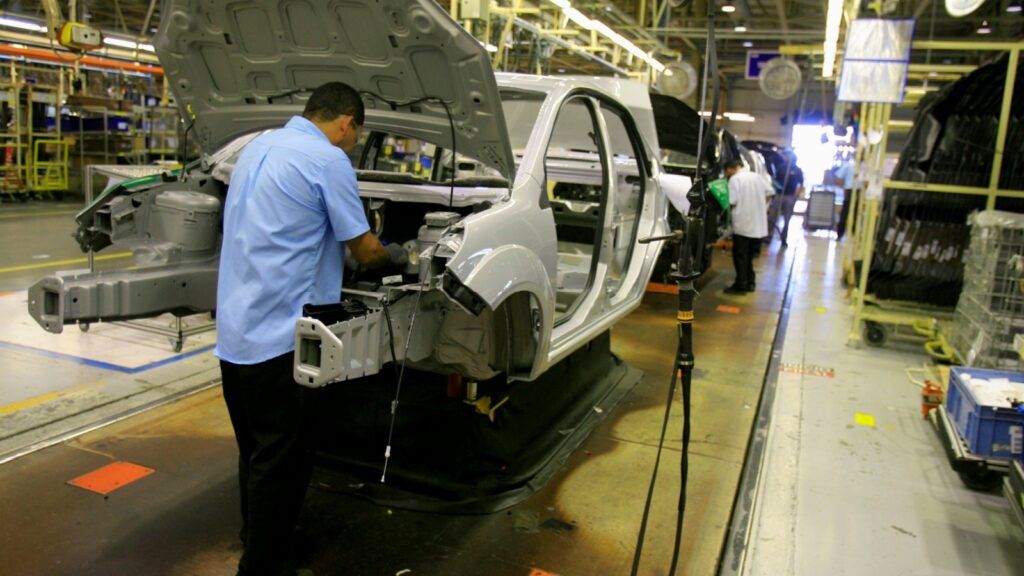
Canada’s automotive supply industry is looking beyond traditional vehicle manufacturing as mounting trade pressures threaten jobs, production and long-established business relationships with the United States. With President Donald Trump’s tariffs disrupting the North American auto industry, Canadian parts manufacturers are exploring a new opportunity: producing military equipment to support Ukraine’s defence against Russia.
The Automotive Parts Manufacturers’ Association and the Ukrainian Council of Defence Industry are pursuing a partnership that could bring drone production, electronic-warfare technology and military vehicle manufacturing to Canadian factories. The initiative offers a potential way to put underused industrial capacity back to work while strengthening Canada’s defence industry. However, turning that ambition into operating production lines will require firm orders, technical cooperation and investment.
A Toronto Agreement Could Open the Door to Military Production
The proposed collaboration brings together the Automotive Parts Manufacturers’ Association (APMA) and the Ukrainian Council of Defence Industry (UCDI), which represents more than 360 Ukrainian defence manufacturers. The organizations planned to formalize their cooperation on November 26, 2026, during the fifth annual Rebuild Ukraine Business Conference in Toronto. Their objective is to establish joint ventures, coordinate supply chains and explore military equipment production in Canada. PwC Canada is expected to serve as a strategic adviser, helping connect Canadian manufacturers with Ukrainian defence companies seeking additional production capacity.
The arrangement remains at an early stage. It is a memorandum of understanding rather than a guaranteed manufacturing contract, and no specific production volumes, investment amounts or factory start dates have been publicly confirmed. Under the proposed model, Ukrainian manufacturers would communicate their technical requirements and expected quantities, allowing Canadian suppliers to determine which products they could manufacture. The approach could accelerate commercial discussions by connecting existing industrial expertise with specific defence needs. However, meaningful economic benefits will depend on the companies negotiating contracts and demonstrating that production can be delivered reliably.
Trump’s Auto Tariffs Are Increasing Pressure on Canadian Manufacturers
Canada’s automotive industry remains heavily dependent on the American market. According to the federal government, more than 90% of Canadian-made vehicles and approximately 60% of Canadian-made automotive parts are exported to the United States. The sector supports more than 500,000 workers across Canada, including approximately 125,000 direct manufacturing jobs. That integration has helped build sophisticated supply chains over several decades, but it also leaves Canadian businesses vulnerable when trade policies change in Washington.
Since April 2025, Canadian-made automobiles have faced U.S. tariffs of 25% on applicable non-American content, although qualifying automotive parts receive important exemptions under the Canada-United States-Mexico Agreement. The situation could become more difficult, with U.S. automotive tariffs scheduled to increase to 50% in January 2027. Reuters reported on November 19 that negotiations had produced limited movement toward relief. Even suppliers whose parts qualify for tariff exemptions can be affected when higher vehicle costs influence automakers’ production and investment decisions. For Canadian parts manufacturers, defence production represents a possible additional source of revenue rather than an immediate replacement for their American customers.
Canadian Auto-Parts Factories Have Already Proven They Can Adapt
Canada’s automotive suppliers have experience moving beyond traditional vehicle components when circumstances demand it. During the COVID-19 pandemic, several manufacturers redirected their equipment and engineering expertise toward medical supplies. Guelph-based Linamar was among the companies involved in ventilator production, with Ontario announcing $2.5 million in support in September 2020 for a project targeting 10,000 Canadian-made ventilators. ABC Technologies also established a medical devices business unit and began developing approximately 20 different components for ventilators. These initiatives demonstrated how established automotive operations could respond to urgent industrial requirements outside their usual markets.
APMA president Flavio Volpe has pointed to the industry’s ability to manufacture large quantities of complicated products quickly. One example he discussed involved a supplier capable of producing approximately 1,000 seats daily for a Jeep model assembled in Ohio. That kind of repeatable manufacturing capacity could be valuable for defence companies seeking to expand production without constructing entirely new factories. However, moving from automotive components to military technology would still require additional engineering, testing and quality controls. The pandemic experience provides a useful precedent, but it does not eliminate the challenges associated with producing defence equipment.
Drones and Uncrewed Military Vehicles Are Among the First Priorities
The proposed Canada-Ukraine partnership is concentrating on technologies that could be produced using advanced manufacturing capabilities already available in Canada. Early possibilities include uncrewed ground vehicles, aerial drones, drone interceptors and electronic-warfare equipment. Each serves a different operational purpose. Uncrewed ground vehicles can transport supplies across dangerous terrain, while reconnaissance drones help military personnel understand conditions beyond their immediate position. Interceptor drones are designed to counter hostile aircraft, and electronic-warfare systems can interfere with enemy communications or drone operations.
These technologies are already important priorities for both countries. Canada’s Department of National Defence identified reconnaissance drones, logistical ground robots and affordable counter-drone systems among six focus areas in its July 2026 Defence Drone Initiative. Meanwhile, Ukraine’s Ministry of Defence reported in September that 650 new uncrewed aerial systems had been authorized for military use since the beginning of the year, including 42 interceptor-drone models. Those figures illustrate how quickly military technology is evolving. Canadian manufacturers could contribute through precision components, mechanical assemblies and scalable production processes, although the specific products assigned to individual factories remain undetermined.
Ukraine Offers Battlefield Expertise That Canadian Manufacturers Cannot Easily Replicate
Ukraine’s defence industry brings something particularly valuable to the proposed arrangement: experience developing and adapting technology during an ongoing war. Its manufacturers have produced equipment designed around changing battlefield requirements, including increasingly sophisticated drones and systems intended to counter electronic interference. The Ukrainian Council of Defence Industry connects hundreds of private manufacturers working across uncrewed systems, armoured vehicles, electronics and other military technologies. Its leadership sees opportunities to combine Ukrainian engineering knowledge with Canada’s established industrial infrastructure, potentially allowing proven designs to be manufactured in greater quantities.
The strategy also reflects Ukraine’s growing interest in manufacturing military equipment with international partners. On November 24, Ukraine’s Ministry of Defence announced another joint production agreement with Germany, involving plans to manufacture several thousand reconnaissance drones in 2027. Similar arrangements have been pursued with other European countries. These partnerships demonstrate that Ukrainian companies are increasingly looking beyond domestic factories to expand production. For Canada, the opportunity is not simply to manufacture components from imported blueprints. Long-term cooperation could give Canadian businesses experience in modern defence systems while allowing Ukrainian companies to expand their manufacturing networks beyond the immediate conflict zone.
Ottawa’s Expanding Defence Partnership With Ukraine Creates Additional Momentum
The automotive industry’s proposal comes during a broader expansion of Canada-Ukraine military-industrial cooperation. In May 2026, the two governments announced an arrangement supporting production of Ukrainian drone systems in Canada through a partnership between Ukraine’s Airlogix and Canada’s Sentinel Research and Development. That initiative was intended to combine Ukrainian technology with Canadian manufacturing capabilities. It also established an important precedent: defence cooperation between the countries can involve producing equipment in Canada rather than relying exclusively on shipments from existing manufacturers.
The relationship expanded further in September when Prime Minister Mark Carney and Ukrainian President Volodymyr Zelenskyy announced additional defence initiatives. These included cooperation between General Dynamics Mission Systems-Canada and Ukrainian company Green Tech Harvest on drone technologies. The governments also signed a declaration outlining their intention to establish a 100-year strategic partnership, including defence innovation, joint manufacturing and economic cooperation. Separately, Ottawa announced initial drone-related procurement contracts worth up to $50 million. These initiatives provide a supportive environment for the APMA proposal, although they do not constitute funding commitments or confirmed orders for the automotive industry’s new arrangement.
Defence Manufacturing Could Support Jobs, but It Cannot Replace the Entire Auto Industry
The search for alternative manufacturing opportunities comes as automotive employment faces mounting uncertainty. One particularly visible example emerged in November when Stellantis announced an agreement to sell its idled Brampton assembly plant to Canadian armoured-vehicle manufacturer Roshel. The facility had originally been expected to produce the Jeep Compass before the automaker shifted that program to Illinois. More than 2,000 workers were affected by the prolonged shutdown. Although Roshel said it would prioritize former Stellantis employees when hiring, the company also made clear that it was not assuming the automaker’s previous employment obligations.
The Brampton transaction is separate from the proposed APMA-Ukraine agreement, but it illustrates why defence manufacturing is attracting greater attention across Canada’s automotive sector. For workers in machining, welding, toolmaking, quality control and industrial engineering, expanding military production could create additional employment opportunities. Existing suppliers might also benefit if defence manufacturers purchase more Canadian-made components. However, the scale of automotive manufacturing is far larger than the opportunities currently identified under the Ukrainian partnership. New contracts would need to be substantial and sustained before they could replace lost automotive business. There is also no guarantee that every displaced automotive worker would immediately qualify for a position in defence manufacturing.
Security Requirements and Export Controls Could Complicate the Transition
Manufacturing military equipment involves regulatory and commercial challenges that differ from those facing conventional automotive suppliers. Canadian businesses handling certain military-related goods or technology must comply with the federal Controlled Goods Program, which can require registration and security assessments. Equipment covered by Canada’s Export Control List can also require permits before it is shipped internationally. These requirements help protect sensitive technologies and ensure that controlled military products are handled and transferred appropriately. Companies entering the sector may therefore need to establish new compliance procedures before production and exports can proceed.
Technical requirements create additional complications. Drone systems and electronic-warfare equipment can involve sensitive software, communications technology, specialized components and intellectual-property arrangements that manufacturers must protect. Canadian suppliers would also need to demonstrate that their products meet customer specifications and function reliably under demanding operational conditions. Federal defence policy recognizes security clearances, supply-chain integrity and procurement procedures as important considerations for expanding domestic manufacturing. The proposed partnership could eventually help firms overcome some of these hurdles through cooperation with experienced Ukrainian companies, but it does not automatically resolve them. Financing, equipment modifications, testing and dependable purchase commitments will all influence whether the initiative becomes commercially viable.
Diversifying Beyond the United States Could Reshape Canada’s Manufacturing Future
The proposed partnership highlights a broader challenge facing Canadian manufacturers: reducing economic vulnerability without abandoning the North American market that helped make them successful. The United States remains by far the most important destination for Canadian automotive production, and that relationship cannot realistically be replaced by a single defence agreement. However, Canada’s 2026 Defence Industrial Strategy identifies domestic manufacturing, expanded military exports and stronger international partnerships as national priorities. The federal government has set a goal of increasing Canadian defence exports by 50% over the next decade, making diversification an increasingly important part of its industrial planning.
For Canadian auto-parts companies, Ukraine could become an important new customer and technology partner if the proposed cooperation produces viable commercial agreements. Experience gained through Ukrainian projects might eventually help Canadian manufacturers compete for additional defence business domestically and internationally. The immediate test will be whether the organizations can move beyond preliminary commitments and announce actual production contracts, participating factories, investment amounts and delivery schedules. Success could give established automotive suppliers a broader industrial future while helping Ukraine obtain urgently needed equipment. Until those milestones are reached, the opportunity remains promising but uncertain.
