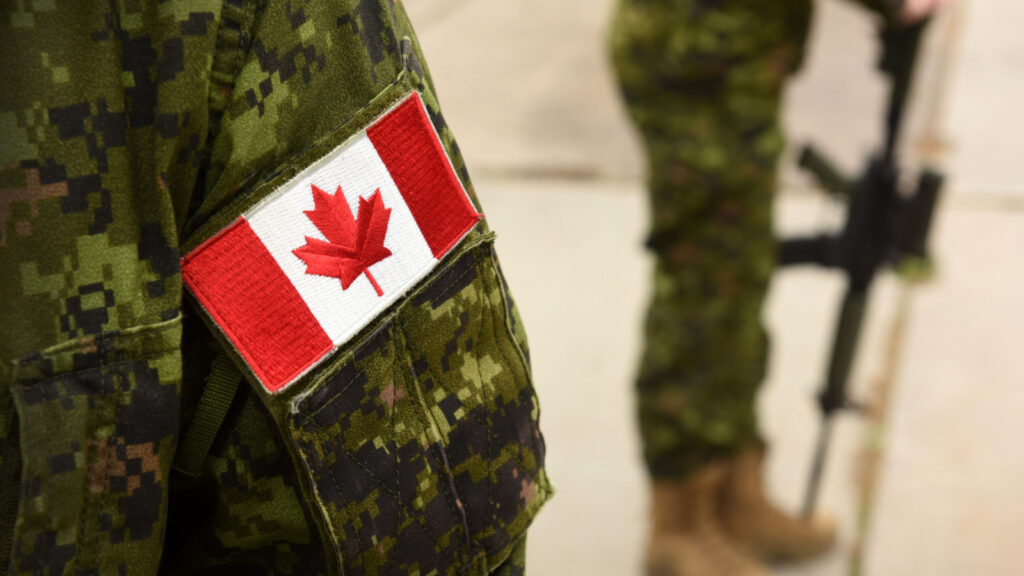
In Ottawa, two of Canada’s closest security partners have delivered sharply different verdicts on the same military buildup. NATO’s deputy military commander in Europe has praised the country’s role in defending the alliance’s eastern flank and its efforts to rebuild the armed forces. The Pentagon, meanwhile, has accused Ottawa of inadequate readiness and questioned whether its spending plans will meet NATO’s new targets.
The clash comes as Prime Minister Mark Carney increases defence investment, reconsiders a major American fighter-jet purchase and navigates strained relations with Washington. Beneath the competing statements is a question that matters far beyond politics: how much progress should be measured by promised funding, and how much by forces ready to deploy?
Why NATO’s Deputy Commander Sees Progress
Air Chief Marshal Sir John Stringer did not declare Canada’s military problems solved. His message was narrower and more revealing. In a CBC News interview in Ottawa on November 25, the British officer praised Canada’s contribution to NATO’s mission in Latvia and its efforts to rebuild air, land and maritime forces. He declined to endorse the Pentagon’s public criticism, choosing to focus on the work Canadian troops are already doing. Asked directly about the readiness of the Canadian-led brigade in Latvia, Stringer said he was “happy when I look at Canada.”
Stringer’s assessment carries weight because he serves as NATO’s Deputy Supreme Allied Commander Europe, second-in-command of the alliance’s military operations in Europe under U.S. General Alexus Grynkewich. He assumed the role in March 2026 after holding senior NATO air-command positions. His remarks were not a blanket endorsement of every Ottawa budget line or procurement delay. They reflected the perspective of a commander assessing deployed forces, multinational cooperation and the direction of a rebuilding effort. A country can have serious equipment problems while still making a meaningful contribution to a frontline mission. That distinction sits at the heart of the disagreement.
The Pentagon’s Unusually Blunt Rebuke
On November 23, the Pentagon released a sharply worded fact sheet portraying Canada as a weak link in North American defence. Officials accused Ottawa of failing to produce a credible, fully resourced path to NATO’s new spending target, while placing economic interests and scattered commitments ahead of military effectiveness. The document argued that decades of underinvestment had weakened the Canadian Armed Forces and left American taxpayers carrying too much of the burden of continental defence. It was an unusually direct public rebuke of a longstanding ally.
The criticism went beyond whether Canada had reached a particular percentage of gross domestic product. The Pentagon pointed to ageing aircraft and ships, personnel shortages and uncertainty around fighter procurement as signs that spending decisions were not keeping pace with operational demands. It also challenged the timing of Ottawa’s promised future increases. That made the dispute more consequential than a disagreement over accounting. The United States wants Canada to convert its commitments into usable capabilities, particularly for defending North America. Ottawa argues that rebuilding forces and contributing to overseas deterrence are not competing responsibilities. Both positions raise a practical question: how quickly will new spending translate into equipment and personnel ready to respond?
What NATO’s Five-Percent Pledge Actually Requires
The disagreement becomes clearer once NATO’s targets are separated. At the alliance’s June 2025 summit in The Hague, members pledged to invest the equivalent of 5% of gross domestic product annually in defence and related security by 2035. At least 3.5% is intended for core military requirements, including forces and equipment. Up to 1.5% can cover broader needs such as critical infrastructure, cybersecurity, civil preparedness and defence-industry resilience. Allies are expected to show credible, incremental annual plans rather than simply promise a large increase in the distant future.
Canada reached NATO’s previous 2% core-defence benchmark in fiscal 2025–26, according to its Department of National Defence. That was a significant change after years in which Canada was criticized for spending below the earlier goal. But achieving 2% does not satisfy the newer pledge, and not every dollar counted as defence-and-security-related investment directly improves combat readiness. NATO also scheduled a review of the trajectory and balance of spending for 2029. This gives governments time to adjust their plans, but not an exemption from explaining them. Washington is concentrating on the remaining gap; NATO’s military leadership is also looking at what countries already contribute.
Canada’s Budgets Tell Two Different Stories
Ottawa can point to substantial commitments. Budget 2025 set out C$81.8 billion in cash-basis investments over five years to rebuild and rearm the Canadian Armed Forces. Budget 2026 then projected core defence funding rising from approximately C$75.1 billion in 2026–27 to C$99.2 billion by 2030–31, measured on the cash basis used for NATO reporting. The latest budget also proposed C$2.3 billion over five years for a defence drone initiative and highlighted plans for armoured vehicles, submarines and early-warning aircraft. These are concrete priorities, not merely a promise to think about modernization.
The unresolved issue is the path beyond the current budget horizon. Federal projections show combined defence and security-related spending reaching 4.1% of GDP in 2027–28, but core defence spending reaching only 2.6%. Canada’s Parliamentary Budget Officer says the budget does not show how the country will close the remaining distance to 5% by 2035, or fully reflect the cost of doing so. There is a meaningful difference between announcing a procurement, allocating funding and delivering a working system to a military unit. The Pentagon has seized on that gap, while Ottawa maintains the spending trajectory is accelerating. Both statements can be true at once.
Latvia Is the Strongest Case for Ottawa
For NATO commanders, Canada’s role in Latvia is a visible measure of its commitment. Under Operation REASSURANCE, Canada leads a multinational brigade on the alliance’s eastern flank, where personnel from more than a dozen NATO countries train together to deter aggression. Canadian defence officials have reported about 2,200 Canadians stationed in Latvia, with plans to increase the persistent deployment to as many as 2,600. The wider multinational brigade numbers roughly 3,000 personnel. This is a sustained operational responsibility, not a short visit for a military exercise.
The brigade combines infantry, armour, artillery and supporting units, requiring troops to coordinate equipment, communications and tactics across national boundaries. Canada has maintained a military presence in Latvia since 2017 and expanded its leadership role as NATO reinforced its eastern flank. In July 2026, Ottawa extended Operation REASSURANCE to 2031 and agreed to join Denmark and Latvia in leading Multinational Division North. Budget 2026 earmarked C$7.6 billion over five years on a cash basis for the mission’s extension and expansion, sourced from existing defence resources. It is the kind of contribution Stringer sees directly, even as readiness problems persist elsewhere.
Readiness Figures Reveal Real Problems
The Pentagon’s concerns about equipment availability are grounded in troubling figures, although the figures need precise labels. Canada’s own 2025–26 Departmental Results Report found that 41.9% of key aerospace fleets, 53.91% of key maritime fleets and 48% of key land-equipment fleets were serviceable for training and operations. The Pentagon described the land figure as an Army readiness rate, but the Canadian report measures equipment serviceability, not the readiness of every soldier or unit. Separately, the report said 61% of force elements met their readiness targets for operations.
Those distinctions do not make the shortages harmless. Canada’s department attributed weak serviceability to ageing equipment, maintenance demands, shortages of personnel and supply-chain problems. Its goal is to reach at least 90% readiness among operational force elements by 2032, a reminder that recovery will take years. Still, Canada is not alone in the problem. The U.S. Government Accountability Office found that 25 of 27 U.S. Army and Air Force aircraft types missed their mission-capable goals in fiscal 2024. Another audit recorded a 44% mission-capable rate for the American F-35 fleet in fiscal 2025. Comparisons require care because countries measure readiness differently, but the challenge extends beyond Ottawa.
The F-35 Decision Has Become a Flashpoint
The most politically sensitive procurement question involves fighter jets. Canada announced a plan in 2023 to buy 88 American-made F-35A aircraft to replace its ageing CF-18s, with a current project budget of about C$27.7 billion including related equipment, infrastructure and services. Prime Minister Mark Carney ordered the overall acquisition reviewed in March 2025 as relations with Washington deteriorated. Ottawa has already committed to at least the first 16 aircraft, and the first two reached a U.S. training base in Arizona in October 2026. The broader fleet decision remains unsettled.
The government has considered the possibility of incorporating Sweden’s Saab Gripen into its future fighter force, partly amid interest in Canadian manufacturing opportunities and strategic diversification. Pentagon officials argue that operating two different fighter types could add training, maintenance and staffing pressures to a military already struggling with personnel shortages. They also warn about complications for NORAD interoperability. Those are operational concerns worth testing, but Canada must also weigh long-term industrial capacity, supply-chain dependence and national control over procurement choices. Buying a modern aircraft is only one step; crews, spare parts, facilities and dependable maintenance determine whether it can defend the skies when called upon.
NORAD and the Urgency of Defending the North
Behind the diplomatic exchange lies a shared command with immediate responsibilities. NORAD is the binational organization through which Canada and the United States monitor aerospace threats, control continental airspace and maintain maritime warning. A threat approaching North America does not wait for the allies to settle a spending dispute. Canada’s vast northern approaches make surveillance, communications and timely fighter response especially important. Washington’s criticism focuses heavily on whether Canadian forces can sustain those tasks as aircraft age and new military threats emerge.
Ottawa is not starting from zero. Canada announced C$38.6 billion over 20 years to modernize its NORAD capabilities, including new surveillance systems, command-and-control upgrades, northern infrastructure and improved air weapons. Work on Arctic over-the-horizon radar is intended to help detect threats approaching from the north. Budget 2026 also described negotiations toward acquiring six Saab GlobalEye airborne early-warning aircraft, a separate project from the Gripen fighter discussion. But an announced project cannot track a missile or launch an interceptor until it is operational. The important test is whether Canada can deliver those systems fast enough, sustain them and integrate them effectively with American and allied forces.
Growing Diplomatic Friction, Continuing Military Cooperation
The dispute has already affected how defence officials interact. In May 2026, Washington paused participation in the Permanent Joint Board on Defense, an advisory forum established in 1940. Then, in November, U.S. Defence Secretary Pete Hegseth issued classified guidance restricting certain contacts with Canada. Republican Senator Mike Rounds said the new rules mainly concerned attendance at think-tank events and informal engagements, rather than joint operations. The Pentagon has said intelligence cooperation, NORAD and NATO activities remain unaffected. That distinction matters: strained diplomacy is not the same as a breakdown in the command structure protecting North America.
The rhetoric nevertheless grew sharper. A senior U.S. defence official warned in late November that Washington could consider more significant, unspecified measures if it judged Canadian investments insufficient for continental security. The administration has not publicly defined what those measures would involve. Meanwhile, representatives from both countries have continued to describe day-to-day military cooperation as ongoing. The mixed signals complicate a relationship already pressured by American tariffs and political disputes over Canadian sovereignty. Military partnerships depend on formal agreements, but also on the confidence that officials can communicate openly. Public accusations and ambiguous warnings can erode that confidence even without changing a single operational order.
What Canada Must Prove Next
Canadian leaders have pushed back without denying that the military needs rebuilding. Defence Minister David McGuinty emphasized that Ottawa makes sovereign decisions and does not report to Washington. On November 25, Prime Minister Mark Carney said President Donald Trump had not personally raised the Pentagon’s complaints in their conversations. Carney pointed to the Latvia deployment, cooperation with allies in Europe and the Arctic, and increased defence investment. His response highlighted a growing tension: Canada wants closer military capability with its allies while retaining control over where its procurement money goes.
The next tests will be measurable rather than rhetorical. Canada must improve the share of equipment that can actually operate, recruit and retain trained personnel, deliver aircraft and surveillance systems, and produce a convincing route toward NATO’s 2035 commitments. The Parliamentary Budget Officer’s warning about the missing post-2030 spending path is a genuine accountability issue, even if the Pentagon’s characterization of Canada is unusually harsh. Stringer’s praise and Washington’s criticism therefore need not cancel each other out. One recognizes a meaningful contribution already being made on NATO’s frontline; the other emphasizes capabilities still missing at home. Canada’s credibility will ultimately rest on whether its ambitious rebuilding plans become reliable military strength.
