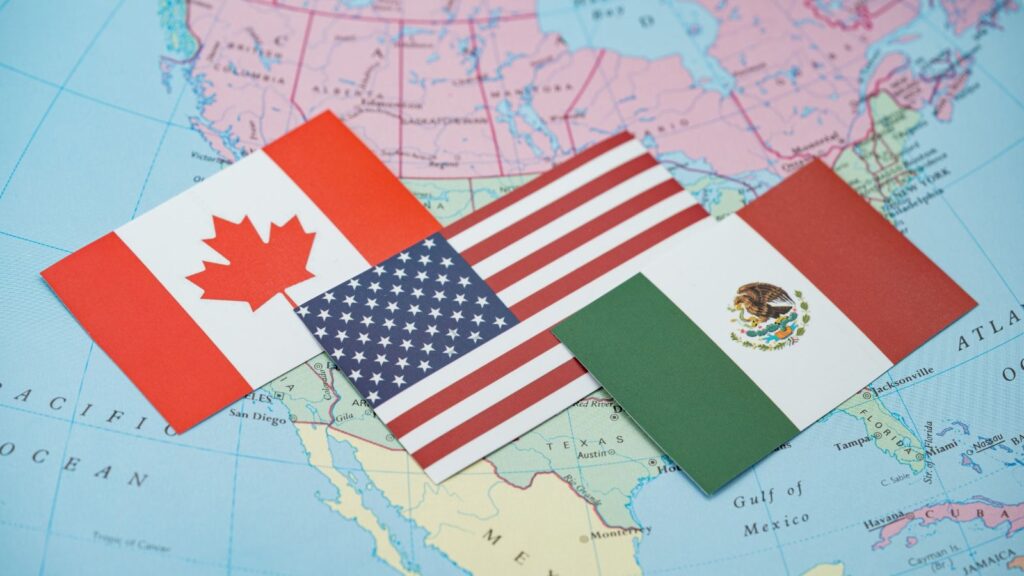
Canada and Mexico are experiencing sharply different trade outcomes under U.S. President Donald Trump’s tariff policies, raising new questions about Canada’s competitiveness in its largest export market.
A Federal Reserve study released November 9, 2026, found that Canadian goods exports to the United States declined approximately 10%, while Mexican exports increased roughly 16%, comparing the 12 months ending in April 2026 with calendar year 2024.
The findings reveal a more complicated picture than the headline numbers suggest. Although Mexico recorded strong overall growth, industries facing higher tariffs struggled in both countries. Meanwhile, Canada’s declining exports reflect broader weaknesses across several major sectors, including energy, automotive manufacturing, and metals.
The research highlights how tariffs, changing American demand, and shifting supply chains are reshaping North American trade, with important implications for Canadian businesses, workers, and policymakers.
The 26-Percentage-Point Gap Reveals a Major Trade Divide
The Federal Reserve’s findings show a difference of more than 26 percentage points between Canadian and Mexican export performance. More precisely, Canadian goods exports to the United States were 10.5% below their 2024 level, while Mexican exports were 15.6% higher. Researchers examined shipments during the 12 months from May 2025 through April 2026, capturing the period after Trump’s administration began introducing sweeping tariffs. The comparison provides a picture of how trade patterns changed as businesses adjusted to higher costs and uncertainty.
However, the figures represent changes in the value of exports, not necessarily the physical quantity of goods shipped. Commodity prices, exchange rates, and changing American demand can influence these totals. The findings also should not be mistaken for the latest monthly trade figures available in November 2026. They describe an earlier 12-month period against a common 2024 baseline, making the comparison useful for understanding the initial adjustments to Trump’s second-term trade policies.
Mexico Faced Higher Average Tariffs but Still Increased Exports
One of the study’s most surprising findings is that Mexico faced higher average tariff exposure than Canada despite recording much stronger export growth. Using announced tariff rates and exemptions as of June 2026, applied to a fixed 2024 import basket, researchers calculated an effective tariff rate of approximately 8% for Mexico, compared with 5.4% for Canada. These estimates reflect the structure of tariff exposure during the study period rather than the rates necessarily paid on every shipment.
The contrast challenges the assumption that countries facing higher average tariffs must experience weaker overall export performance. American demand for particular products can sometimes outweigh the effects of increased trade costs on national totals. Mexico benefited substantially from rapidly expanding demand for computers and servers, while some of its traditional manufacturing industries struggled. Canada’s lower average tariff exposure offered comparatively little protection against broader export weakness. The distinction demonstrates why an economy’s industrial composition can matter as much as its headline tariff rate.
Higher Tariff Exposure Weakened Industries in Both Countries
Beneath the contrasting national figures, Federal Reserve researchers identified a consistent relationship between tariff exposure and weaker export performance. Canadian industries facing tariff rates 10 percentage points higher than other Canadian industries recorded approximately 4.9% weaker exports after March 2025, relative to their earlier performance. The corresponding estimate for Mexico was 11.8%. Across the combined data, the estimated difference was 7.4%, indicating that higher tariff exposure was associated with a meaningful competitive disadvantage.
Importantly, the researchers cautioned that the difference between Canada’s and Mexico’s estimated responses was not statistically significant. Their analysis compared industries within each country while accounting for broader monthly economic conditions. That approach helps distinguish tariff-related patterns from movements affecting an entire economy, such as currency fluctuations or changing U.S. demand. For manufacturers deciding where to invest, the findings suggest that national export growth alone offers an incomplete measure of industrial health. Some businesses can lose market share even while their country’s overall exports continue rising.
Steel, Aluminum, and Copper Faced Particularly Heavy Pressure
Canada’s metal-producing industries emerged as an important source of the tariff-related weakness identified by the Federal Reserve. Steel, aluminum, and copper products faced substantially greater exposure than many other Canadian exports because industry-specific U.S. tariffs generally lacked the same exemptions available to qualifying goods under the Canada-United States-Mexico Agreement. The researchers estimated effective tariff rates ranging from 25% to 48% across the affected metals categories, compared with rates below 1% for more than half of the sectors examined.
The importance of metals became clearer when researchers removed these industries from their statistical analysis. Canada’s estimated relationship between tariff exposure and declining exports became small and statistically insignificant. Mexico’s negative relationship remained, suggesting a broader pattern of exposure across its manufacturing economy. For Canadian producers, the distinction matters because metal tariffs can affect both direct shipments to American customers and the competitiveness of manufacturing supply chains. A metal producer facing additional border costs may have to accept lower margins, negotiate new prices, or pursue customers outside its traditional U.S. market.
Mexico’s Export Growth Was Driven Largely by the Artificial Intelligence Boom
Mexico’s impressive export performance was largely concentrated in one rapidly expanding industry: computer equipment. The Federal Reserve calculated that machinery exports contributed 17.3 percentage points to Mexico’s overall 15.6% increase in shipments to the United States. Within that category, American imports of computers and related equipment from Mexico rose from approximately US$48 billion in 2024 to US$106 billion during the 12 months ending April 2026. Much of this expansion reflected demand for servers supporting artificial intelligence and data centres.
Without machinery, Mexico’s exports to the United States actually declined by approximately 2%. The median Mexican export sector also experienced a 5.2% decline, suggesting that the benefits of the technology boom were far from universal. Mexico’s growing role in server assembly has also depended heavily on imported Asian components, meaning the value of finished exports does not translate directly into equivalent domestic economic output. The findings suggest Mexico’s apparent resilience was partly a consequence of exceptional demand in one industry rather than broad immunity from Trump’s tariffs.
Automotive Manufacturing Shows Both Countries Are Vulnerable
The automotive industry provides an important example of how tariffs can disrupt established manufacturing relationships. According to the Federal Reserve’s calculations, vehicles reduced Canada’s overall export growth by 2.1 percentage points, while subtracting 2.4 percentage points from Mexico’s performance. These declines occurred within an industry built around cross-border production, where vehicle components and finished automobiles regularly move between factories and customers in different North American countries. In 2024 alone, Canada exported approximately C$44.4 billion in finished vehicles to the United States.
American tariffs on vehicles introduced in 2025 added costs and uncertainty to these established arrangements. Under the applicable framework, qualifying vehicles can receive an exemption for their U.S.-origin content, while non-U.S. content remains exposed to certain duties. For Canadian assembly plants and parts suppliers, this creates difficult questions about pricing, sourcing, and future production. A factory’s competitiveness depends not only on labour costs and productivity but also on how much additional expense is created when its vehicles cross the border. Even Mexico’s strong overall export figures could not fully conceal pressure on its automotive sector.
CUSMA Exemptions Protect Some Exporters but Not Others
The Canada-United States-Mexico Agreement remains an important source of protection for North American exporters, although its benefits are not universal. Goods meeting the agreement’s rules of origin can qualify for preferential treatment, provided the applicable requirements are satisfied and properly documented. However, some sector-specific tariffs on metals and vehicles can still apply to qualifying products. This uneven treatment helps explain why certain industries continued exporting with relatively limited tariff exposure while others encountered significantly higher costs during the period examined by the Federal Reserve.
For businesses, compliance involves more than identifying where a finished product was assembled. Depending on the product, companies must document the origin of materials, satisfy applicable North American content requirements, and support claims for preferential treatment. The tariff landscape has also changed since the study’s April 2026 export endpoint. Additional U.S. measures introduced later in 2026 imposed tariffs on certain Canadian products without CUSMA exemptions. Consequently, the study’s historical exposure estimates should not be interpreted as a complete description of the tariff barriers exporters face today.
Canadian Businesses Are Searching for Markets Beyond the United States
Canada’s declining exports have intensified efforts to reduce dependence on American buyers, although replacing established trading relationships is proving difficult. The Bank of Canada has documented how businesses are exploring new export destinations and adjusting supply chains to limit their exposure to U.S. trade restrictions. Its third-quarter 2026 business survey found that some aluminum producers were entering European markets, while certain steel companies were pursuing opportunities connected to Canadian procurement and defence spending. These adjustments represent attempts to preserve sales and investment as traditional markets become less predictable.
However, diversification requires more than finding another country willing to purchase Canadian products. Exporters may need new distribution networks, transportation arrangements, regulatory certifications, and customer relationships. Statistics Canada reported that destinations outside the United States accounted for 29.8% of Canadian merchandise exports in September 2026, down slightly from 30.1% in August. This monthly movement illustrates that diversification is not a straightforward or continuous process. While alternative markets may provide greater long-term resilience, the American market remains central to Canadian export earnings.
Tariff Disruptions Could Have Lasting Economic Consequences
The economic consequences of weaker exports extend beyond trade statistics. Canadian manufacturers depend on foreign sales to support production, employment, investment, and purchases from domestic suppliers. In an October 20, 2026 assessment, Canada’s Parliamentary Budget Officer estimated that trade measures introduced since early 2025 could reduce the country’s real gross domestic product by approximately 1.4% after five years compared with a baseline without those measures. Under a scenario where the tariffs remain permanent, employment could also be lower by as many as 185,000 jobs.
These projections are not counts of jobs already lost or guaranteed outcomes. They represent estimated differences from what might otherwise have happened. Nevertheless, they highlight the potential importance of prolonged trade restrictions. Businesses facing higher costs may postpone equipment purchases, reduce production, or reconsider future expansion plans. The Bank of Canada’s third-quarter 2026 business survey identified such adjustments, particularly among companies operating in tariff-exposed industries. For workers and communities dependent on manufacturing, uncertainty over future investment can be almost as consequential as an immediate reduction in export orders.
The Federal Reserve Findings Raise Important Questions About Canada’s Trade Future
The Federal Reserve’s analysis offers substantial evidence that industries facing higher U.S. tariffs generally experienced weaker export performance, but it does not establish that tariffs caused Canada’s entire 10.5% decline. Researchers examined differences between more-exposed and less-exposed industries, rather than calculating the total economic damage from the administration’s trade policies. Changes in energy prices, American demand, exchange rates, and industry-specific conditions could also influence the overall results. Similarly, Mexico’s export growth should not be interpreted as evidence that its economy avoided tariff-related difficulties.
More recent Canadian statistics also demonstrate why the study’s time frame matters. In September 2026, exports to the United States increased 0.7% from August, supported mainly by crude oil and unwrought gold. That monthly improvement does not erase the earlier decline measured by the Federal Reserve, but it shows that trade conditions continue evolving. The central finding remains significant: both Canada and Mexico experienced weakness in tariff-exposed industries, even though their national export figures moved in opposite directions. Canada’s longer-term challenge is maintaining competitive access to American markets while developing opportunities elsewhere.
