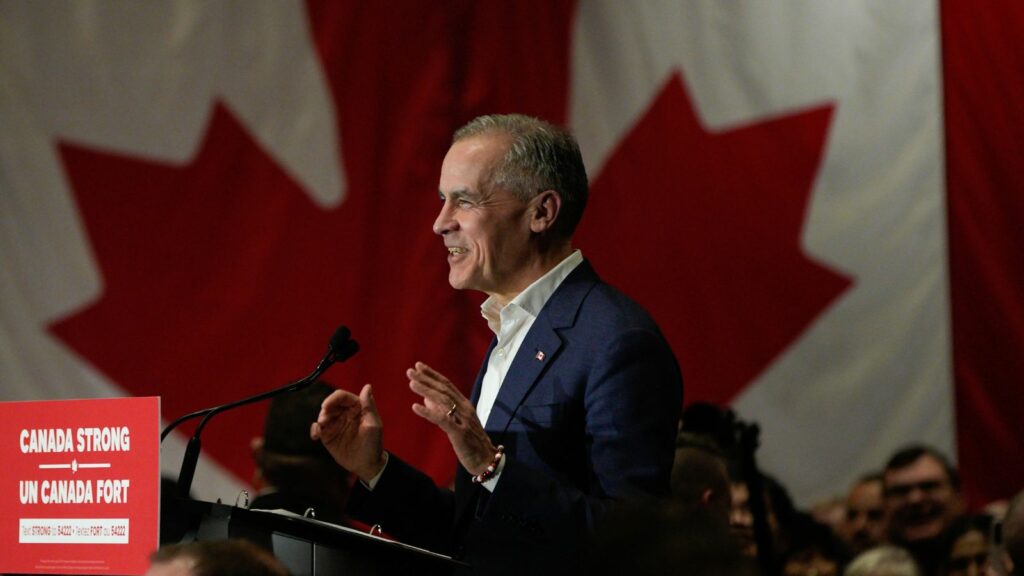
A tariff promise sounds straightforward until the customs paperwork arrives. Prime Minister Mark Carney pledged to match Washington’s new tariffs “dollar for dollar,” and Canada’s September 8, 2026, countermeasures targeted C$27.6 billion in American imports. Yet a Globe and Mail analysis, reported by The Hub on October 3, found that roughly one-third of the 629 targeted tariff lines already carried some form of relief.
That does not mean one-third of the import value is exempt, or that every buyer of those goods avoids paying. It exposes a difficult balancing act: Ottawa is trying to defend Canadian producers without making essential American inputs prohibitively expensive for Canadian factories.
What Carney Promised—and What Ottawa Implemented
Carney announced the retaliatory plan on August 22, 2026, after Canada–U.S. trade negotiations broke down. Three days later, Finance Canada set out countertariffs covering C$27.6 billion in American goods, with rates of 15%, 25% and 50%. The measures took effect on September 8. Ottawa described the response as matching the new American measures both in trade value and in the applicable rates, while targeting sectors including steel, dairy, appliances, agricultural equipment, pulp and paper, and electronics.
The important distinction is between the value of goods covered and the money ultimately collected. C$27.6 billion describes imports within the package’s stated scope, not a promised tariff-revenue total. Different rates, changes in buying patterns and authorized relief can all alter the resulting bill. A company that stops importing a targeted product does not pay the projected duty on that cancelled shipment. A qualifying importer granted remission may also pay less than the published rate initially suggests.
One-Third of Tariff Lines Is Not One-Third of Trade
The headline finding concerns customs classifications, not the dollar value of imports. The Globe and Mail’s analysis, as reported by The Hub, identified some relief for roughly one-third of 629 tariff lines in the new package. A tariff line is a product category used to administer customs charges. Finding that category in a remission order does not establish that every shipment classified under it qualifies for the same treatment.
That distinction changes the meaning of the numbers. Two tariff lines each count as one in the analysis, even when one represents far more trade than the other. Relief may also cover only a narrowly specified product, a particular importer or a defined period. Consequently, the available count cannot support a claim that Ottawa has exempted one-third of the package’s C$27.6 billion import value. Nor does it establish that one-third of the expected revenue has disappeared. Those conclusions would require much more detailed information about eligible shipments and actual claims.
Remission Is Part of the Rules, Not an Unofficial Loophole
A remission order is a legal mechanism for forgiving a tariff that would otherwise be payable or refunding one already paid. Canada’s framework operates under section 115 of the Customs Tariff. It does not erase the underlying tariff for every importer. Instead, it sets conditions under which particular goods or activities receive different treatment, allowing Ottawa to retain a published countermeasure while limiting some of its domestic consequences.
The government’s stated rationale is practical: certain businesses cannot obtain suitable inputs from Canadian producers or reasonably switch to non-American suppliers. Exceptional economic harm can also justify consideration. Imagine a factory whose equipment requires a specialized American component. A duty intended to strengthen Canada’s bargaining position could make that Canadian production line more expensive to operate. Relief addresses that conflict, although its availability does not prove every approval is economically justified. The central policy question is whether the exemption preserves activity that would otherwise be damaged, rather than merely reducing a recipient’s costs.
Steel and Aluminum Show the Core Trade-Off
The overlap is especially pronounced in metals. The reported analysis found some relief for more than three-fifths of roughly 300 steel and aluminum tariff lines. Finance Canada’s September package also increased duties on certain American steel and aluminum products from 25% to 50%. For businesses buying affected inputs, the difference between qualifying for remission and paying the full rate can therefore be substantial.
Magna International provides a concrete example. The Globe’s findings, reproduced by The Canadian Vanguard, identified eight remission approvals covering 17 steel tariff categories, including screws, bolts and several kinds of sheet steel. Those approvals should not be mistaken for a blanket exemption covering everything Magna imports. They illustrate the tension between two Canadian interests: a steel producer seeking stronger protection against American competition and a manufacturer trying to keep component costs manageable. Relief can support the second business while weakening the price advantage the tariff was intended to give the first. Neither side’s workers are an abstraction in that calculation.
The Tariff Bill First Lands on the Importer
The phrase “tariffs on American goods” can obscure who receives the bill. As the Bank of Canada explains, the importer pays the tariff to the government imposing it. The eventual economic burden can then be shared through lower supplier prices, reduced business margins or higher prices for customers. It is not a direct payment from the American government to Canada, and the full cost does not necessarily reach a household’s receipt.
Consider a hypothetical shipment with a customs value of C$100,000, subject to a 50% countertariff. The surtax alone would be C$50,000, before other applicable charges. Full remission of that surtax would remove that particular levy, not make the shipment itself free. For a manufacturer ordering the same essential input repeatedly, the difference could affect the price it needs to charge to remain profitable. That is why relief can matter to Canadian production even when it also makes the American supplier’s goods easier to keep buying.
Broader Relief Depends on How Goods Are Used
Product-specific approvals are only one part of the system. Canada also provides what officials call “horizontal” relief: eligibility based on an approved use, rather than solely on an individual company’s application. The framework includes provisions for health care, public safety, manufacturing and certain automotive and aerospace inputs. The reported one-third count excludes this broader category, so it cannot capture every route through which an importer might qualify.
The details remain essential. Under the consolidated order, qualifying imports under its health-care provisions must arrive before July 1, 2027. A separate provision for specified automotive and aerospace inputs also has a defined import window ending before that date. Other categories have different conditions or deadlines; there is no universal manufacturing exemption lasting through 2027. For a hospital buying eligible equipment or a parts producer importing a qualifying input, the benefit depends on meeting the actual legal terms. Simply appearing in an industry associated with relief is not enough to establish entitlement.
Earlier Revenue Figures Show Why Relief Matters
Ottawa’s earlier fiscal figures demonstrate that remission is more than a theoretical safeguard. The 2026 Spring Economic Update reported C$9.7 billion in gross revenue assessed from countermeasures and C$5.5 billion in remissions intended to mitigate their effect on Canadians. Using those rounded figures, relief represented approximately 57% of gross assessments. That is a substantial difference between duties initially assessed and the burden left after authorized relief.
Those numbers nevertheless describe an earlier period, not the results of the September 8 package. They cannot establish that 57% of the new tariffs will also be remitted. The products, rates, import patterns and eligibility rules may differ. The accounting language matters as well: assessments are not necessarily identical to cash collected, and remission can involve either relief from payment or a refund. Treating all C$5.5 billion as cheques handed back after collection would oversimplify the mechanism. The historical figures show the potential scale of relief, not a reliable shortcut for forecasting the latest countermeasures.
A Cardboard Container Explains the Missing Dollar Total
The challenge becomes clearer in an ordinary product: a cardboard container. Schedule 2 of the remission order includes an entry under tariff classification 4819.10.00 for eight-ply cardboard containers. Its description specifies internal dimensions of 42.5 by 34.5 inches, alongside particular external dimensions. That is much narrower than an exemption for every box or case falling under the broader customs category.
Suppose trade data show the total value imported under that classification. Those figures alone would not reveal how many containers met the precise remission description. Applying the exemption to the entire category would therefore exaggerate its scope. Conversely, counting only the category would reveal little about how important those qualifying containers are to the businesses buying them. This is why a defensible dollar estimate requires matching shipment-level information with the legal conditions. A customs code can identify where relief exists; it cannot, by itself, establish how much trade escapes the tariff or how much money the government forgoes.
Applying for Relief Still Requires a Substantial Case
For a company seeking new exceptional relief, Finance Canada asks for considerably more than a statement that tariffs are expensive. Its submission template requests an eight-digit tariff classification, import volumes and values, evidence that suitable alternative suppliers are unavailable, and documentation of relevant contractual restrictions. Manufacturers must also explain their production costs and describe possible effects on employment, investment and output. These requirements make the application an economic case, not simply a request for a discount.
The department had received more than 1,800 requests related to U.S. surtaxes since March 2025, according to the reporting reproduced by The Canadian Vanguard. One request can cover multiple products, so that total is not a count of approved companies or exemptions. Finance assesses submissions and may consult domestic producers; the minister’s recommendation still requires Governor in Council approval. For a business making purchasing decisions, that distinction matters. An application under review is not the same as an approved order, and an expected exemption should not be confused with relief already secured.
Price Effects Reach Beyond the Customs Desk
Research on Canada’s earlier retaliation offers evidence that these duties can reach consumers. A Bank of Canada staff working paper published in June 2026 examined daily product prices at seven major Canadian retailers. The researchers found that prices of tariffed goods rose gradually, peaking about 6% higher after three months. That represented roughly one-quarter of the 25% tariff being passed through to retail prices, rather than consumers absorbing the entire duty.
The study also found a rapid reversal after the tariffs were removed. Its findings concern the earlier measures and the products studied, not a forecast that September’s package will raise all Canadian prices by 6%. Nevertheless, they help explain the domestic case for limiting countertariff costs. Relief may reduce the pressure that would otherwise reach shoppers, even when some of the benefit remains within business margins. For families, the relevant outcome is the price at the checkout. For workers and employers, it may also be whether a business can maintain production without accepting an unsustainable loss.
The Real Test Is Whether Canadian Workers Are Better Protected
Finance Canada says the countertariffs’ primary objective is to improve the competitive position of Canadian producers hurt by American duties. Judged against that goal, collecting the largest possible amount of tariff revenue is not automatically a sign of success. A measure that raises more money while making essential inputs unaffordable could undermine some of the same employers it is supposed to defend. Equally, broad relief could weaken incentives to purchase Canadian alternatives where those alternatives genuinely exist.
The 629-line package therefore needs a fuller public accounting: the value of imports actually receiving relief, duties assessed and remitted over comparable periods, and evidence of effects on prices, production and employment. Until then, “dollar-for-dollar” describes the government’s announced scope of retaliation, not proof of an equal economic burden on both countries. The one-third finding reveals meaningful qualifications to that promise. It does not, by itself, establish either a hollow response or a successful strategy. The consequential question is what remains protected after the exemptions are applied.
