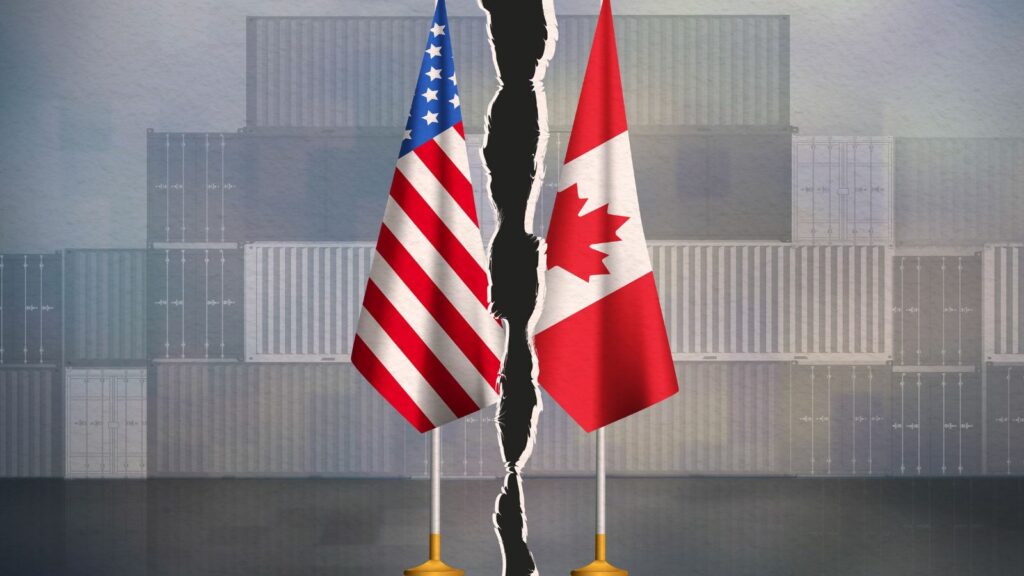
For a small Maine town, the trade fight with Canada came down to something more immediate than negotiating leverage: the price of keeping winter roads safe. In Michigan, the stakes reach into the factories and supply routes behind American-made vehicles. Those local realities are making President Donald Trump’s Canada tariffs increasingly uncomfortable for Republicans.
As the 2026 midterm campaign enters its final stretch, some Republicans are challenging the policy, while others defend its goals and seek relief for their states. This is not a unified rebellion. It is a conflict between loyalty to the president and the cross-border economic relationships their constituents depend on.
The Latest Escalation Has Made the Stakes Harder to Ignore
The immediate dispute intensified on August 22, 2026, when the United States imposed 50% tariffs on selected Canadian goods representing roughly US$20 billion in trade. Canada responded with duties of 15%, 25% and 50% on C$27.6 billion in American products, effective September 8. The retaliation covered categories including steel, dairy products and agricultural equipment. Another escalation arrived September 29, when U.S. import bans on certain Canadian products, including specified alcohol and dairy goods, took effect.
These measures should not be mistaken for a uniform 50% tax on everything crossing the border. Their coverage depends on the product and legal authority involved. The White House argues that the restrictions counter unfair Canadian treatment of American businesses and encourage domestic production. Border-state Republicans face a more immediate question: whether those promised gains justify the disruption their communities experience while negotiations remain unsettled. A tariff intended to create leverage abroad can become a difficult economic policy to explain at home.
Susan Collins Is Making Her Objections Specific
Maine Senator Susan Collins has put numbers behind her criticism. In an August 28 letter to senior administration officials, the Republican warned that approximately US$170 million in Maine goods would face Canada’s proposed countertariffs. Forest products represented about 62% of that exposure. She also reported hearing from two paper mills concerned about rising costs and potential employment consequences. Both were the largest employers in their respective towns, making their concerns especially significant beyond the factory gates.
Those were warnings, not evidence that the tariffs had already caused the threatened job losses. Nevertheless, they explain why Collins has approached the dispute as more than a disagreement over negotiating tactics. Her opposition also predates the latest escalation: her office has pointed to earlier efforts to challenge broad Canadian tariffs and strengthen congressional oversight. For a senator representing affected communities, defending local employers can mean publicly questioning the economic strategy of her own party’s president, rather than simply blaming Ottawa for the confrontation.
A Road-Salt Exemption Shows How Local the Costs Have Become
The town of Frenchville gave Collins a particularly tangible example. Her office said the tariffs would add approximately US$10,000 to its road-salt costs. A small ready-mix concrete business, meanwhile, estimated that higher cement costs would add US$150,000 to its monthly expenses. These were specific estimates reported by the senator, not statewide averages. They put the argument in terms a town administrator or business owner could readily understand: an essential purchase suddenly becoming much more expensive.
On September 8, Collins announced that road salt and cement would be exempted; the White House set September 15 as the effective date for those product removals. That was meaningful relief, but not a settlement of the broader dispute. Collins continued pressing for help for other affected industries, including forest products. Politically, the exemptions cut both ways. They gave Collins a tangible result to point to, while also highlighting why a Republican senator was seeking protection from her own administration’s trade measures in the first place.
Michigan’s Factories Complicate the “America First” Argument
Michigan’s trading relationship with Canada makes it difficult to separate Canadian economic activity neatly from American jobs. A Michigan Department of Transportation freight report puts the state’s 2025 exports to Canada at US$21.2 billion, or 36% of its international merchandise exports. Vehicles and parts were central to that trade. The report describes a regional production network that sends out engines, transmissions and machinery while bringing in parts, modules and assembled vehicles.
That arrangement does not make every tariff indefensible, nor does it mean every automotive shipment faces the same duty. It does mean that a Canadian customer or supplier can help sustain an American factory rather than simply compete with it. For Michigan Republicans, the challenge is explaining how a particular restriction strengthens that production network instead of making it more expensive to operate. “Buy American” is a straightforward political message. Determining which cross-border transactions actually support American manufacturing requires a much closer look at how vehicles are built.
Mike Rogers Is Betting on Access Rather Than Defiance
Michigan Republican Senate candidate Mike Rogers is offering a different answer: stay close to Trump and press for changes through that relationship. Reuters reported that he supports tariffs but rejects a one-size-fits-all approach, arguing that access to the president could help Michigan. Unlike Collins, he is emphasizing influence rather than open opposition to the Canada tariffs. That distinction allows him to acknowledge problems without abandoning the president’s larger argument for using trade restrictions.
Business support can persist alongside disagreement. On September 17, the Detroit Regional Chamber’s political action committee endorsed Rogers while explicitly noting that it disagreed with him on tariffs. It nevertheless welcomed other positions, including his approach to housing affordability and economic growth. That is a concrete example of why tariff criticism does not automatically translate into abandoning a Republican candidate. Rogers’ approach still carries a practical test: whether promised access can deliver results that affected employers consider more valuable than public opposition. An endorsement does not make that question disappear.
Vermont’s Republican Governor Is Defending the Relationship
Vermont Governor Phil Scott has been less interested in defending tariff tactics than in preserving the relationship itself. In an August 20 statement, the Republican reiterated that tariffs on Canada were harmful to Vermont and urged both countries to reach a durable agreement. He pointed to a recent gathering of New England states and eastern Canadian provinces in Vermont as evidence of their shared interests. His message was that disagreements should not obscure Canada’s enduring importance as a neighbour and ally.
There is an economic foundation beneath that language. An August report by Oxford Economics for the Canadian American Business Council highlighted Vermont’s integration with Quebec through hydroelectricity trade and its links to Canadian wood-product supply chains. Such relationships cannot be understood solely as competition between national economies. Scott’s position therefore represents a different Republican response from seeking isolated exemptions: protect the underlying partnership. The argument is not that every trade disagreement should be ignored, but that the cost of damaging a closely connected regional economy must be part of the calculation.
Ottawa Is Also Applying Political Pressure
Canada’s countermeasures have an economic purpose and an openly acknowledged political dimension. Ottawa says its response is designed to support Canadian producers facing U.S. restrictions. Canadian Industry Minister Mélanie Joly has also described the effort as applying political pressure. Prime Minister Mark Carney said on September 29, however, that Canada would not time its response around the American political calendar. Tariffs on American exports can create complaints from businesses whose customers are across the border, adding another source of pressure on U.S. politicians. The confrontation therefore exposes border states from two directions: American duties on imports and Canadian duties affecting their export markets.
Ohio Republican Senator Jon Husted has responded by defending the possibility of an eventual agreement. Stateline reported that he would not second-guess Trump’s approach, although he said it was not how he would personally negotiate. His position reflects a wager that the eventual deal will justify the disruption. That is different from denying local concerns exist. It also leaves an unresolved question for affected businesses: how long they should be expected to wait, and what concrete improvements would make the uncertainty worthwhile.
The Tariff Bill Does Not Stay on the Canadian Side
The economics behind the complaints are straightforward, even when the politics are not. Tariffs are collected from importers, rather than paid directly by a foreign government. Researchers writing for the Federal Reserve Bank of New York found that nearly 90% of the economic burden of the 2025 U.S. tariffs fell on American firms and consumers. Their February 2026 analysis used import data through November 2025. It concerns the wider tariff program, not a Canada-specific measurement of the latest restrictions, but it challenges the idea that foreign countries necessarily absorb the bill.
Companies can respond in several ways: accept smaller margins, raise prices, find another supplier or negotiate a discount from the exporter. The balance varies by product and market. Canadian retaliation works through the same basic mechanism, meaning it can also impose costs on Canadian importers while making American suppliers less competitive. Neither country can assume the pain stays entirely across the border. For Republican officials hearing from employers, this explains why a policy described as pressure on Canada can generate urgent requests for help from Americans.
Even Supporters of Targeted Tariffs Draw a Line at Canada
Support for protecting American manufacturing does not necessarily mean supporting this confrontation. United Auto Workers president Shawn Fain has defended strategic, targeted tariffs while opposing the 50% Canada tariffs, according to Michigan Public’s September reporting. That distinction matters because it challenges a simple division between people who favour industrial protection and people who oppose it. A person can want stronger safeguards for American jobs and still conclude that a particular restriction on Canadian trade is counterproductive.
The same reporting captured a more personal expression of that view at Detroit’s Labor Day parade. Retired tool-and-die worker Stan Geis carried a sign displaying an American flag and a Canadian maple leaf. The message was simple: “Solidarity. We stand with our neighbor.” One worker’s gesture is not an electoral trend, but it illustrates the relationships behind the policy debate. For Republicans seeking support in manufacturing communities, the question is not merely whether to defend American workers. It is whether treating Canadian workers and businesses primarily as competitors helps accomplish that goal.
The Political Risk Is Real, but the Outcome Is Not Settled
National polling helps explain the discomfort. A Reuters/Ipsos poll of 1,023 U.S. adults, conducted August 28–30, found that 57% opposed new additional tariffs on Canada and 20% supported them. Among Republicans, 44% supported the measures and 33% opposed them: stronger backing than among Americans overall, but not majority support. In the combined independent-or-other category, opposition reached 59%. Those differences leave Republican candidates addressing audiences with sharply different views of the same policy, including disagreement within their own party’s supporters.
The poll was a snapshot taken before September’s retaliation, not a forecast of individual Senate races. Its overall margin of error was approximately 3.5 percentage points, with larger uncertainty for partisan subgroups. It cannot establish that tariffs will decide an election. The more immediate conclusion is narrower: Republican officials are already having to defend, challenge or seek exceptions to a policy promoted by their own president. In border communities, that debate is moving beyond party loyalty to a practical test—whether the trade fight is protecting local livelihoods, or making them harder to sustain.
