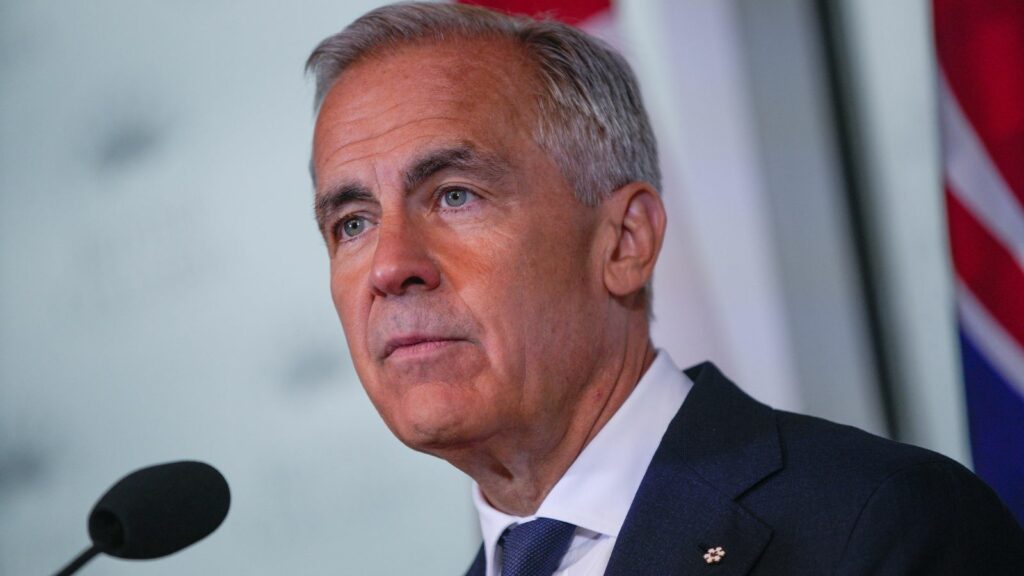
Canadians are giving the federal government two very different report cards. A new Abacus Data poll finds 57% approve of how the government led by Prime Minister Mark Carney is handling Canada’s relationship with the United States, making it Ottawa’s strongest-rated policy area. Housing affordability and supply sits at the opposite end, with only 33% approving. The wording matters: respondents were evaluating the federal government led by Carney, rather than giving Carney a separate personal rating on each issue. Overall government approval remains much higher at 60%, highlighting an electorate that appears willing to distinguish between leadership, external challenges and everyday domestic pressures. The gap comes as Canada confronts renewed U.S. tariffs while housing construction remains well below levels CMHC estimates are needed to restore earlier affordability.
A 24-Point Gap Defines the Poll
The most striking figure is not simply the 57% approval on Canada-U.S. relations or the 33% approval on housing. It is the 24-point distance between them. National defence and security is the only other area receiving majority approval, at 52%. Jobs and economic growth stands at 43%, healthcare at 41%, cost of living and inflation at 38%, while several other domestic files sit at 37%. Housing is last among the policy areas measured.
The difference has also widened over the summer. Approval of the government’s handling of the United States increased from 50% on August 26 to 57% in the latest wave. Housing edged from 32% to 33% over the same period. Abacus surveyed 2,744 Canadian adults from September 18 to 23, weighting its sample by age, gender, education and region. For comparison, a probability sample of that size would carry a margin of error of roughly 1.87 percentage points, 19 times out of 20.
The U.S. File Has Become a Different Kind of Political Test
The high Canada-U.S. rating is arriving during a genuine trade confrontation rather than a quiet period in bilateral relations. Washington imposed a 50% tariff on $27.6 billion worth of Canadian goods beginning August 22. Ottawa subsequently announced matching countermeasures covering $27.6 billion in U.S. imports, with tariffs of 15%, 25% and 50% taking effect September 8 on targeted categories including steel, dairy products, appliances, agricultural equipment, pulp and paper, and electronics.
That confrontation has made the U.S. relationship unusually visible in Canadian politics. In the Abacus poll, 44% selected Donald Trump and his administration as one of Canada’s three most important issues, second only to the cost of living. The economic consequences are also tangible. The Bank of Canada has warned that renewed tariffs and uncertainty surrounding the future of Canada-U.S. trade could cause businesses to postpone investment or hiring decisions, even if the direct effect of the latest tariffs is concentrated in particular sectors.
Housing Is Still the Weakest-Rated Domestic File
The 33% housing rating comes against a supply picture that remains difficult despite signs of easing in parts of the market. CMHC estimates Canada would need between 417,000 and 469,000 housing starts annually through 2036 to restore affordability to pre-pandemic levels. By comparison, the six-month trend in national housing starts stood at 244,149 units in August. Actual starts in urban centres of at least 10,000 people were also 4% lower during the first eight months of 2026 than during the same period in 2025.
There is no single national housing experience. CMHC says the estimated supply gap has narrowed in Toronto and remained stable in Vancouver, while increasing in Montreal and Ottawa. Calgary’s unusually strong construction has reduced its gap significantly, while Edmonton remains the only large market CMHC identifies as having no housing supply gap. The bigger concern is ownership-oriented construction: outside Calgary and Edmonton, new supply in major markets has increasingly been dominated by rental housing.
Affordability Is Broader Than Housing Alone
Housing is not the only domestic pressure showing up in the polling. Sixty-three percent of respondents identified the rising cost of living as one of Canada’s three most important issues, making it the most commonly selected concern. Yet only 38% approved of the federal government’s handling of the cost of living and inflation. That difference helps explain why an improving overall government rating can coexist with much weaker assessments of household economic conditions.
Official price data provide some context. Statistics Canada reported that the Consumer Price Index was 3.0% higher in August 2026 than a year earlier. Grocery prices were up 2.8%, while rent increased 2.8%. Grocery inflation has slowed considerably from the sharp increases seen earlier in the decade, but Statistics Canada notes grocery prices were still 29% higher than in August 2021. For households managing rent, food, transportation and other recurring expenses, a slower rate of price growth does not mean prices have returned to earlier levels.
Overall Approval Is Stronger Than the Issue-by-Issue Grades
Despite the weaker housing and affordability ratings, 60% of respondents told Abacus they approved of the overall job being done by the federal government, compared with 25% who disapproved and 15% who were neutral. That overall approval figure increased one point from the previous wave. Separately, 56% reported a positive impression of Carney, compared with 25% holding a negative impression, producing the strongest net impression Abacus has recorded for him in its tracking.
Another measure moved in the same direction: 48% said Canada was heading in the right direction, compared with 39% who believed it was on the wrong track. Two weeks earlier, those figures were 45% and 41%, respectively. None of these numbers means Canadians are satisfied with every policy area. In fact, the issue ratings indicate the opposite. They show why overall approval should not be treated as a simple average of attitudes toward housing, healthcare, trade, inflation and other individual files.
The Liberal Lead Coexists With a Generational Split
The same poll has the Liberals at 46% among committed voters nationally, compared with 34% for the Conservatives, 9% for the NDP and 7% for the Bloc Québécois. The national result, however, looks considerably different when broken down by age. Among Canadians aged 60 and older, Liberal support reaches 59%, compared with 26% for the Conservatives. Among voters aged 45 to 59, the figures are 47% and 35%, respectively.
Among younger respondents, the order reverses. Conservatives receive 42% among 18-to-29-year-olds, compared with 32% for the Liberals and 15% for the NDP. Among 30-to-44-year-olds, Conservatives are at 39%, Liberals at 36% and the NDP at 14%. Housing pressures are especially relevant to younger households in practical terms, but this particular poll does not establish that housing dissatisfaction causes the age divide in voting intention. The two patterns can be observed together without assuming one entirely explains the other.
Housing Policy Is Moving, but Results Operate on a Longer Clock
The low housing approval does not mean Ottawa has been inactive. The Build Canada Homes Act received Royal Assent in June, establishing the framework for Build Canada Homes as a Crown corporation. At that stage, the government said six direct-build projects and other partnerships represented more than 11,000 homes either underway or nearing construction. The agency is designed to work with governments, Indigenous partners, non-profit organizations and private builders while using public land and financing tools to increase affordable housing supply.
More recently, Build Canada Homes announced deployment of a $1.5-billion Canada Rental Protection Fund through the Canadian Housing Acquisition Fund. The program is designed to help community housing providers acquire and preserve rental properties that might otherwise lose their affordability. The federal government estimates it could protect approximately 7,000 at-risk rental homes during its first five years, depending on market conditions and acquisition opportunities. Those initiatives operate over years, while public perceptions can respond much more quickly to current rents, home prices and availability.
The Rental Market Shows Why National Averages Can Mislead
There are signs of improvement for some renters. CMHC’s mid-year rental update found asking rents declining in Toronto, Vancouver and Calgary, with Ottawa also experiencing decreases. Rising apartment supply and slower population growth have given some prospective tenants more choice, particularly in newer and more expensive buildings. In several markets, landlords have responded with incentives ranging from discounted parking and move-in credits to periods of free rent.
Yet those conditions do not describe every household. CMHC found that average rents being paid on occupied units continued to increase in most major markets, while vacancy remained particularly tight among the lowest-priced units. The agency described much of the easing as concentrated in newer, higher-priced housing. That distinction matters politically. A renter looking at a newly built apartment may see more options than a year ago, while another household trying to remain in the lowest-cost segment may experience little meaningful improvement. Both experiences can exist within the same national housing statistics.
The Domestic Contest Is Much Closer Than the U.S. File
Abacus also asked respondents who identified particular topics among their three most important issues which party they believed would handle those issues best. Among people focused on the cost of living, 32% selected the Conservatives and 31% selected the Liberals, with 21% unsure. Among those focused on housing affordability and accessibility, 29% selected the Conservatives and 27% the Liberals, while 17% chose the NDP and 20% were unsure.
The pattern looks very different on the U.S. issue. Among respondents who placed Trump and his administration in their top three concerns, 68% selected the Liberals as the party they believed could best handle the issue, while 14% selected the Conservatives. These are not national voting-intention figures and should not be read as such; they apply only to respondents who first identified each subject as a major concern. Still, they help illustrate why the same electorate can produce a sizable overall Liberal lead while expressing much less differentiation between the two largest parties on affordability-related issues.
The Regional Picture Keeps the Divide From Being Simple
Domestic affordability pressures extend across the country. Cost of living ranked as a top-three issue for 68% of respondents in British Columbia and Alberta, 63% in Ontario, 60% in Saskatchewan and Manitoba, 56% in Quebec and 70% in Atlantic Canada. Housing was selected by 22% in Alberta at the low end and 30% in Atlantic Canada at the high end, with Ontario at 29%. Concern about Trump, however, varied much more dramatically and reached 59% in Quebec.
That produces a more complicated picture than a single approval number can capture. As of the September 18–23 polling period, Canadians were giving the government its strongest marks on relations with the United States while reserving their weakest assessment for housing. At the same time, overall government approval remained at 60% and cost of living remained the public’s most frequently selected concern. Future polling will show whether that gap persists, but the current snapshot makes one point clear: Canadians are evaluating external leadership and domestic affordability as distinct parts of the government’s record rather than treating them as one political judgment.
