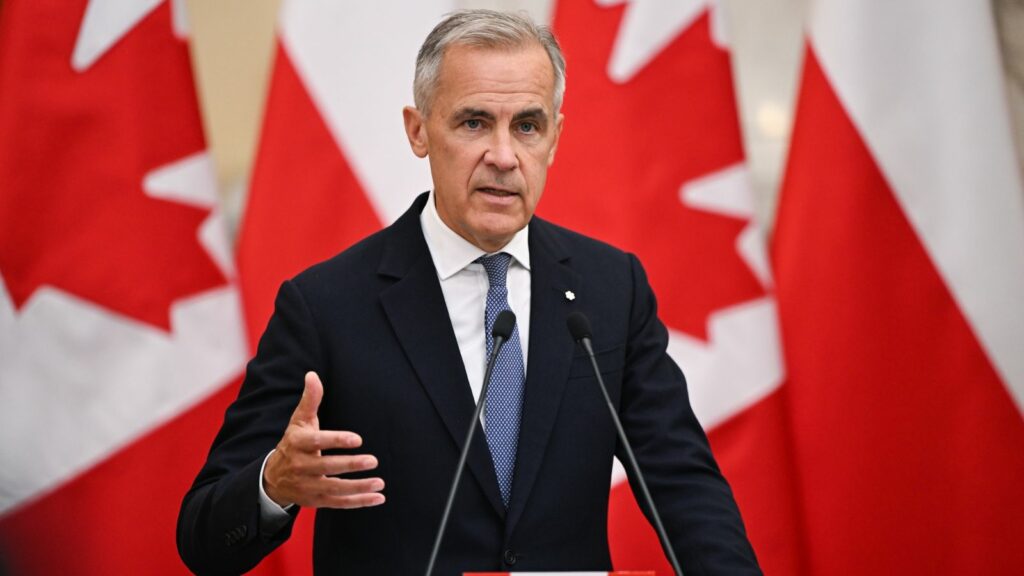
Canada’s trade fight with Washington has become a test not only of economic endurance, but of political leadership. New Angus Reid Institute polling shows Prime Minister Mark Carney’s approval climbing to 62%, up 11 points from August, after Ottawa walked away from negotiations it said had become unfair and economically unacceptable. At the same time, public resolve appears unusually strong: 73% want Canada to refuse difficult concessions, while 60% say they would stay the course even if household expenses rose by 20%.
Those numbers do not mean Canadians are unconcerned about the consequences. Recent polling also shows deep anxiety about inflation, jobs and the economy. What has changed is the balance between fear and resolve. For now, many Canadians appear willing to accept significant short-term pain rather than support a deal they believe would weaken the country’s long-term bargaining position.
Carney’s Approval Rebounds to 62%
Carney’s political rebound is striking because it came quickly. Angus Reid measured his approval at 62% in early September, an 11-point increase from August and just one point below the 63% high the institute recorded earlier in 2026. The rebound followed Ottawa’s decision to suspend trade negotiations after Carney said late U.S. demands were unfair, uneconomic and damaging to Canadian interests.
That decision had already received strong backing. In Angus Reid polling conducted immediately after the talks collapsed, 76% of Canadians said walking away was the right choice, while 69% said Carney had shown strength by rejecting terms he believed were not in Canada’s interests. The connection is politically important: the prime minister’s approval has risen during a confrontation that carries real economic risk. For now, resistance to Washington appears to be strengthening rather than weakening his standing. That political reward gives Ottawa more room to resist immediate compromise.
Support for a Hard Line Climbs to 73%
The broader mood is even more hawkish than Carney’s approval rating. Angus Reid found 73% of Canadians want the government to refuse difficult concessions even if that worsens relations with the United States. Only 27% preferred a softer approach. The institute said this was the strongest support for a hard line it had recorded since the current trade conflict began.
That matters because Ottawa’s position is no longer merely rhetorical. Canada’s new counter-tariffs took effect on September 8, covering $27.6 billion in U.S. imports and applying rates of 15%, 25% or 50% depending on the product. Steel, dairy, appliances, agricultural equipment, pulp and paper, plastics and electronics are among the affected sectors. In practical terms, Canadians are backing firmness at the same moment the dispute is moving from political threats into measures that can affect prices, supply chains and business decisions. The public is endorsing the policy itself.
Conservative Voters Are Almost Perfectly Divided
One of the most revealing findings is the split among people who voted Conservative in the 2025 federal election. Angus Reid found 51% of past Conservative voters favour the hard approach, while 49% prefer Canada to soften its stance. That near-even divide contrasts sharply with past Liberal, NDP and Bloc Québécois voters, among whom support for concessions was far lower.
The result suggests the trade fight is cutting across normal partisan lines. Only weeks earlier, 53% of 2025 Conservative voters had also said Carney was right to walk away from the U.S. talks rather than accept a bad deal. That does not translate automatically into support for the Liberal government, but it complicates the opposition’s political task. A government can be vulnerable on affordability or jobs while still benefiting from a national-unity effect when the dispute is framed around sovereignty, fair treatment and resisting pressure from Washington. For now.
The 20% Cost Question Shows How Deep the Resolve Runs
The headline-grabbing number is the willingness to absorb higher household costs. Angus Reid asked whether Canadians would continue the current approach if household expenses increased by 20%. Three-in-five, or 60%, said they would stay the course. It is an unusually high tolerance for hypothetical economic pain, particularly when affordability remains a major concern across the country.
The figure needs careful interpretation. It does not mean households expect a 20% across-the-board price increase, nor does it predict that tariffs will produce one. It measures willingness under a hypothetical scenario. Even so, the response is significant because current price pressures are already visible. Statistics Canada reported that consumer prices were 3.0% higher in July than a year earlier, while grocery prices rose 3.1% and gasoline prices jumped 25.7%. Supporting a hard trade line while living with rising everyday costs represents a meaningful political commitment. Despite immediate household budget pressures.
Canadians Have Limits, but the Breaking Point Looks Surprisingly High
Public resolve weakens as the hypothetical consequences become more severe, but it does not disappear immediately. Angus Reid found about half of Canadians would continue the dispute even through a recession or the closure of local small businesses. Support falls further when the scenario involves major factories leaving Canada or respondents personally losing their jobs, although the institute still found plurality-level willingness to hold the line in those cases.
That gap between abstract national interest and personal economic exposure is likely to become increasingly important. In late August, 38% of Canadians in the labour force told Angus Reid they were worried the trade dispute could affect their own job. Statistics Canada then reported that employment fell by 41,700 in August while the unemployment rate held at 6.4%. The labour report also warned that industries dependent on U.S. export demand face heightened uncertainty because of new American tariffs.
Canadian Voters Want More Than a Partial Auto-Tariff Deal
Autos remain one of the clearest tests of how much compromise Canadians will tolerate. Angus Reid found 43% believe Ottawa should accept a trade agreement only if U.S. tariffs on Canadian vehicles are removed entirely. Another 31% would accept a deal that merely reduced those tariffs. That makes full removal the popular position, even though it may be harder to secure.
The stakes are substantial because the automotive sector sits at the heart of the cross-border manufacturing system. Reuters reported in August that Donald Trump threatened to raise U.S. tariffs on Canadian cars, trucks and auto parts to 50% starting January 1, 2027, after negotiations collapsed. The deal before the breakdown would have lowered certain Canadian vehicle tariffs to 15%. For communities tied to assembly plants and parts suppliers, the difference between 15% and 50% is not an abstract negotiating detail; it can shape investment and production decisions.
Dairy and U.S. Alcohol Remain Politically Difficult Concessions
Agriculture shows resistance to concessions is not limited to factories. Only 36% of Canadians told Angus Reid they support their province selling U.S. alcohol, after provincial removals of American products became one of the visible symbols of the dispute. The institute also found Canadians oppose giving the United States additional dairy access by roughly a two-to-one margin.
Those issues had been part of the negotiating conversation before talks broke down. Carney said Canada had been willing to encourage provinces to return U.S. alcohol to shelves as part of a fair agreement, while taking administrative steps on supply management without changing the system, U.S. quotas or applicable tariffs. The polling shows why those offers were politically sensitive. Concessions involving grocery shelves, dairy farms and provincial liquor stores are tangible to households in a way that technical tariff schedules are not, making them potent symbols of who is yielding.
Canadians Are Defiant Without Assuming Canada Holds the Stronger Hand
Canadians are taking a hard line without necessarily believing their country holds the stronger hand. Angus Reid found 31% consider Canada’s negotiating position strong, 34% call it weak and 22% see the two countries as evenly matched. Among 2025 Conservative voters, three-in-five said the United States has the upper hand, while half of past Liberal voters disagreed.
The economic data explain some of that caution. Statistics Canada reported that Canada exported $50.5 billion in goods to the United States in July, equal to about two-thirds of total merchandise exports that month. Exports to the U.S. fell 6.6% from June, while exports to countries other than the United States rose 7.4% to a record $25.6 billion. The numbers capture Canada’s dilemma: Washington remains by far the dominant market, but diversification is becoming more visible. Public resolve is therefore coexisting with a realistic sense of dependence. Today.
A Large Bloc Wants Canada to Wait Out the U.S. Midterms
Many Canadians also appear willing to use time as a negotiating tool. Angus Reid found 41% would wait until after the U.S. midterm elections before returning to the table. Another 26% want talks restarted immediately, while 18% would wait longer than November. Within that latter group, 13% said Canada should wait until Trump is scheduled to leave office in 2029.
The political calendar gives that preference a concrete date. The next regularly scheduled U.S. federal general election is November 3, 2026, when all 435 House seats and roughly one-third of the Senate are up. Carney has said Canada is prepared to resume negotiations when the United States is ready for a serious, mutually beneficial agreement. Waiting carries economic risks, but the polling suggests many Canadians believe political conditions in Washington may change enough after the midterms to justify patience. That patience is itself a form of political leverage.
Carney’s Biggest Test May Come When the Economic Pain Becomes Real
Carney’s 62% approval is a powerful political asset, but it is not a guarantee of lasting support. August employment fell by 41,700, July inflation stood at 3.0%, and the Bank of Canada has identified the evolution of the Canada-U.S. trade relationship as one of the most important risks to the inflation outlook.
That is why the new Angus Reid numbers are best read as a snapshot of resolve rather than an unlimited mandate for escalation. The poll was conducted online September 3–4 among 1,498 Canadian adults and weighted to national demographic benchmarks. For comparison purposes, Angus Reid said a probability sample of that size would have a margin of error of about plus or minus two percentage points, 19 times out of 20. Political support can remain firm through uncertainty, but sustained job losses or rising household costs could still change the equation. For now.
