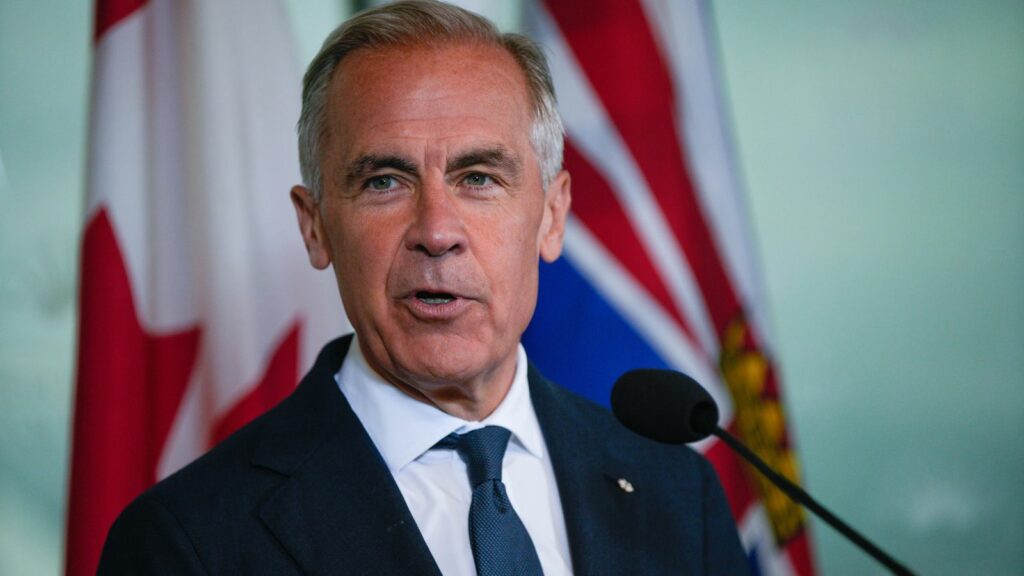
Canada’s effort to reduce its economic dependence on the United States is moving deeper into Southeast Asia. On September 24, Prime Minister Mark Carney is scheduled to greet and meet Tô Lâm, Vietnam’s Communist Party general secretary and president, during a state visit hosted by Governor General Louise Arbour. Ottawa has explicitly framed the visit as a chance to deepen commercial ties, strengthen economic resilience and diversify trade relationships. The timing is notable: Vietnam is already Canada’s largest merchandise trading partner in ASEAN, while Ottawa is pressing to complete a broader Canada-ASEAN free trade agreement. With bilateral trade now above $20 billion a year, the meeting is less about opening a relationship than deciding how much further it can go.
The Visit Puts Vietnam Inside Carney’s Diversification Strategy
The Ottawa meetings place Vietnam directly inside Carney’s wider push to build economic relationships beyond Canada’s traditional U.S. market. The Prime Minister’s official itinerary schedules a greeting, welcome ceremony and bilateral meeting with Tô Lâm at West Block, followed later by a state dinner hosted by Governor General Louise Arbour. The Governor General’s office says the visit is intended to strengthen political co-operation, commercial ties and trade diversification.
That gives the day more weight than a ceremonial exchange. Canada and Vietnam established diplomatic relations in 1973 and created a Comprehensive Partnership in 2017 covering trade, investment, defence, education, science and people-to-people ties. Tô Lâm serves as both Communist Party general secretary and president, placing the visit at the highest level of Vietnam’s political leadership. The meeting therefore connects Canada’s prime minister directly with a central figure in Vietnam’s strategic and economic decision-making.
A $20.6 Billion Relationship Comes With a Large Imbalance
The commercial relationship is already large enough to matter. Global Affairs Canada says two-way merchandise trade between Canada and Vietnam reached $20.6 billion in 2025. Canadian merchandise exports to Vietnam were about $1.3 billion, while imports from Vietnam reached $19.3 billion. That makes the relationship substantial, but also highly uneven from Canada’s perspective.
The composition helps explain why Ottawa sees both opportunity and unfinished business. Canadian exports are concentrated in agriculture and agri-food, along with metals, fertilizer and wood products. Imports from Vietnam are dominated by manufactured consumer goods, including electronics, clothing, furniture and footwear, as well as foods such as seafood and coffee. For Canadian businesses, the diplomatic push is partly about finding more room on the export side of a relationship that has expanded much faster through Vietnamese sales into Canada. Ottawa is therefore seeking growth in Canadian sales without understating the depth of the existing import relationship.
Vietnam Gives Canada a Bigger Foothold in Southeast Asia
Vietnam matters to Ottawa not only as a bilateral market but as an entry point into a much larger Southeast Asian economy. Global Affairs Canada identifies Vietnam as Canada’s largest trading partner in ASEAN. Across the bloc, Canada-ASEAN merchandise trade alone reached roughly $52.5 billion in 2025, up nearly 24 per cent from a year earlier, while ASEAN’s combined nominal economy was valued at $5.9 trillion.
That scale makes diversification more practical than a series of isolated country deals. Canadian companies looking at Vietnam can also be thinking about regional supply chains, customers and manufacturing networks that stretch across Southeast Asia. Ottawa has reinforced that approach with trade missions and new Export Development Canada offices, including one in Ho Chi Minh City. The strategy is designed to give Canadian exporters commercial presence in a region where relationship-building, local knowledge and on-the-ground financing support can matter as much as tariff reductions.
The CPTPP Means Much of the Trade Architecture Already Exists
Canada and Vietnam are not starting from scratch on market access. Both countries belong to the Comprehensive and Progressive Agreement for Trans-Pacific Partnership, or CPTPP, and Vietnam has participated in the agreement since January 2019. In 2026, Vietnam is chairing the CPTPP Commission, giving it an especially visible role as members discuss implementation, expansion and deeper economic co-operation.
For Canadian exporters, the agreement has already reduced or scheduled the removal of many tariffs. Agriculture and Agri-Food Canada notes that Vietnamese tariffs on several Canadian meat, seafood and canola products have been eliminated or are being phased down under CPTPP commitments. Carney has also discussed with Vietnam’s prime minister the possibility of stronger links between CPTPP members and the European Union. That puts the Canada-Vietnam relationship inside a broader effort to connect middle-sized trading economies through overlapping rules and markets rather than relying overwhelmingly on one destination.
Canadian Agriculture Has One of the Clearest Openings
Agriculture is one of the clearest places where closer ties could translate into additional Canadian sales. Ottawa lists agriculture and agri-food among its priority commercial sectors in Vietnam, and Canadian exports already include farm and food products. Agriculture and Agri-Food Canada says Vietnam’s tariff liberalization under the CPTPP has improved access for products including beef, pork, canola oil, seafood and processed foods.
The opportunity is also regionally relevant inside Canada. Federal trade analysis shows that Alberta, Ontario and Saskatchewan were leading provincial exporters of Canadian agri-food and seafood products to Vietnam in the data it reported for 2024, with Alberta alone accounting for about $165 million. For producers, the value of a diplomatic visit is not the ceremony itself but whether it helps resolve market-access obstacles, build buyer relationships and make existing trade rules easier to use. Those practical details can determine whether tariff preferences become actual shipments. That matters.
Energy, Aerospace and Transportation Are Moving Up the Agenda
The economic agenda is broader than food. In a July call with Vietnamese Prime Minister Lê Minh Hưng, Carney highlighted opportunities in aerospace, transportation and agri-food while presenting Canada as a reliable energy partner. He also specifically raised closer energy co-operation, including liquefied natural gas. Those sectors give the September visit commercial themes even before any new agreements are announced.
They also fit Canada’s geography. Ottawa has increasingly presented the Pacific coast as a gateway for expanding trade with Asia, while multiple LNG projects are being developed along Canada’s Pacific side with Asian markets in view. Vietnam, meanwhile, is a large manufacturing economy with growing energy and transportation requirements. Canadian commodities, technology and industrial expertise could all be part of the discussion today. Announced priorities should not be confused with completed deals, however; investment and export gains ultimately depend on contracts, infrastructure, commercial demand and regulatory approvals.
A Canada-ASEAN Deal Could Make the Visit More Important
The biggest trade prize around the visit may be regional rather than bilateral. Canada is negotiating a free trade agreement with ASEAN, and Trade Minister Maninder Sidhu said that the talks were more than 90 per cent complete, with a November finish targeted. Vietnam is an ASEAN member and therefore has a role in the regional framework Canada is trying to conclude.
Ottawa has attached economic estimates to that effort. When Carney hosted Philippine President Ferdinand Marcos Jr. in July, the Prime Minister’s office said a Canada-ASEAN agreement was expected to add nearly $2 billion to Canadian GDP and support almost 14,000 Canadian jobs, including in agriculture and manufacturing. Those are government projections rather than guaranteed outcomes, but they show why Ottawa is investing political capital in Southeast Asia. A stronger relationship with Vietnam can support the negotiation while also helping Canadian firms prepare for any expanded regional market access.
Diversification Is Not the Same as Replacing the United States
Trade diversification does not mean Canada is replacing the United States, and data show why. Statistics Canada reported that exports to countries other than the United States reached a record $25.6 billion in July 2026, up 7.4 per cent from June. Even after that increase, non-U.S. destinations accounted for 33.7 per cent of Canadian merchandise exports, leaving roughly two-thirds still tied to the American market.
That concentration is the economic backdrop to Carney’s language about “strategic autonomy” and building more partnerships abroad. The policy objective is reducing exposure to any single market rather than severing North American integration. Vietnam fits that approach because it offers a large, growing Asian market, access through the CPTPP and a connection to ASEAN simultaneously. The scale remains far smaller than Canada-U.S. commerce, but every additional durable export channel gives firms more options when tariffs, demand shocks or political disputes disrupt one route.
People-to-People Ties Give the Relationship More Depth
The relationship also has a human dimension that can make commercial diplomacy less abstract. Statistics Canada’s 2021 census recorded about 275,530 people reporting Vietnamese ethnic or cultural origin in Canada. Education has created another connection: federal data show 17,790 Vietnamese long-term international students holding Canadian study permits in 2024, placing Vietnam among the top ten source countries that year.
Those links matter because trade relationships are built through more than customs schedules. Families, alumni, entrepreneurs and professional networks can help companies understand local markets and maintain connections that survive changes in government. Canada and Vietnam also have embassies and consular representation supporting the relationship, while Ottawa’s Indo-Pacific strategy explicitly includes people-to-people ties among its objectives. For a state visit focused heavily on economic diversification, that social infrastructure can help turn government-level agreements into business contacts, educational partnerships and longer-term institutional relationships. These networks can lower barriers for newcomers.
Economic Engagement Does Not Remove Political Differences
Deeper economic ties do not erase political differences between Canada and Vietnam. Human Rights Watch called on Canadian officials to raise human-rights concerns during Tô Lâm’s visit. The organization said Vietnam has intensified restrictions on freedom of speech and association and urged Carney and Arbour to address the cases of people it describes as political prisoners. Those are Human Rights Watch’s assessments and recommendations, separate from Ottawa’s commercial objectives for the visit.
Observers have also discussed whether the existing Comprehensive Partnership could be elevated to a strategic partnership. The Canadian Press reported that analysts see room for deeper work in areas such as supply chains, maritime security and energy, while noting both countries’ interest in avoiding overdependence on a single major power. Whether the meetings produce a formal upgrade is separate from the longer-term direction. What official plans already show is that Ottawa views Vietnam as part of a broader diversification strategy spanning trade, energy, security and regional institutions.
