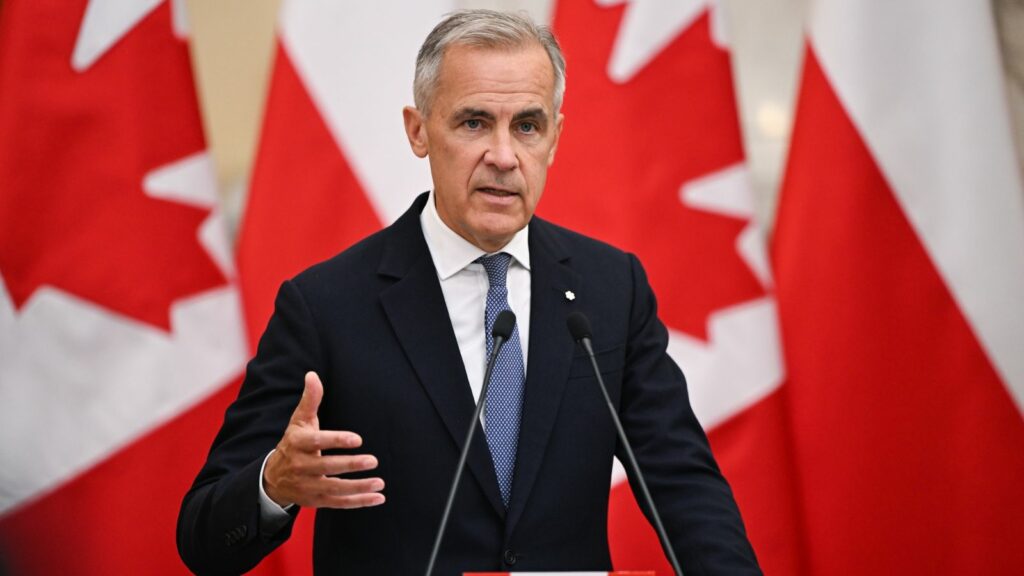
Quebec’s return to Parti Québécois rule has landed at an unusually complicated moment for Canada. Prime Minister Mark Carney is confronting an incoming sovereigntist government led by premier-designate Paul St-Pierre Plamondon just as Donald Trump’s trade offensive is putting new pressure on Canadian industries, workers and the future of continental trade.
The first exchange between Carney and St-Pierre Plamondon was notably practical. Infrastructure and support for Quebec workers affected by U.S. tariffs were among the subjects discussed, even as the PQ remains committed to eventually asking Quebecers to reconsider independence. For now, the strange reality is that Ottawa and a sovereigntist Quebec government have strong reasons to cooperate against economic pressure from Washington, while preparing for a much deeper political confrontation later.
A PQ Win, but Not a Blank Cheque
The Parti Québécois has completed one of the most dramatic political recoveries in recent Quebec history. After winning only three seats in the 2022 election, the party emerged from the October 5 vote with 59 of the National Assembly’s 127 seats. That puts St-Pierre Plamondon five seats short of the 64 required for majority control. The Quebec Liberals took 40 seats, the Conservatives 19 and Québec solidaire nine, while the outgoing Coalition Avenir Québec was shut out entirely.
The popular vote tells an equally important story. The PQ won roughly 28% of ballots cast, compared with about 24% for the Liberals and 21% for the Conservatives. In other words, the result clearly handed the PQ the responsibility to govern, but it cannot reasonably be interpreted as 28% of Quebecers suddenly endorsing independence. A fragmented five-party contest transformed a relatively modest plurality into 59 seats. For Carney, that distinction creates political room: Ottawa can recognize the new government without conceding that Quebec voters delivered a referendum mandate.
Carney’s First Move Is Cooperation, Not Confrontation
Carney moved quickly after the election, speaking with St-Pierre Plamondon and publicly emphasizing the immediate problems confronting Quebec rather than a sovereignty vote that may still be years away. The two discussed infrastructure funding and assistance for Quebec workers affected by the U.S. trade dispute. St-Pierre Plamondon described the conversation positively and has said he is prepared to work with Ottawa when cooperation serves Quebec’s interests.
That opening matters because both leaders have incentives to avoid beginning their relationship with a constitutional showdown. Carney wants to preserve a united Canadian response to Trump while preventing Quebec nationalism from becoming a second destabilizing front. St-Pierre Plamondon, meanwhile, needs to demonstrate that a PQ government can handle housing, public finances, infrastructure and economic uncertainty before asking Quebecers to contemplate something as consequential as independence. The first test of their relationship is therefore likely to come through files with tangible consequences for households and businesses rather than speeches about the Constitution.
The Referendum Is Back, but Its Clock Has Changed
St-Pierre Plamondon has not abandoned sovereignty. He has promised that a PQ government will hold an independence referendum during its first term. What has changed dramatically is the timing. He has ruled out holding that vote while Trump remains in the White House, pushing the referendum window beyond the end of Trump’s term in January 2029. The premier-designate reiterated after the election that a referendum is not among his immediate priorities.
That is a significant tactical retreat from the urgency traditionally associated with a victorious sovereigntist party. Polling has also shown independence support hovering around 30%, with a Léger survey earlier in 2026 finding 29% prepared to vote Yes and 71% choosing No. The PQ’s electoral comeback therefore reflects more than sovereignty. Dissatisfaction with the outgoing CAQ government, immigration, affordability, language and a broad desire for political change all contributed. St-Pierre Plamondon now faces an unusual challenge: keeping sovereigntist supporters mobilized while governing a population that, at least for the moment, remains substantially more skeptical about actually leaving Canada.
Trump Has Rewritten the Sovereignty Risk Calculation
Trump has altered the Quebec independence debate in a way few Canadian politicians could have anticipated. Rather than automatically strengthening separatism by attacking Ottawa, U.S. economic pressure has made some Quebecers more conscious of the security that comes from remaining inside a larger Canadian economy. Reuters reported in August that support for independence had fallen to roughly 30% as tariffs hit Quebec businesses and workers.
The human consequences help explain the change. Reuters documented a Quebec steel operation that lost roughly one-third of its orders for bolts and fasteners within days of earlier 50% U.S. steel tariffs. Its owner froze hiring, shut a plant and carried out layoffs as part of roughly 140 job losses, mainly in Quebec. Cases like that transform abstract questions about sovereignty into practical ones: what negotiating leverage would an independent Quebec have with Washington, how would existing supply chains be protected, and what would happen to market access? St-Pierre Plamondon’s decision to wait until Trump is gone effectively acknowledges how radically the external environment has changed.
Quebec’s Exposure to the U.S. Makes Trade the Immediate Test
Quebec cannot easily insulate itself from an American trade confrontation. During the first half of 2026, the province exported approximately $59.4 billion in merchandise internationally. About $40.5 billion of that — 68.2% — went to the United States. Quebec’s U.S.-bound exports were already down 7.2% compared with the same period of 2025, a decline of roughly $3.2 billion.
Some of Quebec’s most politically important industries are especially exposed. Aluminum and aluminum alloys were the province’s largest merchandise export category during the first half of the year at approximately $5 billion, and 80.1% of those exports went to the United States. Aircraft, aircraft engines and aerospace components also rely heavily on American customers. That concentration makes the federal-provincial relationship more than a constitutional argument. Workers in Saguenay–Lac-Saint-Jean, Montreal’s aerospace cluster and export-oriented manufacturing communities need governments to deal with financing, tariffs, market diversification and investment decisions now. Ideological disagreements between Ottawa and Quebec City do little to help a factory facing lost orders.
Federal Money Gives Carney a Practical Opening
Carney enters the relationship with something more useful than appeals to Canadian unity: federal programs already tied directly to Quebec jobs and infrastructure. In May, Canada Economic Development for Quebec Regions announced nearly $6.8 million for six aluminum companies and one industry organization in Saguenay–Lac-Saint-Jean affected by tariff pressures. Ottawa said the projects would help consolidate more than 350 jobs. The federal government also pointed to broader financing programs intended to help companies cope with disrupted trade.
Infrastructure creates another connection. Ottawa and the previous Quebec government reached agreements in June covering nearly $10 billion in federal infrastructure investment over the next decade, including money for health facilities, housing-related infrastructure and public transit. A PQ government may challenge how some projects are designed or insist on greater Quebec control, but billions of dollars and major construction plans cannot simply be treated as political symbolism. Carney’s strongest argument for federalism may therefore be less rhetorical than transactional: showing that governments can deliver together while Quebec retains substantial authority over its priorities.
French Language Has Already Entered the Trade Fight
The collision between Quebec nationalism and the Trump dispute became even more complicated when French language and culture entered Canada-U.S. negotiations. In August, Carney said Canada had rejected American demands that would compromise protections for the French language and Canadian culture. He said those issues had never been negotiable for his government, even though Washington had pressed them during the final stages of negotiations.
That gives Carney an unusual argument when dealing with a PQ government. The traditional sovereigntist case portrays Ottawa as unable or unwilling to adequately defend Quebec’s linguistic and cultural distinctiveness. Carney can now point to a confrontation with Washington in which the federal government explicitly treated French-language and cultural protections as matters of Canadian sovereignty. The PQ is unlikely to accept that as proof that federalism solves Quebec’s long-term concerns, but it complicates the narrative. Ottawa and Quebec City may disagree about the political future of Quebec while simultaneously finding themselves defending some of the same cultural interests against pressure from a much larger trading partner.
A Minority Government Forces the PQ to Pick Its Battles
The PQ’s 59 seats also impose an important parliamentary constraint. Quebec has 127 electoral districts, meaning 64 seats are required for a majority. With fewer than that, St-Pierre Plamondon cannot simply assume the National Assembly will approve every major initiative. His government will need support from opposition members to remain viable and advance important parts of its agenda.
Sovereignty produces particularly interesting arithmetic. Québec solidaire, which won nine seats, is also sovereigntist and has indicated that it would participate in the Yes camp if another referendum were held. Together, PQ and Québec solidaire members hold more than 64 seats. Yet that does not mean an automatic sovereigntist governing coalition exists; the parties disagree on substantial economic, social and policy questions. The Liberals and Conservatives are firmly opposed to another referendum. St-Pierre Plamondon will therefore have to assemble support issue by issue. In the short term, cooperation on affordability, homelessness, infrastructure or economic protection may be easier to sustain than an immediate constitutional confrontation.
CUSMA Uncertainty Raises the Cost of Federal-Provincial Friction
Behind the tariff battles sits an even larger threat: the uncertain future of the Canada-U.S.-Mexico Agreement. The first mandatory joint review occurred in July. The Trump administration declined to grant the agreement a new 16-year extension, leaving CUSMA in force but beginning a process of annual reviews that could ultimately lead to its expiration in 2036 unless the three countries reach agreement.
Washington is seeking significant changes, including tougher North American automotive rules, while Canada continues to confront U.S. tariffs on steel, aluminum, autos and other products. That environment makes provincial unity strategically valuable to Ottawa. Quebec is too important to the Canadian manufacturing, aluminum, aerospace and electricity sectors for federal negotiators to treat the province as an afterthought. At the same time, the PQ can argue that Quebec should have a louder voice whenever its industries are directly exposed. The result could be an uneasy version of “Team Canada”: a sovereigntist premier participating in efforts to defend Canadian market access while insisting Quebec could ultimately negotiate more effectively as a country of its own.
Quebec Is Now Part of a Wider Canadian Unity Test
Quebec is not the only place where Carney is confronting questions about the future of Confederation. Albertans are scheduled to vote October 19 on a non-binding referendum question asking whether Alberta should remain a province or whether its government should begin the legal process required to hold a future binding referendum on separation. Premier Danielle Smith has said she would vote to remain in Canada, but the very existence of the question gives Ottawa another national-unity problem to manage.
That helps explain why Carney has been emphasizing “cooperative federalism” through major projects and economic agreements. The federal government recently accelerated the proposed Pacific Link pipeline in part to diversify Canadian oil exports away from the U.S., while presenting the project as evidence that Ottawa and Alberta can accomplish more together. Quebec now presents a parallel challenge under very different political circumstances. Carney’s task is to make cooperation materially valuable without appearing to dictate terms to the new PQ government. St-Pierre Plamondon must prove Quebec can obtain results from Ottawa even while preparing to argue that it eventually should not need Ottawa at all.
