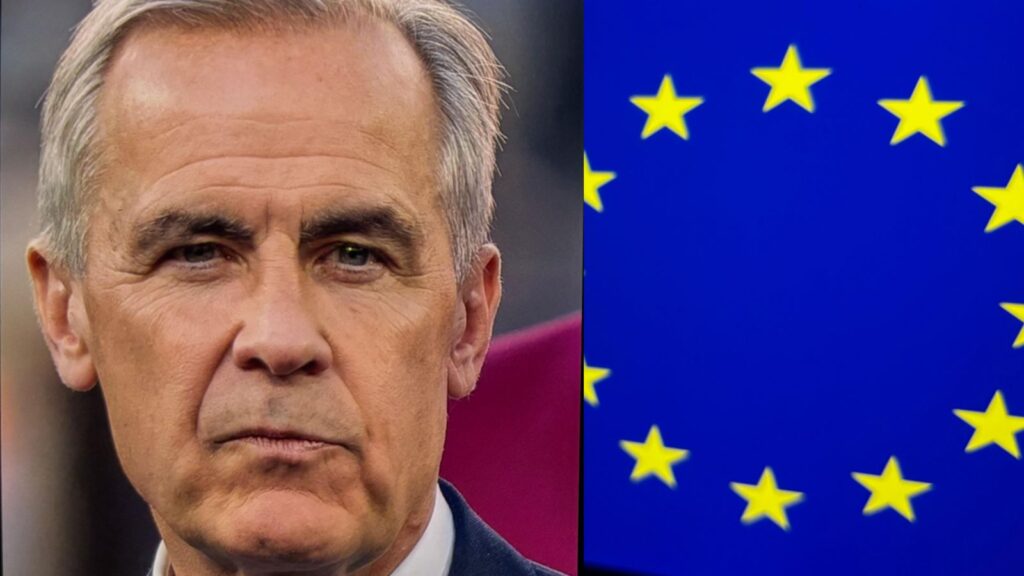
Prime Minister Mark Carney used the closing stretch of his United Nations visit in New York to put money behind Canada’s widening international strategy, pledging $82 million over five years for global ocean observation while co-hosting an initiative with European Commission President Ursula von der Leyen. The funding is for science, monitoring and ocean governance rather than trade, but its diplomatic timing is notable. Canada and the European Union helped mobilize more than $339 million in financial and in-kind commitments for the broader OceanEye effort, while Ottawa continues pursuing deeper economic and security relationships outside the United States. That outreach is occurring as Canada-U.S. trade negotiations remain suspended in the latest public record, leaving Ottawa to manage its most important commercial relationship while accelerating partnerships in Europe, Asia and other regions.
An $82 Million Pledge With a Much Larger Coalition Behind It
Carney announced the Canadian commitment on September 23 during the 81st United Nations General Assembly High-Level Week. Canada will provide $82 million over five years to expand ocean-observation capacity and support the Global Ocean Observing System, or GOOS. Carney and von der Leyen formally launched the OceanEye International Alliance at a high-level pledging event organized with UNESCO’s Intergovernmental Oceanographic Commission and the World Meteorological Organization. The initiative is designed to strengthen the international infrastructure that collects and coordinates information about ocean conditions.
Canada’s pledge was only one part of the financing assembled in New York. Organizers reported more than $339 million, equivalent to roughly €211 million, in commitments from participating countries. Those commitments include direct funding as well as research vessels, sensors, drones, data-processing facilities and other in-kind support. The alliance had attracted more than 30 participating members by its launch, turning what could have been a stand-alone Canadian spending announcement into a broader multinational project.
Why Ocean Observation Has Economic Weight
Ocean monitoring can sound removed from the everyday economy, but the system supports services that governments, shipping companies, fisheries and coastal communities routinely depend upon. GOOS brings together 64 countries, 17 global observation networks and thousands of observing platforms. European and UN-linked materials say the system generates roughly 120,000 observations every day. Those measurements contribute to weather forecasting, climate models, maritime safety, coastal protection and the monitoring of marine ecosystems.
The funding issue is also part of the reason OceanEye was created. The European Commission says roughly 90% of global ocean observations are financed by only nine countries, leaving the network vulnerable when budgets or geopolitical relationships shift. The new pledges are intended to maintain existing platforms, fill geographic data gaps, strengthen coordination hubs and support OceanOPS, which helps track the global observing network. For Canada, with coastlines on the Atlantic, Pacific and Arctic, those capabilities also intersect with shipping, fisheries, northern security and increasingly important Arctic activity.
Europe Is Becoming More Than a Trade Agreement
The OceanEye partnership fits into a Canada-EU relationship that has been expanding well beyond conventional tariff policy. The EU is Canada’s second-largest trading partner for combined goods and services after the United States. Global Affairs Canada reported two-way Canada-EU trade of $178.6 billion in 2025. The foundation remains the Comprehensive Economic and Trade Agreement, which has been provisionally applied since 2017, but recent cooperation has increasingly included defence, technology, critical minerals and investment.
Canada also became the first non-European country to participate in the EU’s Security Action for Europe defence initiative. In September, Carney called for an even deeper economic and security arrangement with Europe, covering areas such as artificial intelligence, energy, critical minerals and defence production. Von der Leyen has floated the idea of an EU “associate membership” arrangement for Canada, although no established legal category currently exists under that name and European governments would still have to define what such a relationship would involve.
New Partnerships at the UN Go Beyond Europe
Canada’s UN activity was not limited to the OceanEye announcement. Ottawa joined Australia, Barbados, Brazil, the European Union, India and Kenya as initial co-sponsors of the new Partners for Multilateralism initiative. The group’s declaration calls for cooperation on international law, resilient supply chains, artificial intelligence, climate issues, global health and reform of international institutions. Additional governments joined after the coalition’s September 21 launch.
Carney also used meetings around the General Assembly to work on individual bilateral relationships. The Prime Minister’s Office reported meetings with leaders from Chile, Angola and Jordan, describing trade, diplomatic and security diversification as part of the agenda. In the case of Angola, the two governments discussed mining and critical minerals as well as potential agreements on economic cooperation and investment protection. Canadian exports to Angola had exceeded $200 million in 2025, according to the Prime Minister’s Office, giving that meeting a concrete commercial dimension alongside the larger diplomatic message.
The U.S. Trade Channel Is Still on Hold
The contrast with Washington remains important because Canada’s trade talks with the United States did not merely slow down—they were formally suspended. Carney announced on August 21 that he was directing Canadian negotiators to return to Ottawa after the government said the United States had introduced last-minute terms it considered economically unacceptable. The breakdown was followed by new U.S. tariffs affecting roughly $20 billion in Canadian exports and Canadian plans for matching retaliation. At the time, U.S. Trade Representative Jamieson Greer said no new negotiations were scheduled.
Carney subsequently said Washington would have to approach the negotiations differently before formal talks could restart. More recent reporting during his September European diplomacy still described him as defending the decision to suspend negotiations rather than announcing a resumption. On that basis, the latest public record reviewed through September 24 shows the bilateral negotiating channel remaining on hold, even though neither government has ruled out future discussions. The distinction matters: suspended talks are not the same as a permanent end to negotiations.
Diversification Is Already Visible in the Trade Data
Canada’s effort to broaden its markets did not begin with the latest U.S. dispute, and recent Statistics Canada figures show measurable movement outside the American market. In 2025, 71.7% of Canadian merchandise exports went to the United States, down from 75.9% in 2024. Exports to countries other than the United States increased 17.2% during the same year, while overall merchandise trade with non-U.S. markets climbed from $484 billion to $553 billion.
Those numbers also show why diversification is a gradual project rather than a quick replacement for the U.S. market. Even after the decline in its share, the United States still absorbed more than seven out of every ten dollars of Canadian merchandise exports in 2025. Statistics Canada also found that some of the growth outside the U.S. was driven by unusually strong precious-metals shipments, particularly gold. Europe, Asia and other markets can reduce concentration risk, but the existing North American supply chains, infrastructure and geography remain economically significant.
Asia Is Becoming the Next Major Test
While Carney was in New York, Canadian trade officials were simultaneously advancing negotiations in Southeast Asia. International Trade Minister Maninder Sidhu told Reuters that separate free-trade negotiations with the Philippines and ASEAN were more than 90% complete. Ottawa hopes to have both ready around Carney’s planned visit to Manila in November. ASEAN officials separately said negotiations had made significant progress and remained on track for a substantive conclusion during 2026.
India is another major part of the diversification effort. Sidhu said Canada was optimistic that negotiations on a comprehensive economic partnership agreement with India could conclude by the end of 2026, with energy and critical minerals among the areas attracting commercial interest. Canada has also concluded negotiations on a comprehensive economic partnership agreement with the United Arab Emirates. Taken together, those initiatives show that Ottawa’s diversification strategy is not limited to replacing U.S. trade with Europe; it is attempting to develop several additional corridors at the same time.
The Next Few Months Will Show How Much Substance Follows the Diplomacy
The next major Canada-EU test is already scheduled. Leaders are due to meet in Montreal on October 29 and 30 for an EU-Canada summit, where the broader economic and security relationship is expected to continue developing. That meeting could provide more detail about the proposed deeper partnership, although the still-undefined idea of an “associate” relationship means significant policy work would remain before any new institutional arrangement could take shape.
OceanEye also has a longer timetable. Organizers intend to continue mobilizing support through 2026, 2027 and 2028, while Canada will host the next Our Ocean Conference in Halifax on May 10 and 11, 2027. Meanwhile, the suspended U.S. trade negotiations leave a separate question unresolved. Canada can build more commercial and diplomatic options abroad, and recent trade data show that process is already underway, but the scale of the U.S. relationship means Ottawa will still have to manage both strategies simultaneously.
