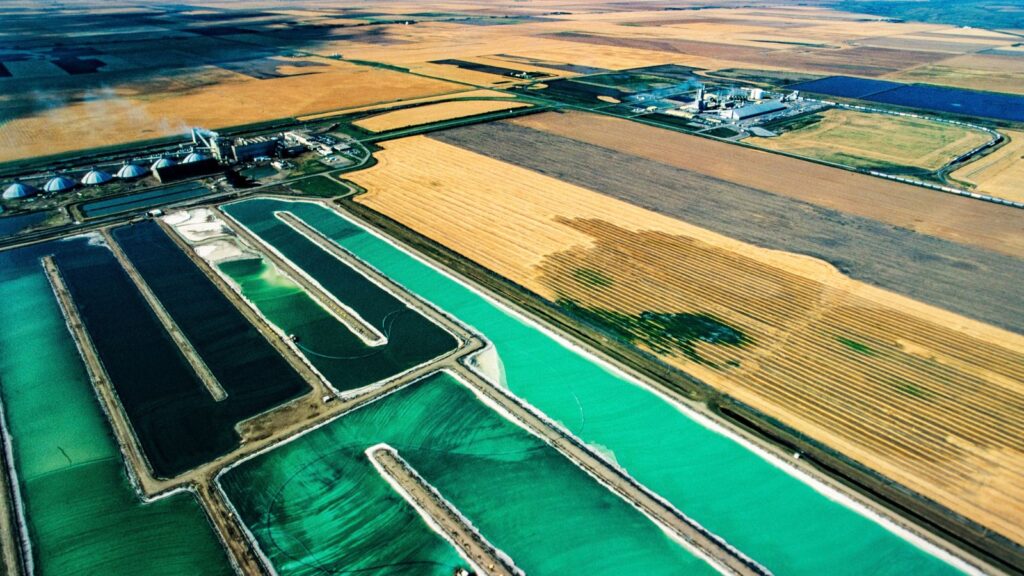
A new potash dispute is testing just how far the Canada-U.S. trade fight can reach into North America’s agricultural supply chain. Saskatchewan Agriculture Minister David Marit says American lawmakers and agricultural officials he has spoken with want the province’s potash to keep moving south, even as U.S. President Donald Trump explores buying more fertilizer from Belarus. Trump initially promoted Belarus as a potentially cheaper supplier, but later said the United States would continue purchasing Canadian potash.
The disagreement matters well beyond Saskatchewan’s mines. Canada dominates U.S. potash supply, American farm groups have repeatedly warned about the cost of disrupting that trade, and Belarus faces significant logistical limitations despite being one of the world’s largest producers.
Saskatchewan Says Its U.S. Contacts Want Supply to Continue
Saskatchewan Agriculture Minister David Marit said discussions with contacts in the United States have produced a message very different from the idea that Canadian potash can simply be replaced. Marit said American lawmakers and agricultural counterparts want Saskatchewan shipments to continue because the supply is reliable and because U.S. farmers depend on it. The Saskatchewan reporting did not identify every lawmaker involved in those conversations, making Marit’s comments a description of his discussions rather than a formal congressional position.
That distinction matters, but so does the underlying agricultural reality. The American Farm Bureau Federation has repeatedly estimated that roughly 85 per cent of U.S. potash needs are met by Canada. U.S. Geological Survey analysis has similarly shown an unusually high dependence on one foreign supplier, with Canada accounting for about 90 per cent of U.S. net potash imports in 2023. For farm-state officials worried about fertilizer availability and cost, an established rail-based supplier next door has practical advantages that extend beyond diplomatic relations.
Trump’s Belarus Proposal Quickly Changed Tone
Trump brought Belarus directly into the North American fertilizer debate when he said the United States was working on a large deal to buy Belarusian potash. He argued that Belarus could offer the product for substantially less than Canada and presented the idea as a potential benefit for American farmers. Reuters reported that no detailed contract volume, delivery schedule or final pricing structure was announced with the proposal, leaving open questions about how large any purchases would actually be.
A day later, Trump made clear that the proposal did not mean Canadian supply would disappear. Speaking in New York, he said the United States would continue buying from Canada while suggesting Belarus wanted to sell at a lower price. That clarification significantly narrowed the immediate threat facing Saskatchewan producers. It shifted the discussion from replacing Canada toward adding another possible supplier or using alternative supply as negotiating leverage. Even then, the commercial importance of any Belarusian deal would depend on its eventual size, price, transportation route and timing.
Canada Is Deeply Embedded in U.S. Fertilizer Supply
The scale of Canadian involvement explains why Saskatchewan officials are treating the dispute as more than political rhetoric. Natural Resources Canada says Canada is the world’s largest potash producer and exporter. In 2024, Canadian mines produced approximately 25 million tonnes of muriate of potash, while Canada accounted for nearly 33 per cent of global production. All 10 active Canadian potash mines listed by the federal government are located in Saskatchewan.
The United States is also Canada’s most important potash customer. Natural Resources Canada reported that 53 per cent of Canadian potash exports went to the United States in 2024. In 2025, Canadian potash exports to the U.S. were worth roughly C$4.2 billion, according to federal mineral trade data. Those figures describe a supply chain built over decades around mines, rail lines, warehouses and farming regions on the same continent. Belarus may be capable of producing large quantities of potash, but creating a comparable delivery network for American agriculture would involve far more than agreeing on a headline purchase price.
Saskatchewan’s Advantage Starts Underground
Saskatchewan is not merely one supplier among many. The province sits on one of the world’s most important potash deposits and has developed an enormous industrial system around extracting and transporting the mineral. Saskatchewan reported C$9.3 billion in potash sales during 2025, an increase of more than 18 per cent from the year before. Provincial figures also show companies have invested more than C$40 billion in Saskatchewan potash operations over the past two decades.
Production capacity could rise further. BHP says its Jansen project in Saskatchewan remains on track for first potash production in mid-2027. Stage 1 is expected to produce roughly 4.15 million tonnes annually once fully ramped up, while the combined first and second stages are expected to reach approximately 8.5 million tonnes a year. That expansion helps explain why Saskatchewan views long-term supply security as one of its strongest arguments with U.S. buyers. Instead of depending on a declining resource base, the region is preparing to add major new production capacity.
Belarus Has Potash, but Spare Supply Is Another Question
Belarus is a genuine heavyweight in the global potash business. Natural Resources Canada estimated that Belarus produced about 12.1 million tonnes of potassium chloride in 2024, making it the world’s third-largest producer behind Canada and Russia under that measurement. Belarus also accounted for nearly 19 per cent of global potash exports that year, so the country cannot be dismissed as an insignificant potential supplier.
The harder question is how much additional material Belarus could redirect to American customers quickly. Belarusian President Alexander Lukashenko said his country did not have large uncommitted volumes available because production had already been contracted to other buyers. Analysts interviewed after Trump’s announcement also questioned whether Belarus could send enough additional supply to the United States to have a major effect on American fertilizer prices. The issue illustrates a basic commodity-market constraint: a producer can be large globally while still lacking millions of tonnes of immediately available product for one new customer.
Geography Makes the Price Comparison More Complicated
Potash is heavy, bulky and comparatively expensive to transport over long distances relative to its value. That makes freight routes central to the economics. Saskatchewan potash can move south by rail directly into major American agricultural regions. Fertilizer Canada has long emphasized that rail transportation and cross-border infrastructure are essential parts of the integrated Canadian-U.S. fertilizer system.
Belarus faces a more complicated route. Sanctions and restrictions have disrupted its historic access through Lithuania, forcing exporters to consider longer alternatives. Reuters reported that transportation through Russia and its Arctic infrastructure can make Belarusian supply considerably more complicated and costly to reach the United States. Saskatchewan Premier Scott Moe has highlighted that logistical disadvantage in questioning whether Belarusian potash could ultimately arrive more cheaply than Canadian material. The answer cannot be determined simply by comparing mine-gate prices. Rail costs, port access, ocean freight, insurance, handling and delivery timing all contribute to what an American fertilizer dealer or farmer ultimately pays.
Belarus Also Brings a Geopolitical Complication
The proposed purchases are unfolding during a significant shift in U.S.-Belarus relations. Washington removed remaining U.S. sanctions on major Belarusian potash companies earlier in 2026 as part of negotiations that included the release of prisoners. Reuters reported that Belaruskali, Belarusian Potash Company and Agrorozkvit were among the companies receiving sanctions relief. That opened a door for Belarusian potash to re-enter the American market more freely.
The European position is different. European Union sanctions affecting Belarus remain in place, and Lithuania has publicly argued against relaxing pressure on the Lukashenko government because of Belarus’s domestic repression and its support for Russia during the war in Ukraine. Saskatchewan Premier Scott Moe has made that geopolitical argument central to his response, describing purchases from Belarus in strongly critical terms. His characterization is a political argument rather than a description of the fertilizer itself, but it demonstrates why the Saskatchewan government sees this trade dispute as involving both commercial and foreign-policy considerations.
American Farmers Have Their Own Reason to Want Stability
For U.S. producers, the central issue is often less about Canada or Belarus than the final fertilizer bill. Potassium is one of the major nutrients required by crops, and the United States does not produce enough potash domestically to cover agricultural demand. The American Farm Bureau has repeatedly warned that disrupting Canadian potash trade could increase costs for farmers already dealing with elevated expenses for fertilizer, fuel, labour and financing.
Those warnings are not theoretical. Farm Bureau testimony in 2026 pointed to broader increases in fertilizer expenses and deteriorating financial conditions across parts of U.S. agriculture. Earlier economic research from the University of Illinois and Ohio State University also concluded that potassium fertilizer was particularly exposed to Canadian trade disruption because U.S. imports are so concentrated in Canada. That helps explain Marit’s claim that American agricultural contacts want Saskatchewan supply to continue. Even officials who support tougher trade negotiations with Canada can face pressure from farm constituencies when those negotiations threaten to make an essential crop input more expensive or less predictable.
Potash Has Already Received Special Treatment in the Trade Fight
Washington’s earlier tariff decisions demonstrated how sensitive Canadian potash is for American agriculture. When the Trump administration imposed new duties on Canadian products in 2025, it created more favourable treatment for potash than for many other non-USMCA goods. The White House reduced the additional tariff on qualifying categories of non-USMCA Canadian potash to 10 per cent rather than the broader 25 per cent rate being applied at the time. USMCA-originating goods continued to qualify for preferential treatment.
More recently, when the administration announced additional tariffs on certain Canadian goods in July 2026, potash was specifically excluded from those new Section 338 measures. The carve-outs illustrate the policy tension surrounding the commodity. Washington has sought leverage against Canada on several trade issues while simultaneously trying to avoid increasing an important farm input cost. Trump’s Belarus proposal fits that same pattern: officials may want additional supply options and lower prices, but the existing Canadian relationship remains difficult to replace without creating other economic complications.
Saskatchewan Has Alternatives, but the U.S. Still Matters
Canada’s potash industry is less dependent on a single customer than the U.S. dependence figures might initially suggest. Canadian potash reaches dozens of countries, and the Port of Vancouver provides access to large agricultural markets in Asia and South America. Fertilizer Canada says approximately 14 million tonnes of fertilizer moved through Vancouver in 2025, with potash accounting for roughly three-quarters of those fertilizer exports. Canadian parliamentary testimony has also highlighted Brazil, China and Southeast Asia as established or growing markets.
Still, losing a substantial portion of U.S. demand would not be painless. The United States remains Canada’s largest potash destination, and Saskatchewan has invested heavily in infrastructure built around continental trade. For now, there is no evidence that Trump’s proposed Belarus arrangement is about to displace that relationship wholesale. Trump has explicitly said purchases from Canada will continue, while Belarus itself has acknowledged limited spare volumes. The more immediate story is therefore one of competitive pressure and bargaining rather than an abrupt replacement of Saskatchewan potash. Actual contract volumes, shipping routes and delivered prices will determine whether Belarus changes that calculation.
