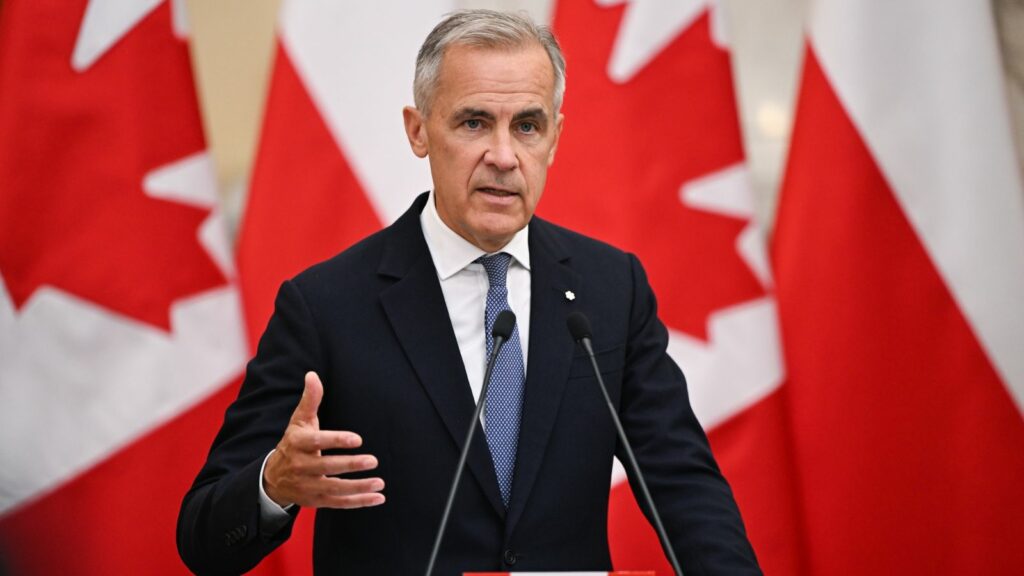
Canada’s bruising trade confrontation with the United States has not closed the door on negotiations. Prime Minister Mark Carney is signalling that Ottawa remains prepared to return to the table — but not simply to end the dispute at any cost.
Speaking at the Canada Investment Summit in Toronto on September 15, Carney said a “mutually beneficial” arrangement with Washington remains possible and Canada will be ready when the conditions are right. His comments do not mean formal negotiations have resumed. Instead, they reinforce a position Ottawa has developed since talks collapsed in August: Canada wants an agreement that provides economic benefits, respects its sovereignty and offers enough stability for businesses to plan around. With billions of dollars in tariffs now affecting cross-border commerce, the question is increasingly not whether the two countries will talk again, but what would make another negotiating round worth pursuing.
The Door Is Open, but Ottawa Is Not Rushing Back
Carney’s latest language is notably different from an announcement that negotiations have formally restarted. At the Toronto investment gathering, he said there was still a mutually beneficial arrangement to be made with the United States and that Canada would be prepared to pursue it when the time was right. At a separate news conference, he said an acceptable agreement would require a clear alignment of interests and a workable sequence for implementation.
That distinction matters after a summer in which negotiations repeatedly appeared close to producing an agreement before breaking down. Earlier in September, Carney had already said Canada was ready to sit down when Washington was prepared to pursue a deal benefiting workers, businesses and consumers in both countries. He also stressed the importance of stability and credibility. Taken together, the comments suggest Ottawa is leaving room for renewed diplomacy without treating the simple resumption of talks as a breakthrough. For companies dealing with tariffs and uncertain investment decisions, an agreement that lasts may matter as much as one reached quickly.
August’s Breakdown Still Shapes Every New Conversation
The current standoff dates back to August 21, when Canada suspended intensive negotiations after the two governments failed to bridge their remaining differences. Carney said at the time that U.S. negotiators had introduced terms Ottawa considered economically unacceptable and incompatible with Canadian sovereignty. Canada’s negotiating team returned home, and Washington’s new duties took effect the next day.
The American government has described the dispute differently. White House proclamations have accused Canada of maintaining discriminatory or unreasonable policies affecting U.S. products in areas including automobiles, dairy and alcoholic beverages. Washington subsequently applied additional duties under Section 338 of the Tariff Act. Ottawa responded by saying the proposed U.S. settlement demanded too many concessions while providing insufficient certainty in return. Those competing accounts explain why Carney’s latest openness does not erase the dispute that ended the August negotiations. Any new round would begin with both governments already knowing where the most difficult disagreements lie — and with tariffs already affecting commercial decisions on both sides of the border.
“Mutually Beneficial” Has Become Ottawa’s Key Test
Carney has repeatedly framed Canada’s objective around the idea of mutual benefit rather than simply greater market access. When negotiations were suspended, he said a workable agreement would have to respect Canadian sovereignty, capitalize on the complementary strengths of the two economies, support employment and lower costs. In early September, he added another requirement: businesses and workers must be able to regard the eventual arrangement as stable and credible.
Ottawa has also identified areas where it was prepared to compromise. Carney said Canada had offered to remove remaining retaliatory measures on strategic sectors including steel, aluminum and automobiles if U.S. tariffs were reduced enough to make Canadian exports commercially viable. At the same time, he said Ottawa would not compromise protections for Canadian sovereignty, the French language or Canadian culture. Those are the parameters behind the phrase “mutually beneficial.” It does not describe a finished proposal. It describes the test Carney says any future package would have to pass before his government would sign it.
Tariffs Are Keeping the Cost of Failure Visible
The negotiations are taking place against a backdrop of real tariff exposure. After the United States imposed 50 per cent duties on $27.6 billion worth of Canadian products in August, Ottawa announced dollar-for-dollar countermeasures covering the same value of American imports. Canada’s measures took effect September 8, with rates of 15, 25 or 50 per cent depending on the product.
The Canadian list focuses heavily on sectors caught in the wider dispute, including steel, dairy, appliances, agricultural equipment, pulp and paper, plastics and electronics. The U.S. regime has also continued to change. On September 15, new American tariffs took effect on a relatively small group of Canadian products while duties were removed from some others. Separately, Washington has announced import restrictions scheduled for September 29 on certain Canadian products, including some alcoholic beverages and goods targeted through its dairy and motor-vehicle actions. For individual manufacturers or exporters, those distinctions can determine whether a cross-border sale remains profitable at all. That makes tariff relief a practical negotiating issue rather than simply a diplomatic one.
Autos Remain One of the Hardest Problems to Solve
Few sectors demonstrate the stakes more clearly than automobiles. Canadian assembly plants and parts suppliers have developed around a deeply integrated North American production system, meaning components and finished vehicles routinely depend on demand and inputs from across the border. Statistics Canada estimates that U.S. demand accounted for 76.4 per cent of payroll jobs in Canada’s automobile and light-duty vehicle manufacturing industry in 2024 — roughly 27,000 jobs.
The trade flows are equally concentrated. More than 93 per cent of Canadian motor-vehicle exports went to the United States in 2025, according to Statistics Canada. That dependence gives changes in U.S. tariff policy an outsized impact on factories in Ontario and throughout the supply chain. Washington has argued that Canadian auto policies disadvantage American producers, while Ottawa maintains that an integrated Canadian industry strengthens North American manufacturing rather than undermining it. President Donald Trump has also threatened substantially higher tariffs on Canadian cars, trucks and parts beginning in 2027. Resolving that conflict could therefore be essential to any durable agreement.
CUSMA Is Still Alive, but Its Future Is Less Certain
The trade dispute is unfolding alongside a separate source of uncertainty: the formal review of the Canada-United States-Mexico Agreement. CUSMA, known as USMCA in the United States, reached its first six-year joint review on July 1. Washington declined to renew the pact in its existing form, saying it wanted changes addressing what it considers shortcomings in the agreement and its trade relationships with Canada and Mexico.
That decision did not terminate CUSMA. The agreement remains in force while the three governments continue the review process, but the refusal to grant an immediate extension creates an extended period in which businesses cannot assume the framework will simply continue unchanged. The United States has been holding detailed discussions with Mexico over automobiles, steel and aluminum, agriculture, economic security and rules of origin. Canada’s bilateral dispute with Washington adds another layer to that process. As a result, future Canada-U.S. talks may ultimately have to address both immediate tariff relief and broader questions about the structure of North American trade.
The U.S. Market Is Still Enormous for Canada
Canada’s push to diversify does not change the sheer scale of its economic relationship with the United States. Global Affairs Canada says Canadian merchandise exports to the U.S. totalled $564.6 billion in 2025 even after falling 5.3 per cent from the previous year. Statistics Canada separately reported that the U.S. still accounted for 71.7 per cent of Canadian merchandise exports during the year.
There are signs that the concentration is easing. When goods and services are measured together, Global Affairs Canada reported that the U.S. share of Canadian exports fell to 64.1 per cent in the first quarter of 2026, its lowest level in that data series. Even during the present tariff conflict, Carney has noted that roughly four-fifths of bilateral trade remains tariff-free. That helps explain why Ottawa can simultaneously pursue diversification and seek a new American agreement. The U.S. remains too large a customer to treat improved access as irrelevant, while recent events have strengthened the government’s case for reducing Canada’s exposure to any one market.
Diversification Gives the Talks a Different Backdrop
One significant change from previous Canada-U.S. trade disputes is the speed with which Canadian exports to other markets have expanded. Global Affairs Canada reported that goods and services exports to non-U.S. destinations rose 11.1 per cent in 2025, reaching their highest share of total Canadian exports in roughly four decades. Merchandise trade with Europe, the Indo-Pacific and other regions also increased.
Carney’s government has been trying to turn that shift into a longer-term strategy. Canada already has preferential trade arrangements covering large parts of Europe and the Asia-Pacific region, while Ottawa is pursuing additional agreements and deeper economic partnerships. Carney travelled to Europe immediately after the Toronto investment summit as his government sought closer economic and security cooperation with the European Union. Diversification cannot quickly replace the American market, particularly for industries such as automobiles that were built around continental supply chains. But the changing trade map means future U.S. negotiations are occurring while Ottawa is simultaneously working to create more alternative destinations for Canadian capital, resources and manufactured goods.
The Investment Summit Was Part of the Same Strategy
Carney delivered his latest trade remarks during a summit designed to demonstrate that Canada can attract capital even as its relationship with Washington becomes more unpredictable. The government said investors from nearly 30 countries attended the Toronto gathering and that participating institutions collectively manage more than $100 trillion in assets. Ottawa said the summit generated or accelerated nearly $500 billion in investment commitments, although many of those commitments cover projects and financing that will unfold over several years.
Carney also announced an expansion of immediate investment write-offs that the government calls the Productivity Mega Deduction. Ottawa estimates the change will reduce Canada’s marginal effective tax rate on new business investment from roughly 13 per cent to 6.4 per cent. The broader political message was closely connected to the trade dispute: Canada intends to improve its domestic investment environment rather than wait for the old U.S. relationship to return. That does not remove Washington from Canada’s economic strategy. Instead, Ottawa is trying to ensure that future negotiations occur alongside stronger domestic investment and broader international partnerships.
A New Deal Would Need More Than a Handshake
One of Carney’s recurring concerns has been whether a negotiated settlement would deliver lasting certainty. His reference to stability, credibility and implementation reflects an obvious challenge for companies making decisions about factories, machinery or cross-border supply chains. A tariff concession has less value if businesses believe the terms could be rewritten months later.
There are nevertheless signs that communication has never completely stopped. Trade Minister Dominic LeBlanc said in September that Canadian officials remained in contact with senior U.S. counterparts even though formal negotiations were suspended. Carney has also welcomed changes in some American positions since the August breakdown. That creates room for another negotiating round without guaranteeing one. For now, the clearest signal from Ottawa is conditional rather than celebratory: Canada is prepared to negotiate, but the government says the next agreement must provide recognizable benefits on both sides of the border, respect Canadian sovereignty and be credible enough for businesses and workers to rely upon. Until those conditions converge, the trade relationship remains open for business — and open for negotiation — but unresolved.
