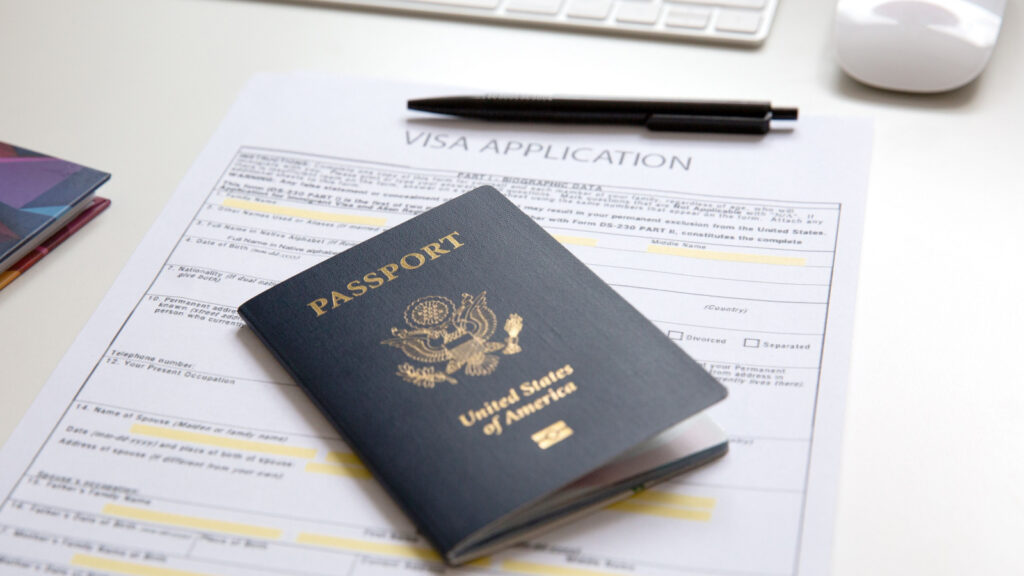
A federal immigration-fraud case in Montreal is drawing attention because of the scale of the allegations and the unusual mix of visa applications, asylum claims and falsified Canadian passports. The Canada Border Services Agency says 42-year-old Montreal resident Abul Kasim helped 65 people provide false information in immigration files and arranged for 53 people to enter Canada using temporary resident visas allegedly obtained through fraud. Investigators also allege that four falsified Canadian passports were used to support visa applications by impersonating Canadian hosts named in invitation letters.
Kasim faces five charges under the Immigration and Refugee Protection Act and the Criminal Code. None of the allegations has been proven in court. The case now carries an additional complication: CBSA says Kasim left Canada in June 2025, is believed to be abroad and is wanted on an arrest warrant.
The 65 Files and 53 Entries Are Related, but Not Identical Counts
The numbers at the centre of the case are substantial, but they describe two related allegations rather than 118 separate people. CBSA says Kasim allegedly assisted 65 individuals in providing false information in applications for temporary resident visas and in asylum claims between January 13, 2022, and March 19, 2024. The agency separately alleges that he arranged the entry of 53 individuals using temporary resident visas obtained through fraud, with the intention that they settle permanently in Canada. CBSA has not said publicly whether all 53 people were also among the group of 65.
That distinction matters. A temporary resident visa is a travel document used by people who must satisfy Canadian authorities that they meet the legal requirements for temporary admission. An asylum claim is a separate protection process and is not inherently suspicious or unlawful. The allegation in this case is specifically about false information and fraud, not about the mere act of seeking refugee protection. The CBSA release also does not identify the 65 or 53 individuals or describe their present immigration status.
The Investigation Stretched From a 2024 Referral to a 2026 Arrest Warrant
The investigation stretched across more than two years before the charges became public. CBSA says the case began in 2024 after Immigration, Refugees and Citizenship Canada supplied information to the border agency. Investigators later executed a search warrant at Kasim’s Montreal residence on May 8, 2025. According to CBSA, evidence gathered through that search contributed to allegations covering conduct from early 2022 through March 2024.
The timeline then took another turn. CBSA alleges Kasim left Canada in June 2025, roughly a month after the search, and is now believed to be outside the country. Proceedings were initiated at the Montreal Courthouse on July 28, 2026, but the agency says he could not be served with a summons to appear. An arrest warrant was therefore issued. The public announcement came on August 21, nearly a month after the court proceeding was initiated. Global News and Quebec media reported the same core timeline while emphasizing that the allegations remain unproven.
Why Temporary Resident Visas Are Central to the Alleged Scheme
Temporary resident visas are central to the allegations because they are issued on the premise that an applicant qualifies for temporary entry. IRCC guidance says applicants generally must satisfy an officer that they will leave Canada at the end of their authorized stay, have adequate financial support and meet other admissibility requirements. A visa is also not an automatic guarantee of entry: travellers can be examined again by CBSA when they arrive at a Canadian port of entry.
That framework explains why the allegation involving 53 people is significant. If proven, it would mean information used to establish temporary eligibility was allegedly manipulated before the individuals travelled to Canada. The wider visa system has also become more restrictive. IRCC reported that the global temporary resident visa refusal rate was 51% in 2025, compared with 39% in 2023, with most refusals tied to officers not being satisfied that applicants would leave after their authorized stay. Those national figures provide context only and are not evidence against Kasim or any applicant connected to this case.
Four Allegedly Falsified Canadian Passports Add Another Layer
One of the most specific allegations concerns four falsified Canadian passports. CBSA says the documents were used in support of temporary resident visa applications and that Kasim allegedly impersonated Canadian hosts in invitation letters attached to those files. Invitation letters can help establish the purpose of a visit, the applicant’s relationship with the person inviting them and where the visitor intends to stay. IRCC makes clear, however, that even a legitimate invitation letter does not guarantee a visa will be approved.
The passport allegation raises the legal stakes because forged travel documents are treated separately from ordinary mistakes on an application. Section 122 of the Immigration and Refugee Protection Act addresses the use of identity and travel documents in contravention of immigration law. The Criminal Code also makes it an indictable offence to use, deal with or act on a passport while knowing that it is forged. That offence carries a maximum sentence of 14 years in prison. Maximum statutory penalties are not predictions of what any person will receive; guilt and an appropriate sentence would first have to be established in court.
Five Charges Span Both Immigration Law and the Criminal Code
CBSA says five charges have been laid: conspiracy to facilitate illegal entry, facilitating illegal entry, counselling or assisting people to provide false information in visa applications, using falsified Canadian passports, and using passports while knowing they were forged. The charges draw on both the Immigration and Refugee Protection Act and the Criminal Code, reflecting the way the alleged conduct spans immigration rules and document-related criminal offences.
Some of the provisions carry severe maximum penalties. Under section 117 of IRPA, organizing or assisting the entry of a group of 10 or more people in contravention of the Act can, on indictment, carry a fine of up to $1 million, life imprisonment, or both. Counselling misrepresentation under section 126 can bring up to five years in prison and a $100,000 fine on indictment. Actual sentences depend heavily on the circumstances. In a separate Saskatchewan case in July 2026, a man who pleaded guilty to counselling immigration misrepresentation received a conditional sentence of two years less a day, a $10,000 fine and 40 hours of community service.
The Claim That Kasim Was an Immigration Consultant Requires Careful Wording
The case also highlights the role immigration representatives can play in a process that is complicated for many applicants. CBSA alleges that Kasim presented himself as an immigration consultant working for a firm with offices in Canada, France and Bangladesh. The agency’s public release does not identify the firm and does not state whether Kasim was licensed by a Canadian regulator. It would therefore be premature to describe him as an unauthorized consultant based solely on the information made public so far.
Canadian rules are clear about paid representation. IRCC says paid immigration consultants must be members in good standing of the College of Immigration and Citizenship Consultants. Lawyers and certain paralegals must belong to a provincial or territorial law society, while Quebec notaries must belong to the Chambre des notaires du Québec. The College maintains a public register where people can verify a consultant’s licence and entitlement to practise. IRCC also stresses an important point for applicants: they remain responsible for the truthfulness of their application even when a representative fills out forms or submits documents on their behalf.
The Case Shows How IRCC Referrals Can Become CBSA Criminal Investigations
The referral path illustrates how responsibility is divided among federal immigration authorities. IRCC processes many visa and immigration applications, while CBSA handles border examinations and significant parts of immigration enforcement. CBSA says this investigation began after information was received from IRCC. It later developed into a criminal investigation that included the May 2025 search of Kasim’s residence. The agency says it is responsible for identifying, investigating and pursuing prosecutions involving immigration fraud and other alleged violations of the Immigration and Refugee Protection Act.
That work extends far beyond one Montreal case. CBSA reported that it opened 161 criminal investigations into suspected IRPA offences between April 1, 2025, and March 31, 2026. Separately, its 2024–25 departmental results show that the agency concluded 47,014 immigration investigations, with 75% of the people investigated identified as inadmissible. Those figures measure different types of enforcement activity and should not be combined. They do, however, illustrate the scale of the investigative work behind referrals, document checks and suspected immigration-law violations.
Ottawa Has Been Putting More Resources Into Detecting Immigration Fraud
The Montreal allegations arrive during a period of heightened federal attention to temporary-resident compliance and immigration-system integrity. IRCC says it has been placing greater emphasis on detecting fraud, while misrepresentation findings can have consequences extending well beyond the rejection of a single application. Temporary residents are expected to comply with the conditions attached to their stay, and CBSA is responsible for many enforcement steps when foreign nationals are found inadmissible or become subject to removal.
Recent prosecutions also show how immigration-fraud investigations can develop. In Ontario, CBSA announced charges in July 2026 after an investigation into an alleged scheme involving international students and approximately $126,000. Investigators said they interviewed alleged victims, executed search warrants and later obtained warrants to examine digital forensic evidence. A separate Saskatchewan investigation produced a guilty plea for counselling misrepresentation. These cases are not connected to the Montreal allegations, but they demonstrate the range of evidence—from referrals and interviews to financial records, documents and electronic devices—that investigators can examine when suspected fraud is identified.
Major Details About the Montreal Case Remain Undisclosed
Several important questions remain unanswered. CBSA has not disclosed the name of the firm Kasim allegedly represented, the countries of origin of the affected applicants, the amount of money that may have changed hands, or whether any of the 65 people allegedly involved in false filings have themselves been charged. The agency also has not publicly detailed what happened to the immigration status of the 53 people it says entered Canada using fraudulently obtained temporary resident visas. Those gaps make it important to separate disclosed facts from assumptions about people connected to the files.
The immediate procedural issue disclosed by the agency is the outstanding arrest warrant. CBSA says Kasim is believed to be abroad, but its release does not identify the country where authorities believe he is located or announce any extradition process. Public reporting similarly offers no confirmed location beyond Canada. Most importantly, the five charges remain allegations. CBSA itself states that they must be proven in court, while news organizations covering the case have repeated that principle. Until the evidence is tested judicially, the allegations should not be presented as findings of guilt.
The Applicants Connected to the Files Should Not Automatically Be Treated as Co-Accused
The 65 applicants and 53 entrants should not automatically be treated as co-accused. CBSA’s August 21 release announces charges only against Kasim and does not say whether the people connected to the files knowingly participated in the alleged deception, were misled by a representative, or face separate immigration proceedings. That distinction is particularly important in representative-fraud cases, where some clients can be victims while others may knowingly participate. Each immigration file can ultimately turn on its own documents, statements, communications and evidence.
For applicants who are actually found to have misrepresented material facts, the potential consequences are serious. IRCC says false documents or information can result in an application being refused, a record of fraud, loss of immigration status, removal from Canada and a ban on returning for at least five years. At the same time, the department says its fraud-enforcement approach is focused on identifying those responsible rather than punishing people who were affected by fraud. That principle does not determine the outcome of these particular files, but it explains why the immigration status or culpability of dozens of people cannot be inferred simply from the charges against one Montreal man.
