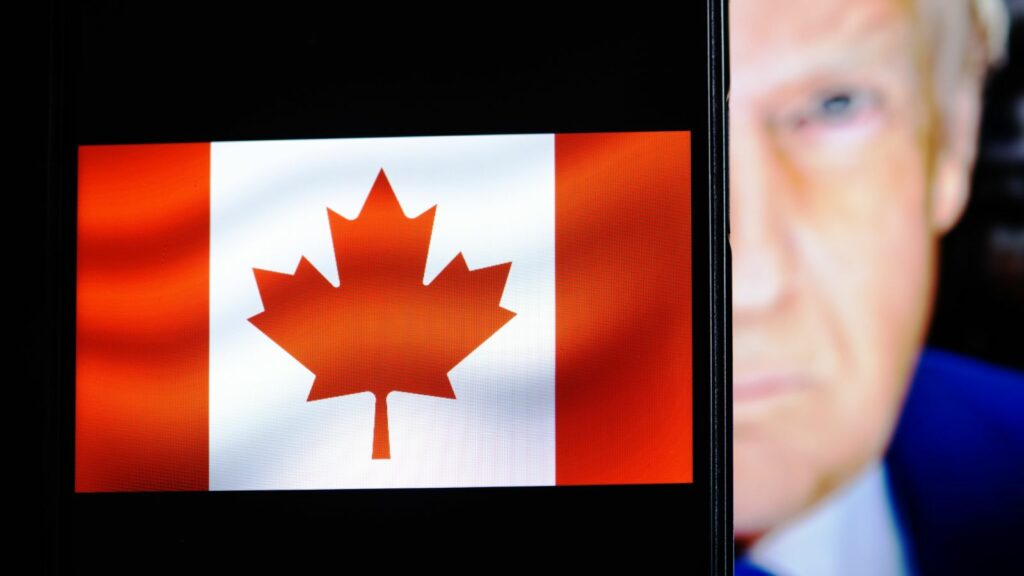
A trade fight that appeared close to cooling has instead escalated sharply. New U.S. tariffs of 50% took effect early Saturday, August 22, on selected Canadian goods after negotiators failed to turn three days of intensive talks into a final agreement. Washington values the targeted imports at nearly US$20 billion, while Ottawa puts the amount at roughly C$28 billion.
Prime Minister Mark Carney responded by suspending negotiations, recalling Canada’s negotiating team from Washington and pledging to match the new tariffs “dollar for dollar.” The escalation does not shut down all Canada-U.S. commerce, but it lands on top of existing disputes involving steel, aluminum, automobiles and softwood lumber. It also injects fresh uncertainty into a trading relationship worth billions of dollars every day and into the already difficult future of CUSMA.
A Three-Day Reprieve Ended With Tariffs at Midnight
The newest U.S. duties took effect at 12:01 a.m. Eastern time on August 22, ending an extraordinary week in which a settlement repeatedly appeared within reach. Trump had originally scheduled the tariffs for August 19 but postponed them for three days after saying the two countries had the basis of a deal. Canadian officials were noticeably more cautious, emphasizing that negotiators still had to settle important details and legal wording.
By Thursday, Canadian trade minister Dominic LeBlanc was describing the sides as “very close.” Negotiations continued for a third consecutive day on Friday, including hours of discussions with U.S. Trade Representative Jamieson Greer. Yet the deadline arrived without signatures. The resulting tariff package covers nearly US$20 billion in imports, equivalent to a little over 5% of Canada’s annual exports to the United States. That is limited compared with total bilateral trade, but a 50% border charge can still transform the economics of an individual shipment overnight.
Both Governments Blame the Other Side for the Collapse
What happened during the final hours remains contested. Carney said the United States introduced last-minute changes that were “unfair” and “uneconomic” and that raised doubts about whether any agreement could provide dependable long-term certainty. He then ordered Canadian negotiators back to Ottawa, arguing that Canada would not accept an agreement simply to meet an American deadline.
Washington presented almost the opposite account. Greer said Canada declined to finalize terms that had effectively been agreed earlier in the week. U.S. officials maintained that their proposal would have given Canada unusually favourable tariff treatment compared with other major trading partners. The disagreement is particularly striking because, only hours earlier, Trump had publicly said the Canada deal was “moving along.” Reported negotiations had included possible reductions in existing American tariffs on Canadian vehicles, steel and aluminum. Instead of producing a broader détente, those discussions ended with an entirely new layer of tariffs and no immediate timetable for restarting negotiations.
Trump Is Using an Almost Century-Old Tariff Power
The legal foundation for the new tariffs makes this dispute particularly unusual. Trump invoked Section 338 of the Tariff Act of 1930, a Depression-era provision allowing the president to impose additional duties of as much as 50% when another country is found to discriminate against U.S. commerce. The administration announced three Section 338 actions in July concerning Canadian treatment of American motor vehicles, alcoholic beverages and dairy products.
The provision had sat largely dormant for generations. Trade researchers and legal specialists say there is no known previous instance in which a president actually used Section 338 to impose tariffs in this manner. That makes the Canada action a major test of presidential trade authority. Congressional Research Service analysis confirms that Section 338 authorizes tariffs up to the 50% ceiling, although its relationship with more modern trade statutes has attracted legal scrutiny. Trade lawyers have already raised the possibility of court challenges, meaning the tariff fight could eventually move from customs offices and negotiating rooms into U.S. federal courts.
The 50% Rate Does Not Apply to Everything Canada Sells
Despite the dramatic headline rate, Americans are not suddenly paying an additional 50% tax on every Canadian shipment. The measures cover selected tariff lines that include products such as wine, furniture, dairy products, cement, clothing, fishing equipment and hockey gear. The White House has said the duties apply to covered goods even when those products would ordinarily qualify for preferential treatment under CUSMA.
Important exclusions make the distinction critical. Energy, potash, critical minerals and some fish products are outside the new Section 338 package. Products already subject to separate Section 232 duties are also excluded from this additional tariff layer. That means the measure is different from existing U.S. tariffs affecting Canadian steel, aluminum and automobiles. For a business shipping an affected item, however, the distinction offers little comfort. A furniture manufacturer or sporting-goods supplier that built its pricing around tariff-free continental trade can suddenly face a charge large enough to wipe out its margin, force a price increase or make an American order commercially unworkable.
Carney’s Dollar-for-Dollar Response Opens a New Front
Carney’s response was deliberately symmetrical: Canada, he said, will match the U.S. tariffs “dollar for dollar” to protect Canadian workers and businesses. Ottawa values the American action at approximately C$28 billion, reflecting the Canadian-dollar equivalent of the nearly US$20 billion figure cited by Washington. The two numbers therefore describe broadly the same trade exposure rather than two different tariff packages.
The precise Canadian product list and implementation mechanics were not immediately detailed when Carney announced the response. That matters because counter-tariffs are normally designed not only to match economic value but also to create political pressure while limiting damage to domestic importers. Canada already has experience with that balancing act. Ottawa continues to use tariff-remission measures for some U.S. inputs needed by Canadian manufacturers and other essential sectors. Carney also promised additional assistance for affected workers and businesses in the coming days, building on more than C$25 billion in tariff-related support measures announced since the trade confrontation began.
Five Percent of Exports Can Still Mean Severe Local Pain
At the national level, the new Section 338 tariffs cover just over 5% of Canadian exports to the United States, making them smaller than an across-the-board 50% levy would be. But national averages can hide the impact on individual towns, factories and small exporters. A company that derives most of its sales from one tariffed product does not experience the measure as a 5% problem. For that business, the relevant exposure can approach 100%.
Canada also remains deeply dependent on its southern market despite recent diversification. Statistics Canada reported that 71.7% of Canadian merchandise exports went to the United States in 2025, down from 75.9% in 2024. Canada and the United States still exchanged nearly C$3.5 billion in goods and services every day in 2025. Existing tariff pressures have already produced visible consequences. Reuters reported this month that Heico Companies had laid off about 140 workers, mainly in Quebec, amid weakness linked to steel-market conditions. Those layoffs involved earlier steel measures, not the new Section 338 tariffs, but they illustrate how concentrated trade shocks can reach workers quickly.
American Importers and Shoppers Are Not Insulated From the Cost
Tariffs are collected at the border from importers, so their economic burden does not automatically remain in Canada. An American distributor importing a tariffed Canadian product must decide whether to absorb the additional cost, negotiate a lower price with its supplier, switch countries, cut orders or pass some of the expense to customers. With a 50% statutory rate, that decision can become especially difficult for products where Canadian alternatives cannot be replaced quickly.
Economic research provides a warning against assuming foreign exporters simply pay the bill. A 2026 NBER study examining recent U.S. tariff increases found pass-through to U.S. import prices at the border was close to 100%, meaning American buyers carried a large share of the immediate cost. Federal Reserve researchers studying 2025 tariffs found a smaller but still meaningful effect at retail: highly tariff-exposed categories experienced consumer-price pass-through of roughly 15% to 20%, while household spending declined. Those studies examined earlier tariff episodes rather than the new Canadian duties, but they demonstrate why American retailers, manufacturers and consumers also have a financial stake in avoiding prolonged escalation.
Retaliation Carries Costs on the Canadian Side Too
Matching tariffs can strengthen Ottawa’s negotiating leverage, but counter-tariffs are not economically painless. Canadian companies that depend on American machinery, components, chemicals or specialized materials can face higher costs when those inputs are targeted. Businesses then have the same uncomfortable choices as their American counterparts: absorb the tariff, find a different supplier or raise prices. That is why the design of Canada’s retaliatory list will be closely watched once the government publishes the detailed measures.
The Bank of Canada has repeatedly warned that tariffs and trade-policy uncertainty can weaken investment, exports and hiring even before every threatened duty actually appears. Its July 2026 Monetary Policy Report identified the evolution of the U.S. trade relationship as one of the most important risks to Canada’s economic outlook. Earlier modelling estimated that existing U.S. trade restrictions were leaving Canadian economic activity on a lower path than before the tariff conflict. Ottawa has consequently paired retaliation with financing, worker retraining, tariff relief and diversification programs rather than relying on counter-tariffs alone.
The Breakdown Makes the CUSMA Fight More Dangerous
The timing is especially sensitive because the North American trade agreement is already in an uncertain phase. CUSMA entered into force in 2020 with a mandatory six-year joint review. At the July 1, 2026 review, the United States declined to approve a new 16-year extension in the agreement’s current form. That decision did not terminate CUSMA. The agreement remains legally in force until 2036, with annual reviews now expected unless Canada, Mexico and the United States reach an extension agreement earlier.
The new Section 338 tariffs nevertheless weaken one of CUSMA’s most valuable features: predictability. The White House says the new duties apply even to covered goods that satisfy CUSMA rules of origin, meaning compliance alone does not shield those products from this particular measure. Before Friday’s collapse, the emerging bilateral deal was expected to help create a pathway toward broader CUSMA negotiations. Instead, Canada and the United States are entering that process with another tariff battle, competing accounts of a failed agreement and significantly less confidence that a temporary understanding will remain stable.
Canada’s Next Challenge Is Limiting Damage Without Closing the Door
Suspending negotiations is not the same as permanently abandoning them. The United States remains too large a market for Canada to ignore, while Canadian energy, commodities, manufacturing inputs and investment remain deeply embedded in the American economy. The immediate challenge for Ottawa is therefore to impose retaliation that carries negotiating weight without unnecessarily raising costs for Canadian industries that depend on U.S. supplies.
The federal government has already built a larger economic cushion than it had when the tariff conflict began. Budget measures have allocated more than C$25 billion to affected workers and businesses, including financing, retraining, regional assistance and programs intended to help exporters reach new markets. Statistics Canada also recorded a 17.2% increase in exports to non-U.S. destinations in 2025, evidence that some diversification is occurring. None of that can replace the American market quickly. For now, the central question is whether the latest confrontation becomes a temporary bargaining phase—or the point at which managed trade friction turns into a more durable restructuring of the Canadian economy.
