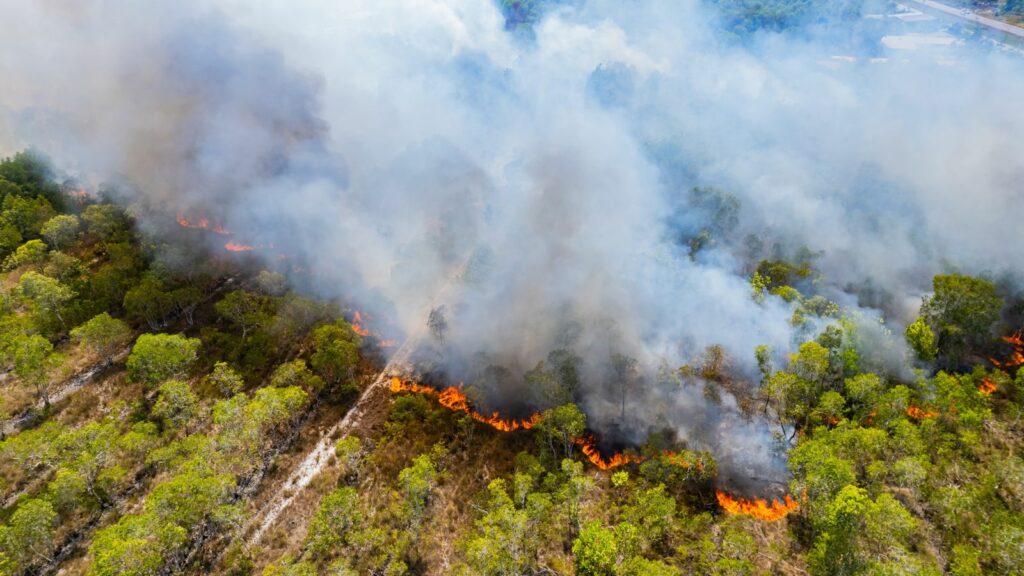
Canada’s wildfire emergency is increasingly exposing a second crisis that begins long before flames reach a community: the shortage of safe, resilient housing in many First Nations. A new report from Federal Housing Advocate Marie-Josée Houle, developed with the Assembly of First Nations, says more than 40,000 First Nations citizens were evacuated during the devastating 2025 wildfire season as longstanding housing and infrastructure gaps magnified the disruption.
The report argues that evacuation cannot be treated simply as a matter of moving people out of danger. Overcrowded homes, buildings requiring major repairs, shortages of replacement housing, fragmented emergency services and slow rebuilding can transform a temporary evacuation into months or even years of displacement. The result, Houle warns, is a recurring cycle in which communities already facing housing shortages enter every wildfire season with fewer options for protecting residents and recovering afterward.
More Than 40,000 People Were Forced From Their Communities
The scale of the 2025 emergency provides the backdrop for the federal housing advocate’s warning. The report describes 2025 as Canada’s second-worst wildfire season on record and says 165 emergency events affected 134 First Nations. By mid-August, more than 40,000 people had already been evacuated, while the completed research identifies at least 88 First Nations communities that experienced evacuations during the season. Those numbers represent thousands of households suddenly needing transportation, accommodation, food, medical care and somewhere safe to remain until authorities determined they could return.
For remote communities, evacuation could itself become a major logistical operation. Some residents had to leave using combinations of aircraft, helicopters, buses, boats and other transportation. In Manitoba, the report says the Canadian Red Cross coordinated approximately 1,500 evacuation flights and 900 cargo flights. Moving people was only the beginning. Residents requiring dialysis, mobility assistance or treatment for chronic conditions needed appropriate care after arriving in host communities. Elders, children and families also had to be kept connected to support networks. The sheer scale demonstrated why the advocate views housing, transportation and emergency planning as interconnected rather than separate policy problems.
The Housing Shortage Was Already Severe Before the Fires
The wildfire emergency arrived on top of a housing deficit that federal auditors had documented well before the 2025 fire season. The Auditor General of Canada reported in 2024 that roughly 119,000 housing units were located in about 600 First Nations communities in the provinces. People in First Nations communities were four times more likely than non-Indigenous Canadians to live in crowded housing and six times more likely to live in housing requiring major repairs. The audit concluded that Indigenous Services Canada and the Canada Mortgage and Housing Corporation had made little meaningful progress despite decades of warnings.
The scale of what remained unfinished was substantial. Based on an Assembly of First Nations estimate, communities needed 55,320 additional homes and repairs to another 80,650 units, with the gap valued at approximately $44 billion at the time. Between 2018-19 and 2022-23, federal programs helped finance 11,754 new units and repairs to 15,859 homes. The Auditor General calculated that this represented only 21% of the new units and 20% of the repairs required to close the identified gap. In a wildfire emergency, shortages such as these leave little spare housing capacity when homes are damaged, residents are displaced or families need temporary accommodation.
Evacuation Can Become a Housing Crisis of Its Own
Getting residents beyond the fire line does not automatically restore stability. The federal housing advocate found major differences in what happened after evacuees arrived in receiving communities. Some municipalities and Indigenous organizations were able to establish culturally appropriate reception spaces and medical supports. Elsewhere, families were divided among different hotels, Elders were removed from familiar support systems and temporary facilities such as arenas and gymnasiums were used while longer-term accommodation was arranged. In Manitoba alone, the report says the Red Cross booked approximately 275,000 hotel nights during the emergency response.
Those experiences matter because displacement can continue well after a wildfire is controlled. If a home is destroyed, seriously damaged or already unsafe before an evacuation, returning to the community may not mean returning to adequate housing. Earlier federal data illustrate how prolonged these emergencies can become. The Auditor General found that, between the 2009-10 and 2021-22 fiscal years, 90 First Nations evacuations lasted longer than three months. Fourteen lasted four years or more. Such timelines can disrupt schooling, employment, health care and family networks, while temporary hotel rooms gradually become something closer to long-term housing. The advocate argues that evacuation planning therefore has to include the entire journey from departure through accommodation, rebuilding and safe return.
Poor Housing Conditions Also Increase the Consequences of Fire
The concern is not limited to wildfires sweeping through forests. Housing conditions can affect how vulnerable residents are to fires of many kinds. Statistics Canada research examining fire-related deaths between 2011 and 2020 found Indigenous people dramatically overrepresented in the available linked mortality data. Of roughly 700 fire-related deaths that could be linked to census or National Household Survey information, 20% involved Indigenous people, even though Indigenous people represented 4.9% of Canada’s population in the 2016 Census. Statistics Canada has also documented substantially higher fire-mortality rates among First Nations people and Inuit than among non-Indigenous people.
The circumstances surrounding those deaths help explain why housing quality has become part of the wildfire-resilience discussion. Indigenous people who died in fires during the study period were 39 years old on average, compared with 59 among non-Indigenous victims. Among Indigenous people who died in residential fires, about 56% had lived in homes requiring major repairs; the equivalent figure for non-Indigenous victims was 13%. About 68% of Indigenous fire victims lived in rural areas, compared with 34% of non-Indigenous victims. Those statistics do not mean inadequate housing causes every fire death, but they demonstrate how poor housing, remoteness, limited fire protection and emergency-response challenges can overlap and amplify risk.
Emergency Management Problems Have Persisted for Years
The federal housing advocate’s concerns also echo findings that Canada’s Auditor General has raised repeatedly. A 2022 audit concluded that Indigenous Services Canada was too heavily focused on responding to disasters instead of helping communities prevent and prepare for them. At that point, the department was spending roughly 3.5 times as much on emergency response and recovery as on preparedness and mitigation. Auditors also identified a backlog of 112 eligible infrastructure projects that could reduce emergency risks but had not been funded. The conclusion was particularly significant because many of the problems had already been identified in a 2013 audit.
A 2025 follow-up found that important gaps remained. During the 2023-24 and 2024-25 fiscal years, First Nations communities experienced more than 560 emergencies involving approximately 150 evacuations. As of April 2025, Indigenous Services Canada had four emergency-management service agreements with provinces, down from six in 2022, and five wildfire agreements, compared with six previously. Four of those five wildfire agreements did not cover every First Nation in the relevant province. The housing advocate’s new research adds the experience of the 2025 wildfire season to that record, arguing that unclear jurisdiction and fragmented responsibilities can leave First Nations governments navigating multiple provincial, federal, municipal and non-governmental systems while an emergency is already unfolding.
Rebuilding Can Be Difficult Even After the Immediate Emergency Ends
A wildfire can destroy housing in hours, but replacing it can take far longer. The housing advocate warns that damage assessments, funding decisions and insurance claims can delay reconstruction, leaving families in hotels or other temporary accommodation long after the evacuation order disappears. That delay becomes especially serious in communities where there was already little available housing. A destroyed home may represent not simply the loss of one residence but the disappearance of housing that several generations depended upon, while overcrowding elsewhere leaves few realistic places for displaced relatives to stay.
Insurance can add another layer of difficulty. The report says First Nations leaders described paying high premiums while sometimes receiving coverage that falls well short of the value of community assets. It gives an example of wildfire protection capped at $10 million for asset portfolios worth considerably more and notes that claims disputes can take months or years to resolve. The advocate is consequently calling for governments and First Nations to explore a First Nations-led insurance model capable of pooling risk and tailoring coverage to community circumstances. The issue is ultimately about recovery speed: every delay in financing repairs or rebuilding increases the chance that what began as an emergency evacuation develops into long-term displacement.
The Advocate Wants Prevention and Housing Treated as the Same Problem
The report’s recommendations move beyond improving evacuation procedures. It calls for a national tripartite emergency-management governance system involving First Nations and federal and provincial governments, stronger First Nations-led fire-safety capacity, and a dedicated climate-emergency housing strategy covering evacuation accommodation, urban reception, rapid return-home funding and climate-resilient reconstruction. It also recommends an Indigenous-led monitoring framework that would track not only how many people were evacuated, but the effects displacement had on housing, health, family stability and community well-being.
The financial challenge is considerably broader than housing alone. An Assembly of First Nations assessment produced with input from Indigenous Services Canada estimated in 2024 that closing the First Nations infrastructure gap by 2030 would require approximately $349.2 billion for needs including housing, water systems, transportation, health facilities, schools and emergency infrastructure. The housing advocate is calling for sustained investment toward closing that gap, including $30 billion identified for climate adaptation. Examples already exist of a prevention-first approach, from Indigenous-led emergency operations to community wildfire mitigation and traditional land-management practices. The report’s central argument is that resilience begins before smoke appears on the horizon: safer homes, stronger infrastructure and locally controlled emergency capacity can determine whether a wildfire remains an emergency or becomes a prolonged housing disaster.
