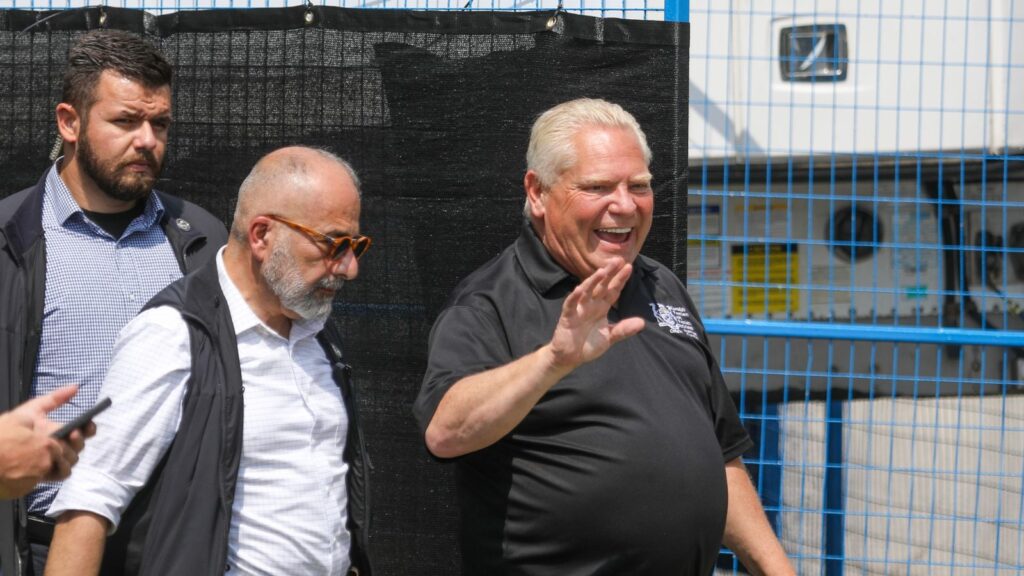
Ontario Premier Doug Ford is drawing a firm line in Canada’s negotiations with the United States, warning that he will not support a trade agreement with President Donald Trump’s administration unless Ontario’s most important industrial sectors believe they can survive and grow under its terms.
Speaking at a business event in Toronto on November 23, 2026, Ford insisted that automakers, steel producers and manufacturers must have an opportunity to assess any proposed agreement before he offers his support.
The warning comes as Ottawa and Washington attempt to revive negotiations that collapsed in August, leaving Canadian businesses exposed to substantial American tariffs.
With thousands of industrial jobs, major manufacturing investments and long-established cross-border supply chains at stake, Ford’s position introduces another challenge for Prime Minister Mark Carney: securing an agreement that satisfies Washington without sacrificing Ontario’s industrial competitiveness.
Ford Makes Industry Approval a Condition for Supporting Any Deal
Premier Doug Ford made his position clear during a November 23 discussion organized by the Toronto Region Board of Trade and the Calgary Chamber of Commerce. Appearing alongside Alberta Premier Danielle Smith, Ford said he would support a Canada-U.S. trade agreement only after Ontario’s automotive, steel and manufacturing industries had reviewed the proposal and determined that their businesses could remain viable. His standard was not simply whether tariffs would decline, but whether companies could continue investing, expanding production and employing Canadian workers.
The declaration creates an important political obstacle for Ottawa, although Ford does not possess a formal veto over federal trade negotiations. The federal government negotiates international agreements, while provincial governments control certain policies that may become part of a negotiated settlement. Ford’s position therefore carries practical consequences. If a proposed agreement requires Ontario to reverse retaliatory measures or change provincial purchasing policies, obtaining the premier’s cooperation could become essential. His message is that an agreement celebrated by political leaders would accomplish little if Ontario’s factories ultimately paid the price.
A Previous American Proposal Explains Ford’s Resistance
Ford’s refusal to offer unconditional support follows the collapse of Canada-U.S. negotiations in August 2026. According to Global News reporting based on sources familiar with those discussions, Washington proposed reducing tariffs on Canadian-made automobiles and parts from 25% to 15%. However, the reported offer lacked a comparable exemption for products qualifying under the Canada-United States-Mexico Agreement, commonly called CUSMA. Canadian automakers, parts suppliers and labour representatives raised concerns that the proposed arrangement could undermine their competitiveness despite the lower headline rate.
The distinction matters because existing American automotive tariffs generally apply differently depending on whether vehicles satisfy North American trade rules. Qualifying vehicles can receive relief for their American content, while qualifying parts receive important exemptions under the current sectoral framework. A lower tariff rate without equivalent protections does not automatically produce a better outcome for every manufacturer. The negotiations also encountered disputes over which vehicle categories would receive relief. For Ford, accepting a permanent arrangement without understanding those consequences would risk locking Ontario manufacturers into an unfavourable competitive position.
Ontario’s Automotive Industry Has Enormous Exposure to the U.S.
Ontario’s dependence on American vehicle buyers helps explain why Ford has made automotive competitiveness a non-negotiable priority. Federal government figures show that Canada produced more than 1.2 million passenger vehicles in 2025, while more than 90% of Canadian-made vehicles were exported to the United States. The Canadian automotive sector supports approximately 125,000 direct jobs, with the substantial majority concentrated in Ontario. Hundreds of thousands of additional jobs depend on related activities, including parts production, transportation, dealerships and services.
These relationships stretch across communities such as Windsor, Oakville, Oshawa, Alliston and Cambridge. Manufacturing jobs at major assembly plants support an extensive network of smaller companies supplying components, equipment and specialized services. When automakers reduce production or reconsider future investment, those decisions can travel through the entire supply chain. Ontario’s 2026 Fall Economic Statement reported that automobile exports to the United States declined 13.7% during the first eight months of 2026 compared with the same period in 2024. For a province heavily invested in automotive production, those figures illustrate why even an apparently modest tariff agreement can have far-reaching consequences.
Ontario’s Steel Industry Is Already Experiencing Severe Trade Pressure
Steel producers face similarly difficult conditions, particularly because American tariffs have directly affected one of their most important export markets. U.S. sectoral duties on many Canadian steel products have reached 50%, significantly reducing their competitiveness against domestic American suppliers. Ontario’s October 2026 economic statement revealed that provincial steel exports to the United States totalled $4.1 billion during the first eight months of 2026, compared with $8.4 billion during the equivalent period in 2024. That represents a decline of 50.6%, illustrating the scale of the industry’s difficulties.
Ontario’s steel sector employed more than 16,000 people in 2025, with production concentrated in industrial communities where major employers play an important economic role. Hamilton and Sault Ste. Marie are particularly important centres of steelmaking activity. Reduced export orders can affect production schedules, employment and the businesses supplying industrial equipment, maintenance and transportation. The province has already participated in financial support measures for steel producers, including assistance for Algoma Steel. Ford’s concern is that an agreement providing inadequate tariff relief could leave these companies dependent on temporary government assistance rather than restoring sustainable commercial opportunities.
The Manufacturing Stakes Extend Beyond Cars and Steel
Ontario’s broader manufacturing economy also has considerable exposure to American trade policy. Federal Economic Development Agency for Southern Ontario briefing materials estimate that approximately 46% of the province’s manufacturing sales are exported to the United States. Ontario government statistics show that the American market accounted for approximately 71.7% of the province’s international merchandise exports in 2025. These figures demonstrate why trade negotiations affect substantially more than a handful of major industrial corporations.
Statistics Canada reported that 50.6% of manufacturing businesses surveyed in the first quarter of 2026 had been negatively affected by American tariffs during the preceding year. For smaller manufacturers, uncertainty can be especially challenging because they may lack the financial resources to absorb prolonged increases in costs or sudden changes in customer demand. Companies producing machinery, fabricated metal components, plastics and specialized industrial products can face difficult choices about pricing, staffing and expansion. Even businesses that do not export directly may depend on customers that do. Ford’s demand for manufacturing-sector approval reflects the risk that an agreement benefiting some industries could leave other parts of Ontario’s industrial economy exposed.
Getting Every Automaker to Agree Could Be More Difficult Than It Sounds
Ford’s proposed industry approval requirement presents an additional challenge: Ontario’s automotive manufacturers do not necessarily agree on which trade concessions are acceptable. Reporting by The Globe and Mail has highlighted differences between the Detroit Three automakers—Ford Motor Company, General Motors and Stellantis—and Japanese manufacturers Honda and Toyota. The Detroit Three have placed considerable emphasis on securing tariff relief quickly, while Honda and Toyota have expressed concerns about accepting arrangements that could permanently weaken the competitiveness of their Canadian production.
The differences partly reflect the vehicles these companies manufacture, their supply chains and the amount of American content incorporated into their products. Ottawa has also considered a tradeable import-credit system that would reward companies for manufacturing vehicles in Canada. That proposal has generated differing responses because some manufacturers produce substantially more vehicles in Canada relative to their domestic sales than others. These competing interests mean Ford’s demand for industry approval cannot necessarily be satisfied through a single endorsement. A workable agreement may require negotiations with automakers, parts suppliers and labour representatives whose immediate priorities differ considerably.
Ontario Has Its Own Trade Measures That Give Ford Leverage
Although Canada negotiates international trade agreements at the federal level, Ontario retains control over certain decisions that matter to Washington. One prominent example is the provincial government’s restriction on American alcoholic beverages. In March 2025, Ontario directed the Liquor Control Board of Ontario to stop purchasing and selling U.S.-made products in response to American tariffs. At the time, the LCBO reported annual sales of American products worth up to $965 million, demonstrating the commercial significance of access to Ontario’s market.
Provincial procurement rules provide another negotiating consideration. Ontario’s Buy Ontario Procurement Directive includes restrictions affecting qualifying American businesses seeking public-sector contracts. These policies are important because Washington has identified provincial alcohol restrictions and other Canadian trade measures as sources of friction. Global News reported that potential Canadian concessions involving alcohol sales and procurement access have featured in discussions surrounding a possible agreement. Consequently, Ford’s refusal to cooperate could complicate Ottawa’s ability to deliver certain commitments. He cannot independently determine Canada’s international trade policy, but he can influence how provincial measures are handled in a broader settlement.
Ford Previously Supported Carney’s Decision to Reject an Agreement
Ford’s latest warning represents a continuation of the position he adopted when negotiations collapsed in August. On August 22, the Ontario premier publicly supported Prime Minister Mark Carney’s decision to reject the American proposal, arguing that its terms were unacceptable for Ontario’s automotive and steel industries. Ford emphasized that trade agreements can shape industrial investment for years, making it particularly important to avoid concessions that deliver temporary political relief while damaging long-term economic prospects.
The premier had already outlined a more confrontational strategy in an August 17 letter to Carney. He urged Ottawa to consider retaliatory tariffs against imports from politically significant American states and to examine how Canada’s strategic economic assets could strengthen its negotiating position. Carney subsequently announced retaliatory tariffs in response to additional American duties after negotiations failed. Despite representing different political parties, the two leaders found common ground in rejecting the proposed settlement. Ford’s current position suggests that this cooperation will continue only if Ottawa delivers an agreement capable of protecting the industrial sectors most exposed to American trade restrictions.
Washington Says Negotiations Are Progressing, but Ottawa Remains Cautious
American and Canadian officials have recently offered different assessments of how close the two countries are to reaching an agreement. On November 22, U.S. Trade Representative Jamieson Greer told Fox News that negotiations had made substantial progress and that both governments were approaching a potential compromise. However, he also identified concerns about Canada’s expanding commercial relationship with China, particularly measures involving Chinese electric vehicles and steel and aluminum products.
Canadian officials have sounded less confident about an imminent breakthrough. According to Global News, Canada’s chief trade negotiator, Janice Charette, told a federal advisory committee on November 19 that multiple unresolved trade issues continued to prevent an agreement. Ottawa’s official account of that meeting confirmed that negotiations and the effects of American tariffs were discussed, although it did not publicly detail every outstanding disagreement. The federal government is pursuing an interim arrangement intended to reduce trade barriers and create conditions for broader CUSMA negotiations. Ford’s intervention adds another consideration to these discussions: an agreement must not only satisfy federal negotiators but also withstand scrutiny from industries directly affected by its provisions.
Ford’s Oakville Plant Reopening Shows What’s at Stake
The importance of maintaining Ontario’s automotive manufacturing base was demonstrated on November 20, when Ford Motor Company celebrated the transformation of its Oakville Assembly Complex. The automaker completed a nearly $5 billion investment to retool the facility for production of F-Series Super Duty trucks, including the addition of a major stamping operation. The project supports more than 2,000 production and skilled-trades employees in Oakville and connects with Ford’s engine manufacturing operations in Windsor and Essex.
The federal government announced $464.5 million in support through its Strategic Response Fund, while Ontario announced a substantial provincial contribution. The upgraded Oakville facility is designed to manufacture as many as 100,000 vehicles annually, depending on production requirements. Its reopening represents an important industrial milestone during a period of uncertainty for Canadian automotive manufacturing. The contrast is difficult to overlook: governments are investing substantial public resources to secure vehicle production while negotiating tariffs that could influence where future vehicles are manufactured. For Ford, the Oakville project demonstrates why trade agreements must protect the commercial conditions necessary to keep Canadian factories competitive.
The Looming Tariff Deadline Adds Pressure to Reach an Agreement
The immediate challenge for negotiators is that the existing tariff dispute could become considerably more damaging. President Trump has threatened to increase American tariffs on Canadian-made vehicles, automotive parts and steel to 50% beginning January 1, 2027. Automotive executives have warned that such an increase could seriously disrupt North American production networks. Reuters reported that Honda and Toyota are particularly exposed because of their substantial Canadian manufacturing operations and dependence on American customers.
That looming deadline creates competing pressures. Manufacturers urgently need relief from tariffs already affecting their operations, but accepting an unfavourable agreement could create problems lasting well beyond 2027. Ford’s demand effectively places long-term industrial competitiveness alongside the immediate need for stability. Ottawa must determine whether the concessions available from Washington represent a sustainable improvement or merely a temporary reduction in economic pressure. With major automotive investments requiring years of planning, manufacturers need dependable rules rather than repeated tariff threats and last-minute negotiating changes. The approaching deadline makes reaching an agreement increasingly important without eliminating the risks of accepting the wrong one.
The Bigger CUSMA Negotiations Will Determine Ontario’s Long-Term Future
Even a successful interim agreement would not resolve every question surrounding North American trade. The Canada-United States-Mexico Agreement entered into force on July 1, 2020, and underwent its first scheduled joint review in July 2026. During that process, Washington declined to renew the agreement in its existing form. Importantly, that decision did not immediately terminate CUSMA. The agreement remains in effect, with annual reviews required until the participating countries agree to an extension or the agreement reaches its scheduled 2036 expiry.
For Ontario, the long-term negotiations may prove even more consequential than the immediate tariff dispute. Future rules governing regional automotive content, market access and the treatment of Canadian manufacturing could influence investment decisions for years. An automaker considering a new assembly line must evaluate whether production in Canada will remain commercially attractive throughout the life of that investment. Ford’s position highlights this broader concern. His willingness to support a deal depends on whether Ontario’s industrial employers believe they can operate successfully under its terms. Until those assurances emerge, the premier is signalling that ending the political dispute cannot come at the expense of the factories and workers his government is trying to protect.
