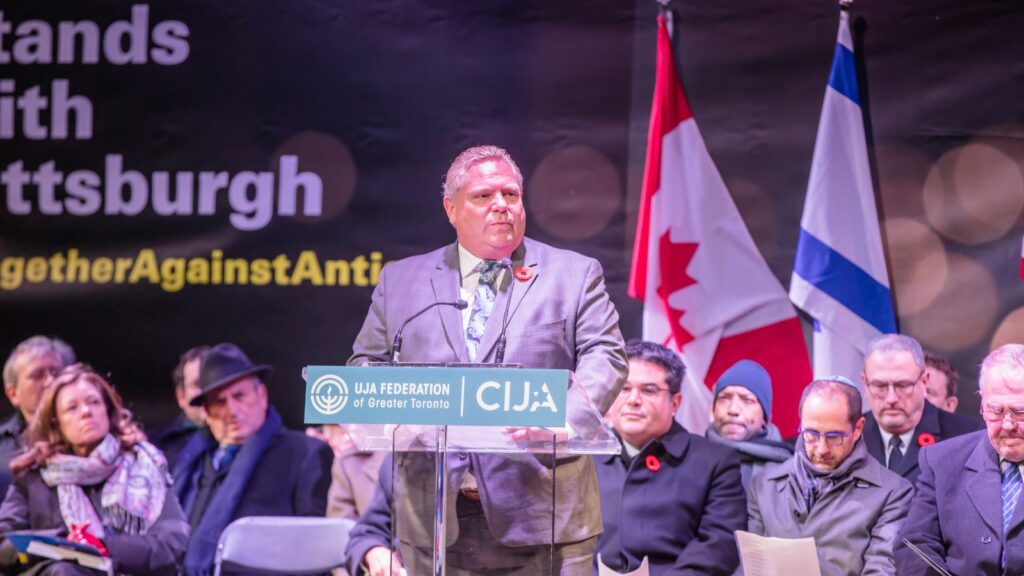
Ontario politics has swung sharply in a month, with Premier Doug Ford’s Progressive Conservatives moving back ahead of the Ontario Liberals just as the Canada-U.S. trade confrontation intensifies. A new Liaison Strategies poll puts the PCs at 39% among decided and leaning provincial voters, compared with 35% for the Liberals, while 83% support matching new U.S. tariffs dollar for dollar.
Yet the same voters are drawing a striking distinction between Queen’s Park and Ottawa. Asked about their federal preference, Ontario respondents give Mark Carney’s Liberals a 48%-36% advantage over the Conservatives. That 48%-36% figure applies specifically to Ontario respondents; Liaison’s separate national tracker has the Liberals ahead 43%-32%. Together, the numbers reveal an electorate prepared to reward different parties at different levels while demanding a hard response to Washington.
The PCs Have Reversed a Five-Point Deficit in Just One Month
The provincial movement is substantial by the standards of a monthly political tracker. Liaison’s July poll had the Ontario Liberals at 38% among decided and leaning voters and the PCs at 33%, leaving Ford’s party five points behind. The August 23-24 wave instead puts the PCs at 39%, the Liberals at 35% and the NDP at 20%. Compared with July, that represents a six-point PC increase, a three-point Liberal decline and a four-point NDP decline. Rather than simply tightening, the ordering of the parties has changed completely.
The timing makes the shift especially noteworthy. Liaison questioned 1,500 Ontarians as new U.S. tariffs were taking effect and Ford was escalating his confrontation with Donald Trump. The poll used interactive voice response and random-digit dialling across landlines and cellphones, with results weighted to 2021 Census benchmarks. Its reported overall margin of error is plus or minus 2.5 percentage points, 19 times out of 20. That means the four-point PC advantage should still be treated as a competitive race rather than evidence that Ford has suddenly rebuilt the commanding position his party enjoyed at the 2025 provincial election.
Ford Is Recovering Politically Without Becoming Popular Again
Ford’s personal numbers tell a more complicated story than the party standings. His job approval has risen to 36%, a 12-point recovery from the 24% recorded by Liaison in July. Disapproval has fallen from 72% to 61%. For a premier who had reached the lowest approval level measured in Liaison’s Ontario tracker a month earlier, that is a meaningful improvement and coincides with a period in which Ford has positioned himself as one of Canada’s most combative political voices against Trump.
The rebound has not erased broader dissatisfaction with the provincial government. Only 27% of respondents say Ontario is moving in the right direction, while 72% believe it is heading in the wrong direction. Those figures barely changed from July, when the split was 26%-71%. The contrast matters: voters can approve of a politician’s handling of a highly visible external threat without becoming satisfied with healthcare, affordability, housing or the general direction of government. It is also too early to establish that the tariff fight caused Ford’s recovery. What can be said is that the change happened while trade displaced the domestic controversies that had dominated coverage around Queen’s Park in July.
Matching U.S. Tariffs Has Become an Overwhelmingly Popular Position
The clearest message in the poll concerns retaliation. Eighty-three percent of respondents support imposing Canadian tariffs on American goods equal in value to the latest U.S. tariffs, including 44% who strongly support the approach. Even more — 85% — support keeping American beer, wine and spirits out of LCBO stores until Canada reaches a satisfactory trade agreement with Washington. Nearly half, 49%, strongly back maintaining the alcohol restriction. Another 72% favour charging more for electricity exported from Ontario to the United States while continuing to supply it.
Those ideas closely resemble measures Ford presented to Carney in an August 17 letter calling for a coordinated response that could include dollar-for-dollar tariffs, strategically targeted U.S. states, electricity and critical-mineral leverage and continued restrictions on American alcohol. Since the poll was conducted, Ottawa has moved from principle to implementation. The federal government announced counter-tariffs on C$27.6 billion of U.S. products beginning September 8, matching Washington’s new Section 338 measures dollar for dollar. Rates of 15%, 25% and 50% will apply across sectors including steel and aluminum, dairy, appliances, agricultural equipment, pulp and paper, plastics and electronics. In other words, an idea enjoying 83% support in Ontario is no longer hypothetical federal policy.
Voters Want Retaliation, but Their Appetite Has Clear Economic Limits
Broad support for fighting back does not mean Ontarians are indifferent to the cost. When respondents were forced to weigh pressure on the United States against economic consequences at home, 42% favoured stronger measures even if they generated additional costs in Ontario. Another 35% wanted equal weight placed on retaliation and economic risk, while 18% preferred limiting measures in order to reduce those costs. The result suggests that the political mandate is strongest for understandable measures such as reciprocal tariffs and the LCBO boycott, and less unconditional when retaliation begins threatening jobs, prices or strategic industries.
That caution becomes clearer inside the Conservative coalition. Among federal Conservative voters in the Ontario sample, only 10% favour stronger retaliation even when it creates additional economic costs. Forty-one percent prefer balancing pressure with economic risk, while 43% prioritize limiting the economic damage. Across all respondents, additional tariffs are the most preferred action at 32%, ahead of more financial assistance for affected workers and businesses at 17%, restrictions on electricity or critical-mineral exports at 16%, and the American-alcohol ban at 15%. Export restrictions are also the option most often identified as concerning, at 24%. Ottawa appears conscious of that tension: alongside its counter-tariffs, the federal government announced a C$7.5-billion support package for tariff-affected workers and businesses.
Ontario Is Splitting Its Provincial and Federal Votes in Opposite Directions
Perhaps the most politically intriguing result is that Ford’s provincial recovery has not translated into a federal Conservative advantage. Among Ontario respondents who are decided or leaning federally, the Liberals lead the Conservatives 48% to 36%, while the NDP sits at 11%. That creates an unusual snapshot: the same electorate currently gives Ford’s PCs a four-point provincial advantage while preferring Carney’s Liberals federally by 12 points. It is a reminder that Canadian voters do not necessarily treat provincial and federal party brands as interchangeable.
There is also an important distinction between the 48%-36% figure in Ontario and Canada-wide voting intentions. Liaison’s separate federal tracker, conducted from August 9 through August 22, placed the Liberals nationally at 43%, the Conservatives at 32% and the NDP at 13%. Carney’s approval in that national tracker stood at 59%. More recent evidence indicates that his decision to break off trade negotiations has also attracted broad support: Reuters reported an Angus Reid finding showing 76% approval for Carney’s decision to suspend the talks. The durability of that support is less certain. The same trade confrontation producing political solidarity today could look different if layoffs, factory disruptions and higher consumer costs become more visible.
The Regional and Gender Divides Show Why Neither Party Can Relax
The Ontario topline hides sharply different political maps. The Liberals lead strongly in Toronto, 44% to 29%, while the PCs hold only a narrow 41%-38% edge in the vote-rich 905 region surrounding the city. Ford’s party performs much better elsewhere, reaching 47% in South Central Ontario and 42% in both Northern and Southwestern Ontario. Those numbers help explain how the PCs can lead province-wide even while losing Canada’s largest city by 15 points. For the Liberals, closing a three-point gap in the 905 could become considerably more consequential than adding votes where they are already dominant.
Gender divides are just as striking. Women favour the Ontario Liberals 41%-33%, while men favour the PCs by a much larger 46%-30% margin. Such subgroup results should be interpreted more cautiously than the province-wide totals because fewer respondents are contained in each category, but the political pattern is unmistakable. Ford won a third consecutive majority in 2025 after making resistance to Trump’s threatened tariffs a central campaign argument. The newest numbers suggest that issue may again be giving the premier political room to recover. Still, a 61% disapproval rating and 72% wrong-track reading leave substantial vulnerability. The trade fight has changed Ontario’s political conversation; it has not erased the frustrations that existed before it.
