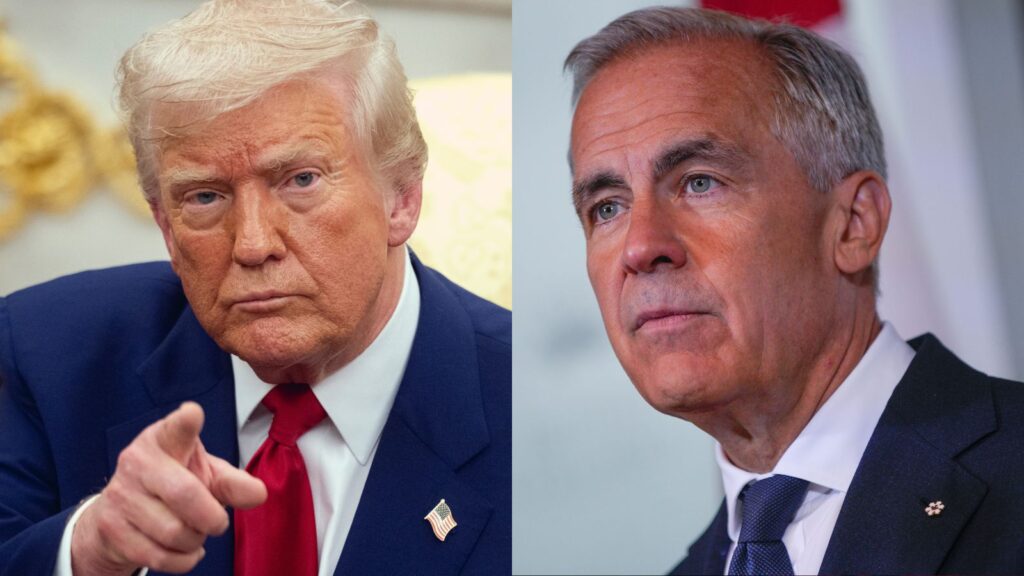
An unexpected endorsement of Canadian Prime Minister Mark Carney is coming from someone who once worked inside Donald Trump’s White House. Anthony Scaramucci, the former White House communications director who has become a prominent Trump critic, believes Carney has emerged as a leading Western voice in dealing with the American president.
In an October 13, 2026, interview with The Big Story podcast, Scaramucci discussed why he considers Carney’s handling of Trump particularly effective, even as Canada and the United States remain caught in a damaging trade dispute.
His assessment comes at a difficult moment for both countries. Washington has refused to renew their North American trade agreement in its current form, new tariffs have disrupted businesses, and Ottawa is pursuing stronger international partnerships. Behind Scaramucci’s praise lies a larger question about Canada’s economic influence and its changing relationship with its most important trading partner.
Scaramucci’s Praise Comes From a Former Trump Insider Who Now Opposes Him
The praise did not come from a serving White House official. Anthony Scaramucci led Trump’s communications operation for a brief period in 2017, after being selected in July of that year. He is now a financier and commentator whose relationship with Trump has deteriorated. On October 13, the podcast The Big Story featured Scaramucci discussing Canada’s trade dispute and why he believes Carney “leads the West.” Host Caryn Ceolin presented the discussion as a look at American attitudes and Ottawa’s response to Washington.
That description should not be mistaken for a consensus among Western governments, or an endorsement by Trump’s administration. It is Scaramucci’s personal appraisal of Carney’s approach. His public criticism of Trump is an important part of the context: Scaramucci has become an outspoken opponent of the MAGA political movement. Still, his experience in Trump’s orbit helps explain why Canadians might pay attention to his assessment of political tactics.
A Three-Decade Friendship With Carney Helps Explain the Unusual Endorsement
Scaramucci’s view is also rooted in a longstanding personal relationship. In a September 22 episode of The Herle Burly podcast, he described knowing Carney for roughly three decades, dating back to the pair’s Goldman Sachs years. The episode’s description characterized Carney as the strongest Western leader at managing Trump, “not even close.” Scaramucci showed host David Herle a photograph involving Carney at his annual Davos wine gathering, a revealing detail about how familiar the two men are.
Carney’s background helps explain why a finance veteran might admire his methods. Before entering electoral politics, he spent 13 years at Goldman Sachs, led the Bank of Canada from 2008 to 2013 and subsequently governed the Bank of England until 2020. Those jobs involved balancing market expectations, political pressure and international coordination. But personal familiarity is not an independent measure of diplomatic achievement; Scaramucci’s praise is an insider’s opinion, not an economic result.
The Tariff Fight Has Made Canada’s Relationship With Washington More Confrontational
Scaramucci’s compliment lands amid costs, not merely diplomatic friction. After Ottawa suspended negotiations in August, Washington imposed a 50% tariff on selected Canadian imports worth C$27.6 billion, effective August 22. Canada’s Finance Department says it answered with product-specific counter-tariffs of 15%, 25% and 50% starting September 8, covering an equivalent value of American goods. Steel, appliances, electronics and agricultural equipment were among the targeted categories. These measures do not mean every cross-border purchase attracts a 50% charge.
Trump’s administration argues that Canadian policies discriminate against American automobiles, pointing to import tariffs and quotas as evidence. Ottawa disputes that characterization, saying its actions defend Canadian workers and match U.S. restrictions. For factories purchasing parts on both sides of the border, the argument has practical consequences: a new duty can force a price increase, a supplier change or an altered delivery schedule. This is the economic backdrop to Scaramucci’s enthusiastic assessment of Carney.
Washington’s Refusal to Renew CUSMA Leaves Businesses Facing Another Layer of Uncertainty
The uncertainty reaches the agreement that governs North American commerce. On July 1, U.S. Trade Representative Jamieson Greer announced that Washington would not renew the United States–Mexico–Canada Agreement in its current form. Canada calls the same pact CUSMA. Yet the American decision did not cancel the agreement or instantly impose tariffs on every qualifying shipment. The trade framework remains in force, with an expiry in 2036 unless the countries agree to extend it or take other action.
Canada’s trade minister, Dominic LeBlanc, has stressed that the countries can renew the pact for another 16-year term. But businesses cannot plan investments around legal survival alone; they need confidence about rules governing factories, supply chains and border costs. A Canadian auto-parts executive weighing where to install new equipment must consider whether today’s trade preferences will survive negotiations. For Carney, protecting predictable market access may be consequential than winning praise from an American commentator.
American Republicans Are Also Questioning the Economic Cost of Trump’s Tariff War
Not all American voices support continuing the tariff confrontation. On October 7, Michigan Republican Senate candidate Mike Rogers called for ending the Canada–U.S. tariff fight, although he had previously defended Trump’s approach. In an advertisement filmed at a neighbourhood bar, Rogers held a bottle of Canadian Labatt Blue and stressed that Canada was not America’s enemy. His appeal reflected Michigan’s reliance on cross-border vehicle production, where factories and parts suppliers operate as a deeply connected regional system.
His shift matters because criticism of the trade war is not limited to former officials such as Scaramucci or Trump’s Democratic opponents. It has entered competitive Republican races as businesses and consumers confront higher costs. Rogers’s Democratic rival, Abdul El-Sayed, accused him of changing positions for electoral reasons. That dispute is a reminder that cross-border commerce has become a domestic American political issue. Keeping factories competitive requires more than rhetorical confrontation with Ottawa.
Canadian Approval of Carney Has Risen Even as Confidence in Negotiations Remains Divided
Polling shows why a confrontational posture can bring political rewards at home. In a September 8 release, Angus Reid Institute reported that 62% of Canadians approved of Carney’s performance, up 11 points since August. Three-quarters had supported his decision to suspend negotiations rather than accept new U.S. terms. Yet respondents did not agree that Canada held the stronger hand: 31% considered Ottawa’s negotiating position strong and 34% weak.
Angus Reid polling painted a different picture across the border. Among Canadians, 79% viewed Trump unfavourably, while 45% reported positive feelings toward Americans. In a separate U.S. sample, 79% expressed favourable views of Canadians and 59% opposed the latest tariff threat. The findings highlight a tension politicians must manage. Anger at an administration does not necessarily amount to hostility toward its population, and an unpopular trade war can still leave voters unsure about Canada’s bargaining power. Scaramucci’s perspective fits within that distinction.
Falling Employment Numbers Are Adding Pressure to Canada’s Trade Strategy
Behind diplomacy, Canadians are judging policy by jobs and household finances. Statistics Canada’s labour report showed employment falling by 68,000 in September, after a 42,000 decline in August. Manufacturing lost 13,000 positions in September, and the national unemployment rate edged up to 6.5%. The largest declines were in education, health care and social assistance, while young workers accounted for 48,000 lost jobs. Those figures describe a weakening labour market, but they do not establish that American tariffs caused every loss.
For an auto supplier or steel fabricator, uncertainty can still influence choices. If a customer postpones an order or cannot estimate future duties, managers may delay hiring or equipment purchases rather than gamble on demand. Ottawa has unveiled a C$7.5-billion package of relief and industrial support in response to the tariff escalation. Whether that support cushions affected firms will depend on eligibility, delivery and how long the trade confrontation lasts.
Canada’s Latest Trade Figures Show Why Replacing the U.S. Market Will Be Difficult
Trade figures offer a reminder of Canada’s reliance on American customers. Statistics Canada reported exports to the U.S. rising 8.1% in August 2026, while exports to destinations elsewhere fell 8.5%. Canada’s merchandise surplus with the United States widened to C$11.2 billion, even as the bilateral relationship deteriorated. Officials cautioned that buyers may have brought shipments forward to beat tariffs taking effect that month, so the surge does not prove trade tensions eased.
That paradox shapes Carney’s dilemma. A Canadian manufacturer may want additional customers in Europe or Asia, but established American distributors remain its fastest route to market. Changing product standards, transport contracts and financing relationships takes time. Canada says trade diversification is a strategic priority, yet recent shipments show how hard it is to replace the convenience of the U.S. market. A credible policy must protect current trade while opening other options, rather than treating those goals as alternatives.
Carney’s Search for Partners Extends From Europe to India and Türkiye
Carney’s response has been to expand Canada’s choices rather than rely on a return to normal with Washington. In September, he addressed the European Parliament and welcomed a plan for deeper Canada–EU ties, potentially including an unprecedented associate relationship. The idea remains a proposal, not approved EU membership. Brussels is a significant partner: Canada’s government valued two-way goods-and-services trade with the EU at about C$178 billion in 2025, while cooperation on defence procurement has broadened through the SAFE initiative.
The outreach is extending elsewhere. On October 13, Carney’s office announced that Indian Prime Minister Narendra Modi plans to visit Canada in December, with both leaders seeking progress toward a comprehensive economic partnership. Carney is also scheduled to visit Türkiye from October 21 to 24 to discuss trade, energy and defence. These openings could produce new demand for Canadian businesses, but new partnerships take years to match established American supply chains.
The Real Test of Western Leadership Will Be Whether Diplomacy Delivers Results
Diplomatic channels nevertheless remain open. On October 8, U.S. Trade Representative Jamieson Greer said Washington was “holding fast” in its stance and speaking frequently with Canadians. He said Washington would negotiate when Canada was ready to reach agreement. Ottawa maintained that it would not accept terms it considered unfair. Carney also spoke with Trump on October 11 about a proposed Ukraine energy ceasefire, demonstrating that cooperation can continue despite the trade dispute.
Whether Carney “leads the West” requires more evidence than Scaramucci’s judgment. The practical tests are whether CUSMA survives, sectoral tariffs ease, Canadian exporters develop additional markets and workers see stable employment. Carney can pursue diplomatic ties, defend sovereignty and build new alliances simultaneously, but there are costs: a firm stance may impose immediate pain while strengthening leverage. The outcome will be decided at negotiating tables and factory floors, not by the praise a leader receives in an interview.
