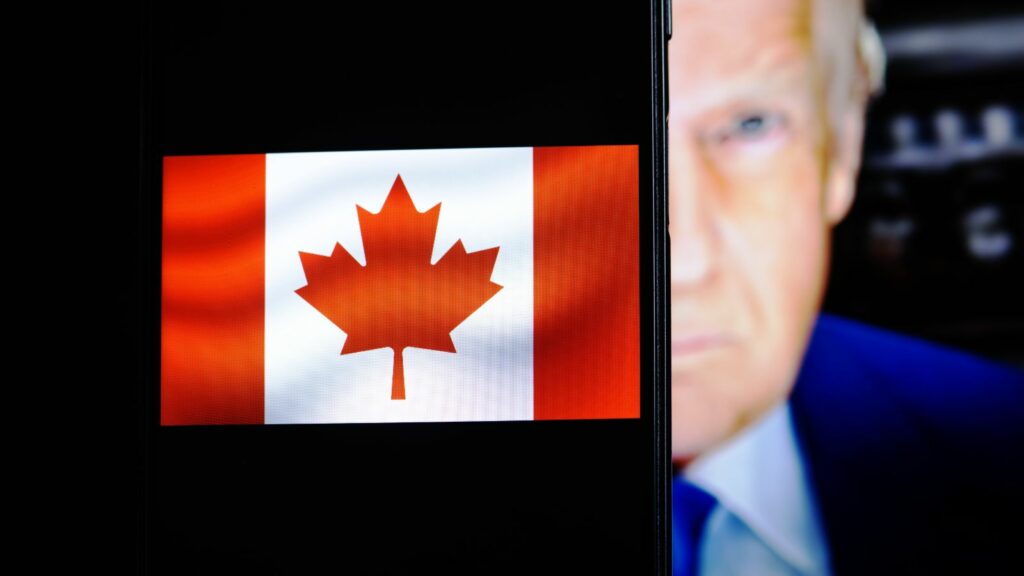
The Canada-U.S. trade fight is moving beyond tariffs and directly into the machinery of government purchasing. President Donald Trump has ordered the U.S. General Services Administration and the U.S. Trade Representative to begin removing Canadian-origin products from a major federal contracting system, unless Canada provides what he calls “full and fair reciprocity” to American businesses.
The move arrived as Canadian counter-tariffs took effect and Washington announced additional restrictions on Canadian imports, widening a dispute that already touches manufacturing, agriculture and cross-border supply chains. The procurement action is especially significant because government contracts have long been governed by a separate network of international commitments. For Canadian companies that built U.S. federal sales into their business plans, the newest front in the trade conflict creates another layer of uncertainty.
Trump’s Directive Targets a Major Federal Buying System
Trump directed GSA to work with USTR to take what he described as all necessary steps to remove Canadian-origin products from the agency’s Multiple Award Schedules. USTR subsequently put a striking figure on the action, saying the president had ordered the removal of $50 billion worth of Canadian-origin products from those schedules. Trump said the restriction could be reversed if Canada restores what his administration considers reciprocal access for American companies and farmers.
The wording matters because this was an instruction to begin taking action, rather than a public notice that every affected product had already disappeared overnight. As of the initial announcements, neither GSA nor USTR had released a detailed implementation timetable showing which contracts, catalog listings or product categories would be removed first. That distinction is important for suppliers trying to determine whether existing orders will continue normally, whether future orders will be blocked, or whether individual Schedule contracts will require modification.
The Multiple Award Schedule Is Much Bigger Than a Typical Contract
GSA’s Multiple Award Schedule, commonly called MAS, is one of Washington’s largest purchasing channels. Rather than requiring every federal department to negotiate separately for commonly available commercial products and services, MAS provides long-term government-wide contracts through which agencies can buy from approved vendors under negotiated terms. GSA reported $52.5 billion in MAS sales during fiscal 2025, up from $50.3 billion a year earlier.
That figure helps explain why the Canadian directive is attracting attention, but it should not be confused with USTR’s separate claim that $50 billion worth of Canadian-origin products will be removed. GSA’s $52.5 billion represents annual sales across the entire MAS program, while USTR has not publicly explained the methodology behind its Canadian-product figure. The numbers therefore are not directly interchangeable. What is clear is that MAS is not a niche purchasing portal. Losing access can remove an important route through which businesses compete for recurring federal demand.
Washington Says the Fight Is About Procurement Reciprocity
Trump has accused Canada’s federal and provincial governments of shutting American small businesses and other companies out of Canadian government purchasing. That argument comes as Ottawa has been deliberately increasing the role of domestic preference in federal procurement. Canada’s Buy Canadian framework took effect in December 2025, giving stronger priority to Canadian suppliers, materials and economic content in government purchasing.
The policy has since widened. Canada lowered the threshold for its strategic procurement preference from $25 million to $5 million in June 2026, greatly increasing the number of projects potentially affected. Large construction and defence projects also face requirements involving Canadian-produced steel, aluminum and wood in qualifying circumstances. Still, describing the entire Canadian procurement market as closed to Americans would be too broad. Canada’s reciprocal procurement rules allow foreign businesses to participate when relevant trade agreements provide access, while different exemptions, thresholds and procurement categories determine which rules apply in individual competitions.
Canada-U.S. Procurement Rights Sit Outside CUSMA’s Main Procurement Chapter
One of the most important details is that Canada and the United States do not rely primarily on CUSMA’s government-procurement chapter for access to each other’s public contracts. Canada is not covered by Chapter 13 of CUSMA. Instead, the two countries agreed when the agreement was negotiated that their government-procurement relationship would continue largely through the World Trade Organization’s Agreement on Government Procurement, or GPA.
The GPA provides reciprocal access to specified federal and subnational procurement markets above defined thresholds. Canada has pointed out that its companies receive access to covered procurement in 37 U.S. states through those commitments, while U.S. suppliers receive corresponding rights in covered Canadian markets. That makes the latest confrontation legally more complicated than a conventional tariff dispute. Depending on how Washington implements the Canadian exclusion, questions could emerge about which purchases remain covered by GPA commitments, which are exempt, and whether the restriction becomes the subject of formal trade consultations or challenges.
The Procurement Order Landed as Canada’s Counter-Tariffs Took Effect
The timing was not accidental. Canada’s newest countermeasures against U.S. goods took effect on September 8, the same day Trump announced the procurement directive. Ottawa said it was imposing tariffs of 15%, 25% and 50% on C$27.6 billion worth of American imports, with rates designed to match U.S. measures imposed on Canadian products. The targeted categories include steel, dairy, appliances, agricultural equipment, pulp and paper, electronics and other manufactured goods.
Canada framed the response as dollar-for-dollar retaliation after Washington imposed 50% duties on C$27.6 billion of Canadian goods in August. Ottawa also announced a C$7.5 billion package of new and expanded assistance for workers and businesses coping with the trade conflict, on top of previously announced support. The procurement dispute therefore did not develop in isolation. It became another retaliatory instrument layered on top of an increasingly complicated network of tariffs, business support programs and politically targeted trade measures.
Washington Is Expanding the Fight Beyond Import Taxes
Federal procurement was only one part of Washington’s September 8 response. Trump also used Section 338 of the Tariff Act of 1930 to move certain Canadian products from punitive tariffs toward outright import exclusions. White House proclamations set a September 29 effective date for bans covering specified Canadian goods, including products connected to the dairy and motor-vehicle disputes. Other announced restrictions also affected Canadian alcohol and motorcycles.
Section 338 gives the president authority to respond when the administration determines another country is discriminating against U.S. commerce, including through additional duties and, in certain circumstances, import exclusions. The Trump administration had already used the provision to impose 50% tariffs on selected Canadian products during the summer. Adding procurement restrictions changes the nature of the confrontation again. Instead of relying only on border charges, Washington is increasingly using access to the American marketplace itself—both commercial and governmental—as leverage in negotiations with Ottawa.
Canadian Companies Already Sit Inside the GSA Contracting System
The companies potentially caught in the procurement dispute are not merely theoretical entries in a trade database. GSA’s own eLibrary has listed Canadian-based Schedule contractors in industries ranging from healthcare equipment to electronics and specialized manufacturing. Records have included Stance Healthcare in Kitchener, Ontario; Cadex Electronics in Richmond, British Columbia; and General Starlight in Woodbridge, Ontario.
Those examples do not establish that each company will lose specific orders under Trump’s directive. Actual exposure will depend on how GSA defines Canadian origin, which product listings are targeted and how existing contracts are handled. They do, however, illustrate why procurement restrictions can reach much further than household-name exporters. A Canadian manufacturer may have spent years completing federal registration, compliance work and contract negotiations to gain Schedule access. If its products are subsequently removed for reasons unrelated to its own performance, a potentially valuable government sales channel can disappear even though the company remains capable of supplying American customers.
U.S. Government Buyers Could Face Consequences Too
The Schedule system exists partly because Washington wants federal agencies to avoid repeatedly rebuilding the same purchasing process. GSA describes MAS as a streamlined channel through which government buyers can obtain commercial products and services from vetted contractors using negotiated prices and standardized terms. The agency reported more than $52 billion in MAS volume in fiscal 2025 and said its broader acquisition programs generated $7.1 billion in savings for customer agencies.
Removing Canadian-origin offerings could therefore affect more than Canadian vendors. Depending on the products involved, American government buyers may need to select alternative suppliers, use different contracting vehicles or revisit purchasing plans. In categories where several substitutes exist, the adjustment could be modest. Where Canadian manufacturers occupy specialized niches, replacing them could take longer or change costs. None of those outcomes is guaranteed, because GSA has not yet published enough implementation detail to measure the effect, but procurement policy can impose consequences on the buyer as well as the excluded seller.
The Wider Trade Relationship Makes Every New Restriction More Significant
Canada and the United States remain deeply intertwined despite the deterioration in political relations. USTR estimates that two-way U.S. trade in goods and services with Canada totaled about US$872.3 billion in 2025. Statistics Canada reported that the United States still absorbed 71.7% of Canadian merchandise exports that year, even after that share fell from 75.9% in 2024 as Canadian exporters expanded activity in other markets.
More recent figures underline how much trade still crosses the border. Canada exported roughly C$50.5 billion in merchandise to the United States in July 2026 alone. Federal procurement represents only one portion of that broader relationship, but its symbolism is unusually strong. Government purchasing rules are normally designed to provide companies with predictable, long-term access. Turning those rules into retaliatory leverage tells businesses that trade tensions can reach contracts once considered relatively insulated from headline tariff battles, potentially encouraging firms on both sides of the border to rethink sourcing and market concentration.
The Next Test Will Be How GSA Turns Trump’s Order Into Contracting Rules
The most important developments may now come from contracting offices rather than presidential statements. Companies will be watching for formal GSA instructions explaining whether Canadian-origin products are removed through catalog modifications, contract suspensions, country-of-origin restrictions or some other mechanism. Treatment of orders already placed, existing agreements and products incorporating components from several countries will also matter considerably to businesses trying to calculate their exposure.
Another question is how Ottawa responds. Reuters reported that the Canadian government had not immediately commented when Trump first announced the procurement directive. Canada could challenge aspects of the measure diplomatically, raise its WTO procurement commitments, adjust its own purchasing rules or fold the issue into renewed bilateral negotiations. Until implementation details emerge, the safest conclusion is narrower than some of the political rhetoric: Trump has ordered a potentially substantial contraction of Canadian access to an important U.S. federal procurement channel, but the precise commercial impact will depend on what GSA does next.
