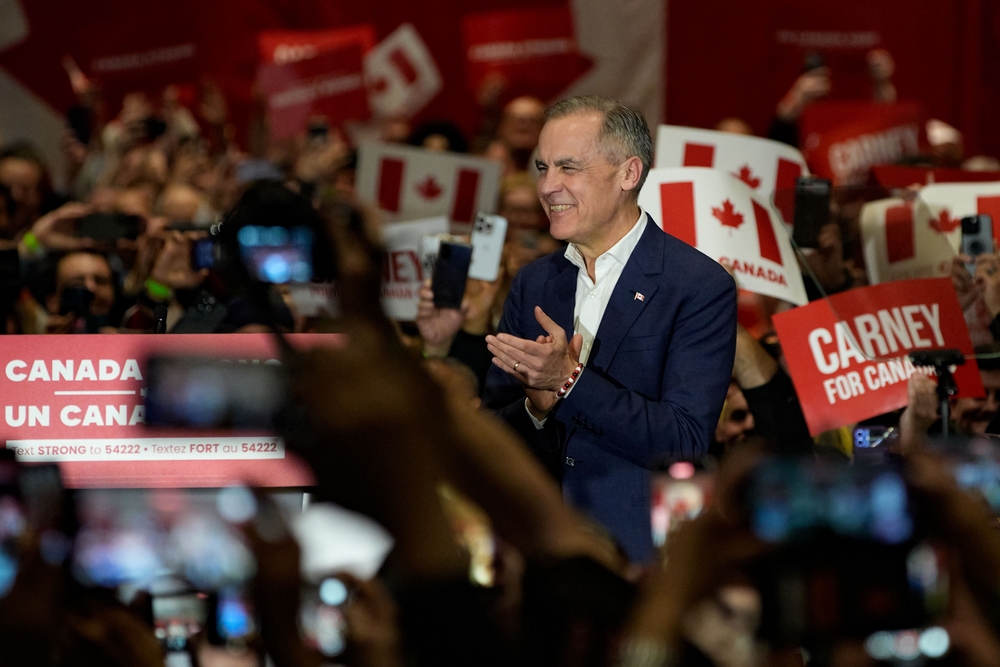
Economic unease is strengthening rather than weakening the federal Liberals’ political position. Nanos Research tracking released May 12 placed the Liberals more than 12 percentage points ahead of the Conservatives, while jobs and the economy remained the issue Canadians mentioned most often when asked about the country’s biggest challenge.
The combination presents an unusual political picture. Voters are clearly worried about employment, inflation and Canada’s uncertain relationship with the United States, yet many continue to favour Prime Minister Mark Carney and his government as the team best equipped to manage those pressures. The numbers provide the Liberals with a substantial cushion, but they also raise expectations. A government benefiting from strong support during economic uncertainty will eventually be judged on whether confidence turns into better jobs, stronger investment and more affordable daily life.
The Liberal Lead Is Clear, but It Is Not a Prediction
Nanos placed Liberal ballot support at 45.5%, compared with 33.4% for the Conservatives. That produced a 12.1-point advantage, large enough to represent a meaningful national lead rather than a statistical tie. The NDP stood at 8.8%, followed by the Bloc Québécois at 5.3%, the Greens at 3.5% and the People’s Party at 2%. The figures suggest federal politics was becoming increasingly concentrated around the two largest parties, with nearly four in five decided respondents supporting either the Liberals or Conservatives.
However, national voting intentions are not the same as an election result. Canada awards seats riding by riding, so the geographic distribution of support can matter as much as the national total. A party can accumulate large margins in safe urban constituencies without producing the same seat gains it would receive from smaller victories in competitive ridings. The tracking therefore shows the Liberals entering the period from a position of strength, but it does not guarantee how individual contests would unfold.
Carney’s Personal Advantage Is Even Larger
The gap between the two main parties was substantial, but the difference between their leaders was considerably wider. Nanos found that 52.5% of Canadians preferred Mark Carney as prime minister, compared with 25.2% who selected Conservative Leader Pierre Poilievre. Approximately 12.5% remained unsure, while the leaders of the smaller parties registered in the low single digits. Carney’s 27.3-point advantage indicates that the Liberal position was being reinforced by confidence in the prime minister personally.
That distinction matters because Canadians may evaluate a leader differently from the party that leader represents. Carney entered politics after leading both the Bank of Canada and the Bank of England, giving the Liberals a recognizable economic brand during a period dominated by tariffs, inflation and weak growth. For a household worried about job security or a business owner delaying an expansion, technical experience may feel more relevant than ideological positioning. The challenge for the Conservatives is therefore not only closing the party gap, but convincing more Canadians that Poilievre offers the steadier choice during an unpredictable economic period.
Jobs and the Economy Have Moved to the Centre
When respondents were asked to name the most important national issue without being offered a list, 24.2% identified jobs or the economy. That was more than double the 10.8% who named inflation and well ahead of the 9.5% who selected Donald Trump or relations with the United States. Health care and housing costs were each mentioned by 5.7%, while the deficit, environment, immigration, national security and homelessness registered lower.
The unprompted format makes the economic result especially significant. Respondents had to identify the concern themselves rather than select it from several prepared options. For many Canadians, the economy is no longer an abstract debate over quarterly growth. It can mean a recent graduate repeatedly applying for entry-level positions, a manufacturing employee wondering whether tariffs will reduce shifts, or a family noticing that a stable paycheque buys less than it once did. The polling suggests these experiences are now shaping how people judge nearly every major federal promise, from defence spending and trade diversification to housing construction and tax relief.
April’s Employment Numbers Explain the Anxiety
The Nanos tracking period ended on the same day Statistics Canada released a cautious employment update. The economy lost approximately 18,000 positions in April, although the change was small enough to be characterized as little movement. More importantly, the unemployment rate increased from 6.7% to 6.9% as an additional 51,000 people entered the labour market and looked for work. The employment rate slipped to 60.5%, matching a recent low reached in August 2025.
The composition of employment was also concerning. Full-time work declined by 47,000 positions in April, while part-time employment increased by roughly 29,000. Over the first four months of 2026, full-time employment had fallen by a net 111,000 positions. Those numbers help explain why economic concern can remain intense even when layoffs are not surging dramatically. Someone moving from full-time hours to part-time work is still counted as employed, but that change can reduce income, benefits and financial security. For voters, the quality and stability of jobs may matter more than the headline employment count alone.
Young Canadians Are Facing a Harder Search
The labour market looked particularly difficult for people between the ages of 15 and 24. Youth unemployment rose to 14.3% in April, compared with a pre-pandemic average of 10.8%. Among students participating in the labour force, the unemployment rate reached 16%. These figures reflect the growing competition for summer work, retail positions, internships and other jobs that traditionally allow younger Canadians to gain experience and build financial independence.
Long-term unemployment is another warning sign. Approximately 22.5% of unemployed Canadians had been searching continuously for work for at least 27 weeks, significantly above the 17.1% average recorded between 2017 and 2019. A prolonged job hunt can erode savings and make applicants worry that a widening résumé gap will make the next opportunity even harder to secure. Politically, this creates pressure on every party to offer more than broad promises about growth. Canadians are likely to look for practical measures involving apprenticeships, business investment, housing mobility, credential recognition and pathways that help new workers move from education into stable employment.
Inflation Is Only One Part of the Economic Strain
Inflation ranked second among the issues identified in the Nanos tracking, but later price data showed why affordability remained politically powerful. Canada’s Consumer Price Index increased 2.8% year over year in April, up from 2.4% in March. Gasoline prices rose 28.6% compared with the previous year, helping push the overall rate higher. Rent inflation slowed to 3.6%, although average rents were still 30.8% higher than they had been five years earlier.
These figures illustrate why a lower inflation rate does not mean prices have returned to their previous levels. Inflation measures how quickly prices are changing, not whether earlier increases have been reversed. A grocery bill, insurance payment or monthly rent that rose sharply over several years can remain difficult to manage even after the pace of increase moderates. Wage growth offers some relief—average hourly pay was up 4.5% year over year in April—but gains were uneven across the income distribution. Canadians can therefore hear encouraging language about slowing inflation while still feeling that household budgets remain unusually tight.
U.S. Trade Tensions Keep the Economy Political
Relations with the United States were the third-most frequently mentioned concern, but they are closely connected to the two issues above them. American tariffs and trade uncertainty can affect Canadian manufacturing orders, investment decisions, export volumes and hiring. The Bank of Canada said the economy remained on a lower path than it had been before the tariffs were introduced, even though businesses and government programs had limited some of the anticipated damage.
The effects have varied across industries. The central bank reported that Canadian steel and lumber exports had declined significantly, while other sectors proved more resilient. Statistics Canada also found that motor vehicle and parts exports remained under pressure during the broader trade disruption. This gives Carney an advantage and a vulnerability at the same time. His international and financial experience fits the moment, but expectations are correspondingly high. Workers in an auto plant or steel community are unlikely to judge Ottawa solely by the number of meetings held with Washington. They will judge the government by whether plants remain open, investment continues and reliable shifts are available.
The NDP’s Decline Is Reshaping the Opposition
Nanos highlighted downward pressure on NDP support after the party’s leadership race. The New Democrats stood at 8.8%, placing them well behind both the Liberals and Conservatives. Avi Lewis had won the NDP leadership on the first ballot in March with approximately 56% of the vote. Nearly 71,000 members participated, producing a turnout rate of 70.6%, but the enthusiasm within the party had not yet translated into stronger national voting intentions.
The weakness creates strategic problems for the NDP. A new leader normally needs time to introduce priorities, build recognition and distinguish the party from its larger competitors. Lewis must appeal to progressive Canadians without allowing the Liberals to occupy the entire centre-left space, while also demonstrating that the NDP can influence issues such as wages, affordability and corporate concentration. The Nanos results do not establish where former NDP supporters have gone, so it would be premature to assume they all moved to the Liberals. Still, the low number reduces the party’s visibility and makes it more difficult to shape a national conversation increasingly dominated by Carney and Poilievre.
A Parliamentary Majority Raises the Stakes
The Liberals entered the May tracking period with more than favourable public opinion. Victories in three April by-elections had increased the government’s representation to 174 seats in the 343-seat House of Commons, giving Carney a majority. The Liberals captured University–Rosedale and Scarborough Southwest in Ontario as well as Terrebonne in Quebec. The result reduced the government’s need to negotiate with opposition parties to pass ordinary legislation.
Majority status can provide stability during a trade or economic crisis because the government has greater control over its legislative calendar. It can introduce budgets, trade-response programs and regulatory changes without constantly calculating whether another party will provide enough votes. Yet that freedom also removes a convenient explanation for delays. When a government possesses both a parliamentary majority and a double-digit polling lead, Canadians can reasonably expect measurable results. The Liberals may receive credit for creating stability, but they will also carry clearer responsibility if investment remains weak, unemployment rises or trade negotiations fail to provide relief.
National Numbers Can Conceal Local Weaknesses
The 12-point lead offers a strong picture of overall public opinion, but it should not be treated as evidence that the Liberals lead by the same amount in every province, age group or type of community. Political support in Canada is rarely distributed evenly. A national party may perform exceptionally well in major metropolitan areas while encountering resistance in rural regions, energy-producing provinces or manufacturing communities exposed to trade disruptions.
That is especially important when the economy is the dominant concern. A technology employee in Toronto, an oil worker in Alberta and an automotive supplier in southwestern Ontario can experience the same national economy very differently. Rising energy prices may strengthen one regional industry while increasing transportation and production costs elsewhere. The publicly available Nanos release focused primarily on the national picture, while more detailed demographic and regional breakdowns were available through the organization’s data portal. The headline therefore establishes clear Liberal momentum, but serious political strategy still requires examining where that support is concentrated and which constituencies remain competitive.
The Rolling Method Reduces Weekly Noise
Nanos based the tracking on random telephone interviews recruited through landline and cellphone sampling. The main issue and leadership measures included 1,036 respondents, while the ballot portion was based on 918 decided participants. The broader sample carried a reported margin of error of plus or minus 3.1 percentage points, 19 times out of 20. Responses were weighted using census information to better reflect Canada’s population.
The results were also calculated as a four-week rolling average. Approximately 250 new interviews were added each week while the oldest group was removed. This approach prevents one unusually eventful day from producing a dramatic but temporary polling swing. It is useful for identifying sustained movement, although it also means the result incorporates opinions collected over several weeks rather than representing a single moment. A major announcement may take time to appear fully in the numbers. Readers should therefore focus on the size and direction of the trend instead of treating every decimal point as permanent. The 12-point advantage is meaningful, but future tracking will determine whether it represents a durable realignment or a strong phase in a changing political cycle.
The Liberal Advantage Ultimately Depends on Delivery
Economic data released after the tracking period reinforced the government’s challenge. Real gross domestic product was unchanged in the first quarter of 2026 after declining 0.2% in the final quarter of 2025. Household spending increased by 0.4%, but business capital investment fell 0.7%, marking its fifth consecutive quarterly decline. Exports edged down as shipments of passenger vehicles and light trucks were affected by U.S. tariffs.
Those numbers describe an economy avoiding a severe contraction but struggling to generate convincing momentum. For the Liberals, the current political opportunity is considerable: a parliamentary majority, a wide ballot lead and a prime minister whose personal ratings exceed his party’s support. But economic confidence can shift when it is not supported by household experience. If unemployment falls, investment returns and trade-sensitive industries stabilize, the Liberal advantage could become deeply rooted. If full-time employment continues to weaken and prices outpace what families can comfortably absorb, the Conservatives and NDP will have openings. The poll is therefore less a victory lap than a clear assignment: Canadians appear prepared to trust the government, but they expect that trust to produce results.
