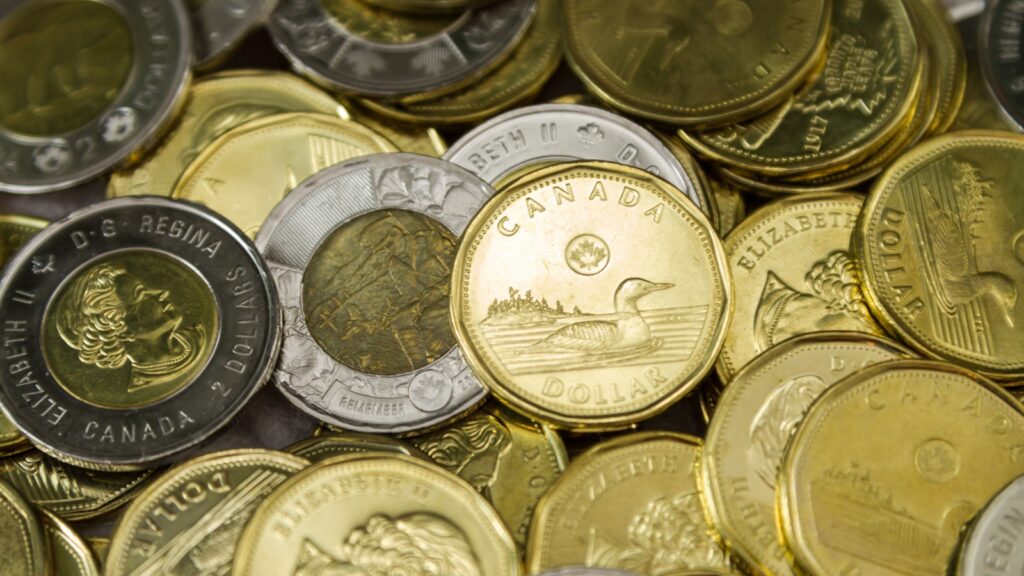
Canada’s dollar has been pulled into a new phase of the global interest-rate story. The loonie sank to a six-week low against the U.S. dollar on September 16 after the Federal Reserve raised borrowing costs for the first time in three years and signalled that its inflation fight may require additional tightening.
The Canadian currency touched C$1.3994 per U.S. dollar before trading around C$1.3990, equivalent to roughly 71.48 U.S. cents. Behind that seemingly small move is a widening monetary-policy divide between Washington and Ottawa, persistent inflation pressures, volatile oil markets and renewed uncertainty about where borrowing costs go next. For Canadian households and businesses, the consequences can eventually reach imported goods, travel expenses, corporate costs and financial markets.
The Loonie’s Drop Was About More Than One Rate Hike
The Canadian dollar fell roughly 0.5% against its U.S. counterpart on September 16, touching C$1.3994 per U.S. dollar. That was its weakest intraday level since August 7 and placed the currency within striking distance of the closely watched C$1.40 mark. The move came immediately after the Federal Reserve increased its benchmark federal funds target range by 25 basis points, to 3.75%–4.00%. For currency traders, however, the actual quarter-point increase was only part of the story.
More important was the message about what could come next. Federal Reserve projections showed that most policymakers expected monetary policy to become tighter again before the end of 2026. That helped push the U.S. dollar higher against several major currencies as investors adjusted expectations for American interest rates. The loonie stabilized somewhat on September 17, trading around C$1.3982 per U.S. dollar during the morning, but it remained close to the previous session’s low. The reaction illustrated how quickly exchange rates can move when expectations about future central-bank policy change.
The Fed Delivered Its First Increase Since 2023
The Federal Reserve’s September 16 decision represented an important reversal in the interest-rate cycle. The Federal Open Market Committee voted unanimously to lift its target range by a quarter percentage point to 3.75%–4.00%, the first increase in roughly three years. In its statement, the Fed said U.S. economic activity was expanding at a solid pace, domestic spending remained resilient, productivity growth was strong and capital investment was robust. At the same time, officials said inflation remained elevated and that tighter policy was intended to support a more timely return to the Fed’s 2% objective.
The Fed’s updated projections reinforced that message. Policymakers projected median U.S. real GDP growth of 2.3% in 2026 and an unemployment rate of 4.1%, while the median projection for personal consumption expenditures inflation was 3.7%. Core PCE inflation, which strips out food and energy, was projected at 3.4%. Reuters reported that 16 of 18 policymakers anticipated at least one additional quarter-point increase before year-end, giving financial markets a reason to reconsider how long U.S. borrowing costs could remain elevated.
Canada and the United States Now Have a Wide Rate Gap
The Bank of Canada entered the Fed decision with its policy rate at 2.25%, where it had been left unchanged on September 2. That puts the Fed’s new 3.75%–4.00% target range considerably above the Canadian policy rate. Differences of that size matter because interest-rate differentials influence where global investors can earn returns. When comparable U.S. assets offer higher yields, demand for U.S. dollars can strengthen relative to demand for Canadian dollars, although exchange rates are always shaped by several forces at once.
Bank of Canada research has repeatedly identified relative interest rates as one of the factors affecting the Canada-U.S. exchange rate. The relationship is not mechanical: trade uncertainty, commodity prices, global risk sentiment and expectations about future economic growth can overwhelm rate differences at times. Even so, the September Fed decision shifted the relative outlook further in the U.S. dollar’s favour. Reuters reported that short-term U.S. Treasury yields rose as investors increased expectations for another Fed increase, while Canada’s two-year government bond yield gained about two basis points to 3.376% on September 16.
The Bank of Canada Has Its Own Inflation Problem
Ottawa’s monetary-policy backdrop is hardly straightforward. Statistics Canada reported that the Consumer Price Index was 3.0% higher in August than a year earlier, matching July’s inflation rate. Transportation prices were up 7.5% year over year, while CPI excluding gasoline increased 2.4%. Those numbers leave inflation above the Bank of Canada’s 2% target even as parts of the domestic economy continue to show excess capacity.
Minutes from the Bank’s September decision, released September 16, showed officials increasingly concerned about persistent energy costs. Governing Council concluded that headline inflation was likely to remain elevated in the near term and discussed the possibility that prolonged gasoline and diesel price increases could eventually spread into a broader range of consumer prices. At the same time, policymakers judged that the Canadian economy remained in excess supply and that trade uncertainty could weaken consumer spending, investment and hiring. That combination makes the next Canadian rate move unusually difficult to anticipate: inflation argues for restraint, while economic slack argues against tightening too aggressively.
Canada’s Economy Is Growing, but the Labour Market Is Softer
The Canadian economy is not in recession according to the latest quarterly data. Real GDP increased 0.8% in the second quarter of 2026 after edging up 0.1% in the first quarter. Statistics Canada attributed the second-quarter improvement to stronger exports, household consumption and business capital investment. Household spending also rose 0.8%, while exports made a substantial positive contribution to economic growth.
The labour market presents a more cautious picture. Employment declined by 42,000 in August, lowering the employment rate to 60.8%. The unemployment rate held at 6.4%, while average hourly wages were 2.0% higher than a year earlier. Employment losses were concentrated in several industries, including business and building support services, public administration, natural resources and utilities, although manufacturing added 22,000 positions. These mixed conditions help explain why the Bank of Canada may not simply follow the Federal Reserve upward. Stronger Canadian growth has reduced pressure for easier policy, but softness in employment and uncertainty surrounding U.S. trade measures still represent potential restraints on demand.
Falling Oil Prices Removed Some Support From the Loonie
Oil added another complication to the currency move. West Texas Intermediate crude settled 3.2% lower at US$102.43 per barrel on September 16 as concerns about Middle Eastern supply disruptions eased. Prices weakened further the next day, with U.S. crude briefly trading near US$100 per barrel as reports of additional Saudi supply helped calm fears about shortages.
Canada is a major commodity exporter, which means oil can influence the loonie, although the relationship has changed over time. Bank of Canada research identifies oil prices, global U.S.-dollar movements and international interest-rate differences as important systematic influences on the currency. Historically, rising commodity prices have often supported the Canadian dollar because stronger export revenues improve Canada’s terms of trade and can attract investment. A decline in crude can therefore remove one potential source of support. The September move was particularly notable because the loonie was simultaneously facing pressure from rising U.S. rate expectations. Oil was not the sole reason for the decline, but its retreat gave the currency one less counterweight against a strengthening greenback.
A Weaker Dollar Has Winners and Losers Across Canada
A move from roughly 72 U.S. cents toward 71 cents may appear modest at a foreign-exchange desk, yet persistent depreciation can become more noticeable in the real economy. Canadian companies importing machinery, technology, consumer merchandise or other goods priced in U.S. dollars must exchange more Canadian currency for each American dollar. Travellers visiting the United States face the same basic arithmetic when paying for hotels, meals and purchases. If currency weakness lasts long enough, some of those higher Canadian-dollar costs can eventually reach customers.
The other side of the equation is more favourable for certain exporters. Canadian goods and services can become relatively less expensive for foreign buyers, while exporters receiving revenue in U.S. dollars may collect more Canadian dollars when those earnings are converted. The Bank of Canada describes the floating currency as an economic “shock absorber” for precisely this reason. Currency depreciation can help redirect demand toward Canadian production when external conditions deteriorate. The trade-off is that imported products become more expensive, making a weaker loonie neither universally good nor universally bad for the economy.
What Happens Next Depends on Expectations, Not Just the Next Decisions
The immediate market question is no longer simply whether the Fed has raised rates. Investors are trying to determine how many additional increases might come and whether the Bank of Canada eventually responds to its own inflation pressures. The Fed’s September projections showed a median federal funds rate of 4.1% at the end of 2026, up from the 3.8% median projected in June. Reuters reported that markets raised expectations for additional tightening after the September decision, helping explain why the dollar initially strengthened so sharply.
Canada’s outlook remains less clear-cut. The Bank of Canada has acknowledged increased upside inflation risks, particularly from energy, while also emphasizing excess supply and uncertainty created by trade tensions. Swap-market pricing cited by Reuters suggested investors were considering the possibility of Canadian tightening in the months ahead, but market expectations can shift quickly as inflation, employment, oil and trade data change. By September 17, the U.S. dollar index had already pulled back about 0.2% after surging 0.7% a day earlier. That reversal is a reminder that a six-week low is a snapshot, not a destination. The loonie’s next major move will depend on how the economic evidence changes the expected paths of both central banks.
