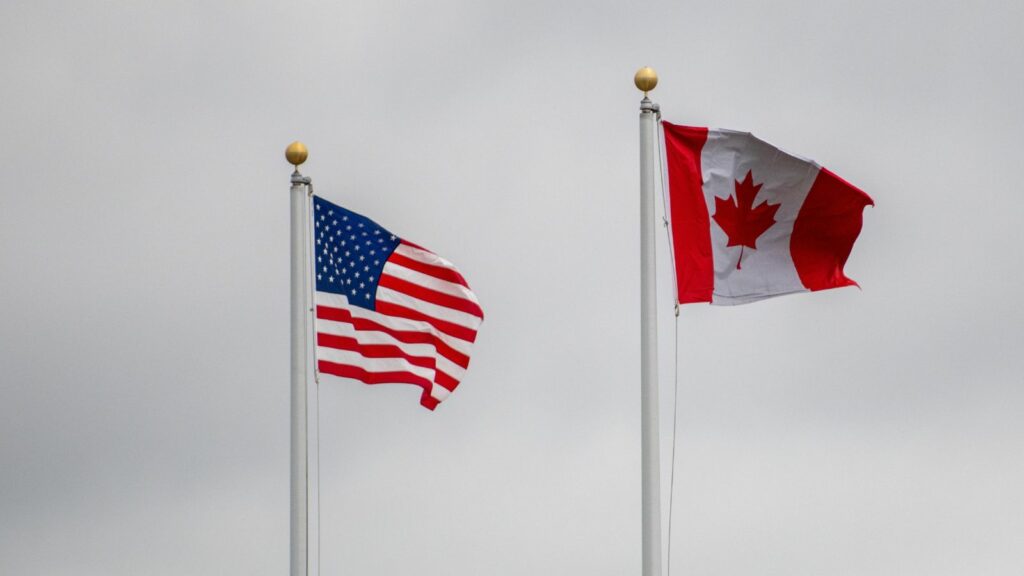
The political battle over America’s future is reaching well beyond its borders, with Canada emerging as an important centre of overseas voter activity ahead of the November 3, 2026, U.S. midterm elections. An estimated 612,780 American citizens were living in Canada in 2024, making it the largest community of U.S. citizens residing abroad.
As President Donald Trump’s trade confrontation with Canada strains economic ties and longstanding relationships, American expatriates are becoming increasingly involved in political discussions on both sides of the border. From volunteer-organized voting campaigns in Toronto to debates over tariffs and congressional control, the election carries unusually direct implications for people whose lives span both countries. Yet despite the size of Canada’s American community, historically low overseas voter participation remains a significant challenge.
Canada Has the World’s Largest American Community Abroad
Canada is home to more American citizens than any other foreign country, according to the U.S. Federal Voting Assistance Program’s 2024 estimates. The agency calculated that approximately 612,780 U.S. citizens lived in Canada, compared with 327,528 in the United Kingdom and 313,602 in Mexico. The Canadian figure represents roughly 18% of the estimated 3.34 million American citizens living overseas, highlighting the country’s importance in discussions about expatriate voting.
Those residents represent a diverse population rather than a single political constituency. Some moved north for employment or education, while others settled in Canada after marrying Canadians. The community also includes dual citizens who maintain connections to both countries and individuals who acquired American citizenship through their parents. Importantly, the population estimate includes children and therefore should not be confused with the number of eligible voters. The 612,780 figure is a statistical estimate for 2024, not a verified headcount for November 2026.
Trump’s Trade War Has Made the Election More Personal
The escalating trade dispute between Washington and Ottawa has given Americans living in Canada another reason to pay attention to U.S. politics. After bilateral negotiations collapsed in August 2026, Trump imposed 50% tariffs on approximately US$20 billion worth of specified Canadian goods. Canada responded with retaliatory measures, further disrupting a commercial relationship that supports businesses, workers and families on both sides of the border.
For American citizens established in Canadian communities, these developments have consequences beyond political disagreements. Tariffs affect employers, manufacturing supply chains and businesses that depend on cross-border customers. An American working in Ontario’s automotive industry, for example, can experience the economic consequences of Washington’s decisions while still maintaining voting rights in the United States. The administration argues that its trade measures protect American industries and employment, while critics point to increased costs and disrupted commercial relationships. That tension has helped turn the trade dispute into a significant election issue.
Toronto Volunteers Are Organizing an Extensive Voting Campaign
In Toronto, Democrats Abroad has organized a grassroots effort to reach American citizens who might otherwise overlook the midterm elections. More than 40 residents volunteered at a Democracy Action Hub operating from a Toronto public library. Their activities included preparing approximately 1,800 postcards, contacting 400 Michigan-registered members through text messages and distributing information about overseas voting opportunities.
The campaign illustrates how political participation can extend beyond traditional party offices and campaign events. Volunteers have organized phone banking, voter assistance and community outreach at local gatherings. Some participants are Americans who moved to Canada for relationships, work or education, while Canadian supporters have also been welcomed at certain outreach activities. Democrats Abroad Toronto describes its mission as helping American citizens participate in U.S. elections. Although the effort is explicitly associated with the Democratic Party, its practical work also highlights a broader challenge: finding eligible voters who remain connected to American politics but are geographically separated from the usual election infrastructure.
Overseas Voter Turnout Remains Remarkably Low
Despite the substantial American population in Canada, overseas election participation has historically remained limited. The Federal Voting Assistance Program estimated that approximately 11% of eligible Americans living overseas voted in the 2024 presidential election, compared with 76.1% of voting-age citizens residing in the United States. Canada performed slightly below the overseas average, with an estimated participation rate of approximately 10%.
Midterm participation can be even weaker. Government estimates indicate that only 3.4% of eligible overseas Americans voted in the 2022 midterm election. Presidential contests generally attract greater attention, while congressional elections receive less international coverage. That creates a particular challenge for overseas political organizations trying to sustain engagement between presidential campaigns. The figures also suggest considerable room for participation to increase, although higher volunteer activity does not automatically translate into more completed ballots. With election results still outstanding as of November 2, the actual level of overseas participation in 2026 remains unknown.
American Citizenship Can Preserve Voting Rights Across Borders
Living in Canada does not automatically eliminate an American citizen’s right to participate in U.S. federal elections. The Uniformed and Overseas Citizens Absentee Voting Act, enacted in 1986, provides protections for eligible American citizens residing outside the United States. The Military and Overseas Voter Empowerment Act expanded those protections in 2009, including requirements intended to give overseas voters more time to receive their ballots.
Eligibility nevertheless depends on individual circumstances and applicable state laws. Most overseas voters maintain an electoral connection to the state where they last lived before leaving the United States. Some American citizens born abroad who have never lived in the country may also qualify through a parent’s former voting residence, although the rules are not uniform. These distinctions matter because the estimated 612,780 Americans in Canada include minors and people whose eligibility cannot be established from citizenship statistics alone. The Federal Voting Assistance Program estimated more than 430,000 eligible overseas voters in Canada in 2024.
Casting a Ballot From Canada Can Be Surprisingly Complicated
Voting from another country can require considerably more preparation than voting locally. American election administration is decentralized, meaning registration requirements, ballot return methods and deadlines depend on the state involved. Although federal protections require states to provide certain absentee voting arrangements, not every jurisdiction permits completed ballots to be returned electronically. Postal delays, unfamiliar paperwork and difficulty confirming whether a ballot arrived can complicate participation.
Research discussed by the U.S. Vote Foundation in June 2026 identified multiple administrative stages at which overseas voters can become discouraged or encounter obstacles. The experience is not necessarily about political indifference. In Ottawa, volunteer Rachel Eugster described spending two hours assisting an 89-year-old woman struggling with an electronic voting form. Such cases explain why organizations have placed considerable emphasis on individual assistance. Even when someone is determined to participate, understanding several separate administrative requirements can become a substantial task, especially for first-time overseas voters.
Personal Stories Reveal Why the Vote Matters
Behind the campaign statistics are people whose connections to the United States have changed without disappearing. Toronto volunteer Austin Pettigrew met his Canadian wife after a dating app connected him with someone across Lake Ontario. Their relationship eventually brought him to Canada, where he now participates in overseas voter outreach. Meanwhile, University of Toronto student Emily Chen, who grew up near Dallas, encountered enough difficulties with voting arrangements that she decided to travel home during a university break.
For others, voting reflects responsibilities to communities in two countries. Josh Hall moved from Charlotte to Toronto in 2022 to join the National Ballet of Canada. He coordinated with an American colleague to keep track of election requirements and successfully participated in North Carolina’s Senate contest. In the Greater Toronto Area, former Republican Tammy Wilsker Mermelstein was preparing to vote from Canada for the first time. Their experiences demonstrate that expatriate participation can be shaped by family ties, careers, practical obstacles and changing political priorities.
Republican Expatriates Are Engaged, but Less Visible
The overseas voting discussion has been dominated by visible Democratic organizing, but American citizens living in Canada do not share a single political outlook. Georganne Burke, the Canada chapter lead for Republicans Overseas, told The Canadian Press that Republican supporters were also motivated to participate. Burke, a Trump supporter who recently returned to the United States after spending 38 years in Toronto and Ottawa, said some Republicans were reluctant to discuss their political views openly.
Burke defended Trump’s emphasis on bringing industrial investment and employment back to the United States, even while acknowledging discomfort with some of his rhetoric. Her perspective illustrates why the trade debate cannot be reduced to universal expatriate opposition to tariffs. Some Americans prioritize domestic manufacturing or border policies, while others place greater weight on cross-border costs and diplomatic relationships. Burke estimated that Democrats outnumber Republicans among American expatriates in Canada, but that was her personal assessment, not a statistically representative survey. The community’s actual partisan composition remains uncertain.
Michigan Demonstrates Why Overseas Ballots Attract Attention
Michigan offers a striking example of why overseas voters receive attention during closely contested elections. During the 2024 general election, the state recorded 21,128 overseas ballots. In the same election, Democrat Elissa Slotkin defeated Republican Mike Rogers in the U.S. Senate race by just 19,006 votes. The overseas ballot total was therefore larger than the final margin between the two leading candidates, illustrating how relatively small groups of voters can become politically significant.
That comparison requires an important qualification. The 21,128 ballots were submitted by voters living across the world, not exclusively in Canada. Their political preferences were mixed, and the figures do not prove that overseas voters determined the outcome. Nevertheless, the proximity of Michigan to southwestern Ontario gives the state particular relevance to cross-border communities. In the 2026 Senate contest, Rogers has publicly called for an end to the tariff conflict with Canada, demonstrating how economic pressure is influencing the positions of American candidates, including Republicans.
Control of Congress Could Reshape the Trade Debate
The November 3 elections will determine control of the House of Representatives and Senate during the final two years of Trump’s presidency. With narrow Republican majorities in both chambers, relatively small changes in congressional representation could alter Washington’s political balance. Democrats have identified Trump’s tariffs, including measures affecting Canada, as a potential subject for greater congressional scrutiny if they gain control of one or both chambers.
A change in congressional leadership could bring additional hearings into tariff exemptions, costs for small businesses and the administration’s use of trade powers. Senator Ron Wyden, the senior Democrat on the Senate Finance Committee, has specifically identified repealing tariffs on Canada as a priority. However, winning congressional majorities would not automatically reverse Trump’s trade policies. The president would retain veto authority, and overriding a veto generally requires a two-thirds majority in both chambers. The election could therefore change the intensity of congressional oversight without producing immediate tariff relief.
Diplomatic Tensions Have Entered the Election Debate
The political tensions surrounding the midterms have also produced an unusual diplomatic dispute. In October, U.S. Ambassador to Canada Pete Hoekstra warned Canadian political leaders against becoming involved in American election politics. The U.S. Embassy subsequently accused Canadian officials of making statements and taking actions intended to influence American political outcomes, including criticism of tariffs and Ontario’s anti-tariff advertising. Prime Minister Mark Carney rejected the allegations, saying they lacked merit.
The controversy demonstrates how difficult it has become to separate ordinary trade negotiations from election-season politics. Canadian officials have defended their right to respond to tariffs affecting Canadian industries, while American representatives have raised concerns about foreign political influence. Those competing positions should not be confused with the legal participation of eligible American citizens residing in Canada. An American casting a ballot from Toronto is exercising an individual voting right, not engaging in foreign government interference. As of November 2, the broader allegations against Ottawa remain contested rather than established findings.
A Possible Trade Breakthrough Does Not End the Electoral Stakes
There was a potentially significant diplomatic development immediately before the election. On November 1, Prime Minister Carney reported a constructive conversation with Trump about a possible trade agreement. He said negotiating teams would continue working in the coming weeks toward an arrangement intended to support employment, improve affordability and respect Canadian sovereignty. Discussions have included possible relief from U.S. tariffs affecting Canadian steel and automobiles, but no completed agreement or final terms had been announced.
The renewed dialogue offers some hope after months of economic confrontation, although the outcome remains uncertain. Even a negotiated settlement would not erase the political disagreements exposed by the trade war or resolve every concern facing American citizens in Canada. Some expatriates are focused on employment, others on family connections, voting access or the direction of American institutions. The approaching midterms bring those concerns together in a powerful way. Canada’s American community may live beyond the U.S. border, but its connections to decisions made in Washington remain substantial.
