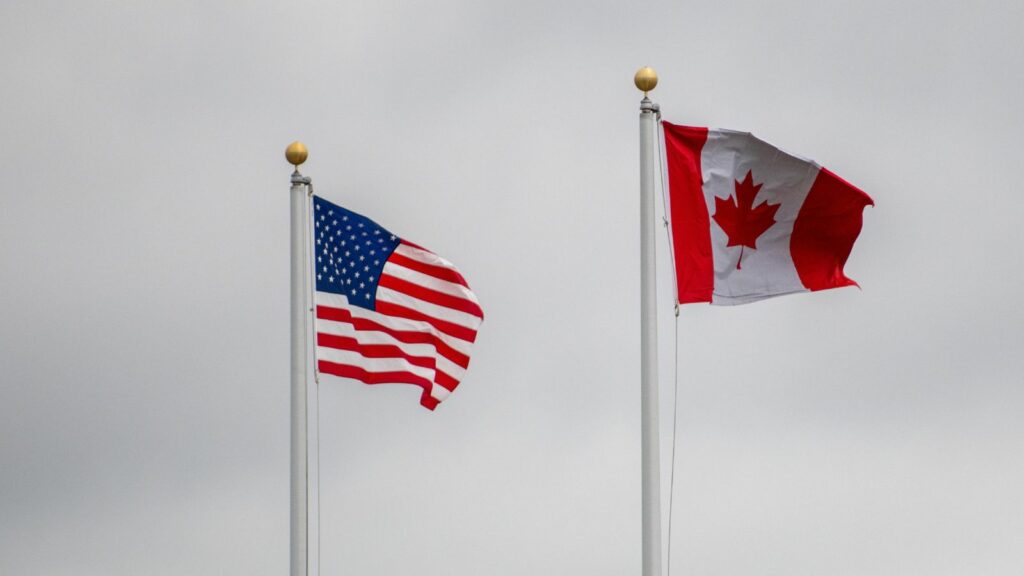
New Brunswick is turning its government purchasing power into another front in the widening Canada-U.S. trade fight. Premier Susan Holt has announced that, beginning Oct. 1, the province will prohibit the procurement of U.S. goods or services in provincial government contracts valued at more than $5 million. Public-sector organizations are also being directed to examine their supply chains and use New Brunswick or other Canadian alternatives where they are available.
The distinction matters. The measure is not simply a blanket prohibition on every company with American ownership. It reaches deeper into the products and services supplied under major contracts, including situations in which a Canadian contractor relies on American inputs. For a province whose economy remains extraordinarily connected to the United States, the decision signals how quickly procurement policy is becoming part of the broader trade confrontation.
The $5-Million Rule Starts Oct. 1
New Brunswick’s most significant new procurement restriction takes effect Oct. 1. For provincial contracts with an estimated value above $5 million, American goods and services are to be prohibited. Holt has simultaneously directed public-sector organizations to examine what they purchase throughout their supply chains and substitute New Brunswick or Canadian products wherever practical. Reporting on the announcement indicates the $5-million threshold captures roughly 90 per cent of the government contracts handled by Service New Brunswick, giving the measure a much wider reach than the dollar figure might initially suggest.
That does not mean every component of every government purchase can suddenly be sourced within the province. Officials have acknowledged the practical problem of products for which no Canadian substitute exists. That leaves room for exceptions and implementation details, especially in specialized areas such as medical equipment, information technology, industrial machinery and other products sourced through highly integrated North American supply chains. The policy’s significance comes from changing the default: purchasing officials are now being told to look north and inward before relying on American supply.
The Target Is the Supply Chain, Not Just the Company Name
One of the most consequential details is that New Brunswick is examining where products originate, not simply where the contractor has its headquarters. Holt told reporters that the approach can apply to Canadian companies supplying U.S.-made products. That gives the measure substantially more economic reach than a rule that merely prevented an American corporation from submitting a bid. A contractor based in Moncton, Saint John or Fredericton could therefore face pressure to replace American equipment or services in its proposal with Canadian alternatives.
That distinction reflects the reality of modern procurement. A large construction, technology or health-care contract may involve dozens of suppliers spread across several countries. A Canadian prime contractor could purchase American software, machinery, building systems or specialized components without the government ever signing a contract directly with a U.S. corporation. New Brunswick’s approach is designed to reach those indirect purchases. It could therefore create new opportunities for Canadian manufacturers and distributors, but it may also require contractors to redesign bids, locate alternative suppliers and demonstrate more clearly where major inputs originate.
Government Spending Has Become a Trade-War Weapon
The announcement came only days after Washington intensified its own pressure on Canada. On Sept. 8, President Donald Trump issued measures restricting imports of selected Canadian products, including certain alcoholic beverages and dairy goods, with import prohibitions scheduled to take effect Sept. 29. His administration also moved against Canadian access to U.S. government procurement, with Trump directing the General Services Administration to begin removing Canadian-origin products from its Multiple Award Schedules.
Canada had already escalated its response. Ottawa imposed new counter-tariffs effective Sept. 8 covering $27.6 billion in U.S. imports, with rates of 15, 25 and 50 per cent depending on the product. Those measures target sectors including steel, dairy, appliances, agricultural equipment, pulp and paper, plastics and electronics. The result is a trade conflict increasingly fought through more than customs duties. Government purchasing rules, import bans and access to public contracts are now being used alongside tariffs. New Brunswick’s procurement decision fits directly into that broader shift.
New Brunswick Had Already Been Cutting U.S. Contracts
The Oct. 1 restriction is an escalation of a policy direction that began much earlier. When the tariff confrontation accelerated in early 2025, the Holt government ordered a review of provincial purchasing and moved to stop new deals with American suppliers except where critical services could not readily be replaced. NB Liquor also stopped purchasing American alcohol and removed U.S. products from its shelves, making consumer-facing procurement one of the province’s first visible forms of retaliation.
Provincial figures suggest those earlier decisions substantially reduced direct spending with American suppliers. Holt said the value of government contracts going to U.S. companies fell from $34.4 million in the 2024-25 fiscal year to $16.4 million in 2025-26. Their share of the total dropped from 1.4 per cent to 0.7 per cent. Government procurement is much larger than those U.S. numbers alone suggest: Service New Brunswick says Strategic Procurement has purchased more than $1.5 billion annually in goods, services and construction in recent years, while its 2024-25 annual report said more than $1.8 billion was awarded to New Brunswick suppliers.
The Province Prepared Legal Groundwork Before This Escalation
New Brunswick did not begin rewriting its procurement rules this week. Regulations adopted under the provincial Procurement Act in February 2025 gave procuring entities the power to refuse bid submissions in extraordinary circumstances related to international trade, explicitly including the imposition or increase of tariffs, when rejecting the bid is considered to be in the public interest. That language provided the province with a policy mechanism tailored to the kind of trade disruption now unfolding.
The broader system remains constrained by procurement law and trade agreements. New Brunswick says its public purchasing must operate within the Procurement Act, applicable regulations, Canadian case law and trade commitments. Those commitments include the Canadian Free Trade Agreement, the WTO Government Procurement Agreement, the Canada-European Union Comprehensive Economic and Trade Agreement and the Comprehensive and Progressive Agreement for Trans-Pacific Partnership. The province’s existing New Brunswick First strategy already encourages local purchasing where legislation and trade agreements permit it. The new American restrictions therefore sit within a framework that still requires officials to consider transparency, competition, exemptions and the specific coverage of each agreement.
Businesses and Workers Are Getting Support Alongside Retaliation
Fredericton is pairing its procurement response with programs meant to cushion companies and employees from the same trade conflict. Existing provincial supports include working-capital loans of up to $5 million, a $40-million competitiveness and growth program for large export-intensive companies, support for the New Brunswick Fisheries Fund and the use of Opportunities New Brunswick’s strategic-assistance budget for contingency planning, productivity improvements and market diversification. Holt’s latest announcement also included further compensation and training measures, a renewed buy-local campaign and plans for a market-diversification strategy.
Worker programs are becoming more important as the dispute continues. In May, the federal and provincial governments announced a three-year Workforce Tariff Response agreement worth roughly $13.8 million. The program is intended to help more than 1,500 New Brunswick workers through retraining and employment support, including people in tariff-exposed industries and supply chains. Earlier provincial estimates suggested the August round of U.S. tariffs could threaten roughly 500 New Brunswick jobs, with forestry, manufacturing and brewing among the sectors identified as particularly vulnerable. Those estimates were made before the latest round of trade measures.
The Hardest Challenge Is New Brunswick’s Dependence on the U.S.
The province can redirect government purchasing more quickly than it can redirect an export economy. New Brunswick officials have said more than 90 per cent of the province’s international exports are destined for the United States, with sectors such as forestry, manufacturing, refined petroleum and seafood especially exposed. Total provincial export sales exceeded $16 billion in 2025. Geography, long-established supply chains and close links with New England help explain why the American market has historically been so dominant.
That is why Holt’s response extends beyond buying Canadian. New Brunswick’s 2026 economic development strategy calls for expanding and diversifying exports, attracting more investment and increasing productivity, with an overall goal of growing the provincial economy by 10 per cent by 2030. The government has pursued trade missions in Europe and says a new market-diversification strategy is coming. None of those efforts can replace the U.S. market quickly. But the $5-million procurement rule reveals the larger objective: use government spending, worker programs, investment and new trade relationships to reduce the economic cost of depending overwhelmingly on one increasingly unpredictable customer.
