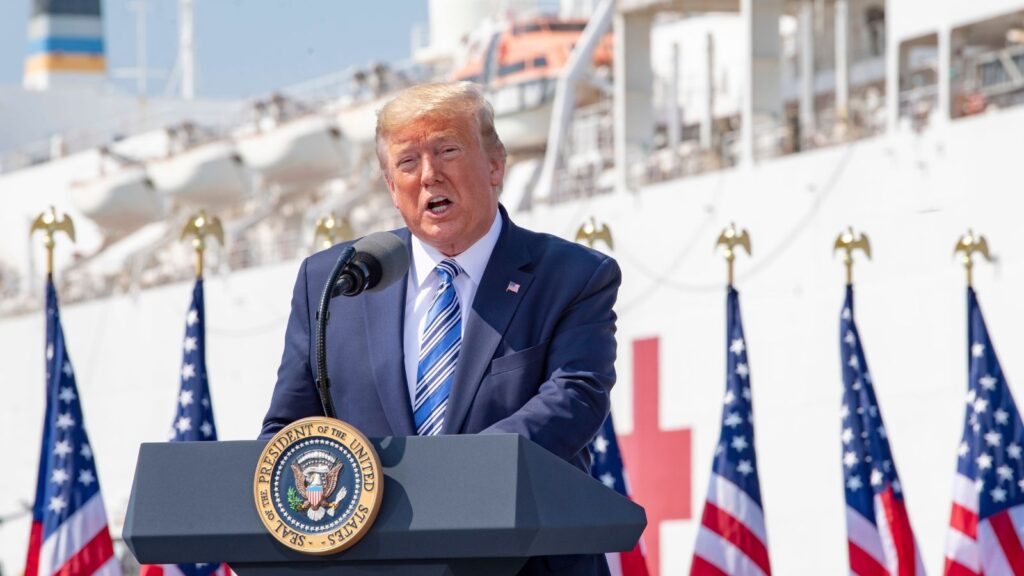
Donald Trump is again sending Canada a confrontational message, but Washington has not entirely shut down the possibility of another trade agreement. Speaking at a White House Hispanic Heritage Month event on September 30, the U.S. president accused Canadian leaders of taking advantage of the United States and said Canada was being “taught a little lesson.”
At almost the same time, U.S. Trade Representative Jamieson Greer was leaving a diplomatic escape route open. Greer said Washington remains willing to discuss a deal, even though the administration is comfortable with the current trade standoff. Those two messages capture the unusual state of Canada-U.S. relations: tariffs and import bans are multiplying, political rhetoric is hardening, yet communication between the countries has not stopped.
Trump’s Latest Comments Take the Dispute Back to Autos
Trump made his latest criticism of Canada while speaking at a Hispanic Heritage Month celebration at the White House on September 30. His comments moved beyond the event’s main subject and into one of his administration’s central economic arguments: that previous U.S. governments allowed too much manufacturing activity to move outside the country. Canada’s auto industry was one of his examples. Trump accused Canadian leaders of benefiting from what he characterized as years of weak American trade policy and described their behaviour as “very bad.”
The argument fits closely with the administration’s push to increase vehicle production inside the United States. But Canada is not a recent destination to which an established American auto industry simply relocated. Automotive manufacturing has existed in Canada for more than a century, and production on both sides of the border became increasingly integrated through decades of trade agreements and investment. Engines, transmissions, components and finished vehicles routinely cross the border as part of a continental supply chain. That history makes autos one of the most consequential parts of the current dispute.
Greer’s Message Is Softer, but Washington Is in No Hurry
The language coming from Trump’s trade representative sounds less confrontational, although the underlying negotiating position remains firm. Greer has said the administration’s door remains open to discussions with Canada and indicated that U.S. officials continue to have contact with Canadian counterparts. That matters because it confirms the diplomatic channel has not disappeared despite the collapse of the most recent negotiations.
At the same time, Greer has repeatedly stressed that Washington does not currently feel pressured to reach an agreement. In a September 25 interview, he said the United States was comfortable with the existing situation and saw “no urgency” on its side. That distinction is important. An open negotiating door does not mean a new agreement is close. Washington is effectively signalling that Canada can return to discussions, but the Trump administration does not believe the costs of the current standoff require immediate concessions. Ottawa, meanwhile, has also said it remains prepared to negotiate if an arrangement protects Canadian economic and sovereign interests.
Both Governments Blame the Other Side for the Breakdown
The current confrontation accelerated after negotiations unravelled in August, but Washington and Ottawa offer sharply different accounts of why they failed. The U.S. Trade Representative’s office says Canada walked away from a near-final agreement after weeks of negotiations. American officials have argued that the proposed arrangement would have provided Canada with unusually favourable access and that Ottawa instead chose retaliation.
Prime Minister Mark Carney’s government describes the final stage differently. Carney said negotiations had produced significant progress before Washington introduced last-minute demands that Canada considered economically unacceptable. Ottawa said it was prepared to discuss tariff relief, provincial treatment of U.S. alcohol and administrative changes connected with supply management, but would not accept conditions it believed would weaken Canadian sovereignty or key domestic industries. Carney suspended negotiations and recalled the Canadian negotiating team. Whatever interpretation is attached to those events, the practical result was the same: the anticipated agreement disappeared, tariffs took effect and the dispute entered a much more confrontational phase.
The Conflict Has Moved From Tariffs to Outright Import Bans
The consequences are no longer confined to negotiating rooms. U.S. 50% duties on targeted Canadian products took effect in August after a short postponement intended to give negotiators more time. Canada responded on September 8 with counter-tariffs of 15%, 25% and 50% covering C$27.6 billion worth of American imports. Ottawa targeted goods including steel, dairy products, appliances, agricultural equipment, pulp and paper, plastics and electronics.
Washington subsequently escalated further. Beginning September 29, the U.S. barred imports of selected Canadian products, including alcoholic beverages, dairy-related goods and certain motorcycles. The Associated Press estimated the affected trade at roughly US$967 million using 2025 figures. The national total is relatively small compared with hundreds of billions of dollars in annual cross-border commerce, but individual businesses can feel the impact immediately. Wolfhead Distillery in Amherstburg, Ontario, for example, stopped shipping whisky to Michigan and put potential U.S. expansion plans on hold. For smaller exporters, a targeted ban can effectively eliminate an entire market overnight.
Canada’s Auto Industry Has More at Stake Than Most Sectors
Autos explain why the confrontation has attracted so much attention in Ontario. The Canadian government says the auto sector supports more than 500,000 jobs when direct and related employment is included, contributes more than C$16 billion annually to GDP and produced more than 1.2 million passenger vehicles in 2025. More than 90% of Canadian-made vehicles and about 60% of Canadian-made auto parts are exported to the United States.
The trade numbers illustrate just how tightly the industries remain connected. Innovation, Science and Economic Development Canada data show Canada exported approximately C$67.8 billion worth of motor vehicles, bodies, trailers and parts to the United States in 2025 while importing about C$73 billion from the U.S. in those categories. That two-way flow makes tariffs unusually disruptive. A component produced in one country may be installed into a vehicle in the other, meaning border costs can spread through a supply chain rather than landing neatly on one company. Changes designed to shift assembly therefore have implications for suppliers, dealerships, logistics firms and workers on both sides.
The Trade Deficit Debate Looks Different Once Energy Is Included
Trump regularly frames the relationship around the U.S. trade deficit with Canada, and a goods deficit does exist. U.S. government figures show American goods exports to Canada were about US$333.6 billion in 2025 while imports totalled roughly US$381.9 billion, producing a goods deficit of approximately US$48.3 billion. Services move in the opposite direction. U.S. services exports to Canada reached about US$92.3 billion, compared with US$64.5 billion in imports, creating an American services surplus of roughly US$27.7 billion.
Energy is also a major part of the equation. The U.S. Energy Information Administration estimates U.S.-Canada energy trade was worth approximately US$137 billion in 2025, with the United States importing US$111 billion in Canadian energy while exporting US$26 billion northward. Crude oil represented 69% of that energy trade. Canada remained the largest foreign source of U.S. crude oil, supplying about 3.9 million barrels per day in 2025. Those purchases contribute substantially to the goods imbalance while supplying refineries designed to process heavy Canadian crude.
Agriculture Is a Real Dispute, but Most Farm Trade Is Already Open
Agriculture has become another major point of disagreement, particularly dairy. Canada operates supply-management systems for dairy, poultry and eggs, using production controls and tariff-rate quotas. Under those systems, specified quantities can enter at lower tariff rates while imports above the quota can face much higher duties. The United States has challenged aspects of Canada’s administration of dairy quotas under USMCA, and dairy access has remained a recurring source of friction.
The broader agricultural relationship is considerably more open. The U.S. Department of Agriculture says the earlier Canada-U.S. Free Trade Agreement, NAFTA and now USMCA removed virtually all tariff and quota barriers for agricultural trade, with several notable managed-product exceptions. In 2025, the United States supplied 50.3% of Canada’s agricultural imports and purchased 60.3% of Canadian agricultural exports. Canada accounted for 16.7% of U.S. agricultural exports that year. Those figures show why dairy disputes can be politically significant without accurately representing the entire farm relationship: most agricultural commerce between the countries operates within a deeply integrated market.
Canada Is Retaliating While Accelerating Its Search for Other Markets
Ottawa’s strategy is increasingly operating on two tracks. Canada has answered U.S. tariffs with targeted countermeasures while simultaneously trying to reduce the economy’s dependence on a single export destination. That does not mean the United States can quickly be replaced. More than 70% of Canadian exports still went to the U.S. last year, reflecting geography, infrastructure and decades of integrated production. Diversification is therefore a long-term project rather than an immediate substitute for American demand.
There are nevertheless signs of movement. At the G20 trade meetings in Wisconsin this week, International Trade Minister Maninder Sidhu said Canadian trade with non-U.S. markets had risen 17%, representing roughly C$33 billion in additional commerce. Canada is also advancing trade negotiations with India and ASEAN, deepening economic ties with Europe and expanding infrastructure capable of sending Canadian energy to Asian customers. LNG Canada’s newly approved C$33 billion Phase 2 expansion, for example, is expected to double the Kitimat facility’s export capacity, giving western Canadian natural gas greater access to markets across the Pacific.
The Negotiating Channel Is Still Alive, but CUSMA Is Now Part of a Bigger Fight
Diplomatic contact continues despite the public confrontation. Sidhu is attending the G20 trade ministers’ gathering in Milwaukee, where Greer is hosting counterparts from major economies. Canadian and U.S. officials have opportunities to speak there, although responsibility for formal Canada-U.S. negotiations on Ottawa’s side primarily rests with Canada-U.S. Trade Minister Dominic LeBlanc. Greer has also indicated that he remains in contact with Canadian negotiators.
The wider question concerns the future operation of CUSMA. The agreement underwent its first mandatory joint review on July 1, 2026. Importantly, that review was not an automatic expiry date. Canada says CUSMA remains in force until 2036 under its existing provisions, even as the three governments debate its future and sector-specific U.S. tariffs continue to complicate North American trade. For businesses, the immediate question is therefore less about whether another meeting occurs and more about whether Washington and Ottawa can narrow their differences enough to restore predictable trading conditions. For now, both sides are talking about possible negotiations while preparing their economies for a dispute that could continue.
