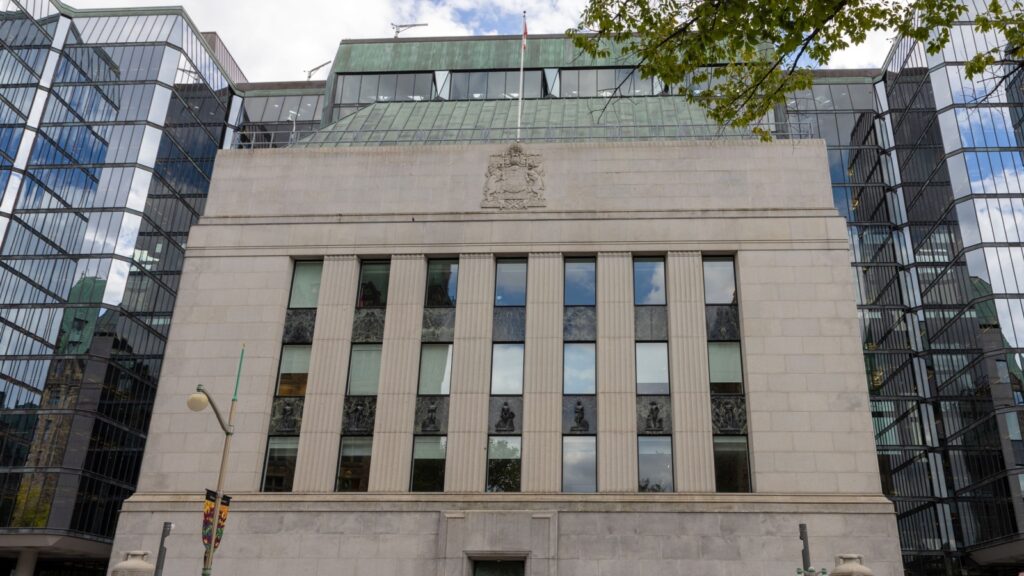
Canada’s renewed trade fight with the United States is creating an unusual problem for the Bank of Canada: some forces are pushing inflation higher, while the trade conflict itself threatens to weaken the economy enough to restrain those same price pressures. TD Economics argues that financial markets may therefore be expecting too many Bank of Canada rate hikes too quickly. The bank’s economists see modest Canadian growth, lingering economic slack and worsening trade uncertainty limiting the case for following the U.S. Federal Reserve higher. At the same time, uncertainty surrounding CUSMA is no longer theoretical. The United States declined to renew the agreement during its July 1 review, moving North America into an annual-review process that could keep businesses waiting longer for a durable trade reset.
TD Thinks Markets May Be Pricing Too Many Bank of Canada Hikes
The starting point for TD Economics is a growing divergence between Canada and the United States. The Federal Reserve raised its target range by a quarter percentage point in September to 3.75%–4.00%, citing elevated inflation and solid U.S. economic activity. TD expects another U.S. increase in the fourth quarter. In Canada, however, TD argues that simply following the Fed would overlook important differences between the two economies. Its September forecast said markets were “overplaying” the likelihood of several imminent Bank of Canada hikes because Canadian inflation pressures are not being driven by the same combination of demand, investment and economic strength.
The Bank of Canada has so far taken that more cautious path. It held its overnight rate at 2.25% on September 2, extending a string of unchanged decisions dating back to late 2025. TD expects trade uncertainty, softer underlying economic conditions and tighter financial markets to keep the central bank on the sidelines rather than automatically responding to higher U.S. rates. That does not mean rate increases are impossible. It means the hurdle is higher: policymakers would need clearer evidence that Canadian inflation is becoming persistent and broad-based rather than being dominated by energy and other temporary shocks.
Canada’s Inflation Problem Looks Different From America’s
Canada’s headline inflation rate appears uncomfortable at first glance. Statistics Canada reported that the Consumer Price Index was 3.0% higher in August than a year earlier, matching July’s increase. Transportation prices were up 7.5%, reflecting the significant role energy costs have played in keeping headline inflation elevated. Yet stripping gasoline out of the calculation produced a considerably milder 2.4% increase. That distinction matters because the Bank of Canada is trying to determine whether the current inflation burst reflects economy-wide demand or concentrated price shocks that could fade without substantial additional monetary tightening.
The Bank reached a similar conclusion at its September meeting. Governing Council noted that inflation excluding gasoline had been 2.2% in July and that core inflation remained around 2%, with little evidence at that point that higher gasoline prices were spreading broadly through the economy. Policymakers nevertheless warned that prolonged energy inflation could eventually affect more goods and services. The result is a difficult balancing act: raising rates unnecessarily could weaken an economy already exposed to tariffs, while waiting too long could become problematic if energy, tariff and supply-chain costs begin feeding into underlying inflation.
Trade Uncertainty Is Acting Like Another Form of Tightening
Tariffs do not need to cover most Canadian exports to influence the Bank of Canada’s thinking. During its September deliberations, Governing Council estimated that recently imposed U.S. tariffs directly affected roughly 5% of Canadian goods exports to the United States. Officials judged the economy-wide direct effect could be relatively modest, even though individual businesses and workers in affected industries could face significant disruption. The broader risk comes from uncertainty: companies unsure about future U.S. market access may delay hiring, machinery purchases, new plants or expansion projects well beyond the industries directly facing tariffs.
Governor Tiff Macklem made essentially the same point in September. He said renewed trade tensions could push businesses back into a period of reassessment after many had begun adapting supply chains and finding new customers. That hesitation can slow investment and employment even before companies experience a direct tariff hit. In monetary-policy terms, the effect can resemble tightening because weaker investment and household confidence reduce demand. TD therefore sees worsening trade relations as one reason Canada may not require the additional rate increases that would otherwise appear justified by higher oil prices or rising global interest rates.
Canada’s Growth Rebound Has Not Eliminated the Weak Spots
Canada produced a surprisingly strong second quarter. Statistics Canada calculated that real GDP increased 0.8% from the previous quarter, with exports, household spending and business investment all contributing. Exports jumped 3.6%, their largest quarterly increase in more than three years, while exports of passenger cars and light trucks surged 27%. The Bank of Canada described the same quarter at an annualized rate of 3.3%, reinforcing the impression that the economy had regained some momentum after a weak start to 2026.
The more recent numbers, however, show why policymakers are reluctant to declare the problem solved. Statistics Canada reported that GDP was essentially unchanged in July, with manufacturing shrinking 0.9%. Its preliminary estimate pointed to only a 0.2% expansion in August. TD expects annual real GDP growth of just 0.9% in 2026, followed by 1.5% in 2027 and 1.8% in 2028. In other words, the spring rebound may improve the starting point without producing the kind of sustained demand boom that normally makes aggressive monetary tightening necessary.
The Labour Market Is Still Softer Than the Headline Suggests
Canada’s unemployment rate has improved considerably from earlier levels, but the latest report still contains signs of slack. Statistics Canada put the August unemployment rate at 6.4%, unchanged from July, while total employment fell by 42,000. Youth employment declined by 19,000, and Quebec and Ontario both lost jobs during the month. Among the roughly 1.5 million unemployed Canadians, 24% had been searching continuously for work for at least 27 weeks—well above the 17.1% pre-pandemic average recorded from 2017 through 2019.
That is why TD describes the labour market as soft rather than truly tight. The Bank of Canada has reached much the same assessment, saying demand for labour remains subdued and the economy continues to operate with excess supply. This matters enormously for inflation. A labour market with spare capacity tends to produce less upward pressure on wages and consumer demand than one characterized by acute worker shortages. The Bank’s September deliberations explicitly noted that softer growth caused by the trade conflict could keep inflationary pressures contained, reducing the urgency for additional rate hikes unless inflation begins spreading more broadly.
Financial Conditions Can Tighten Even When the Bank Does Nothing
The policy rate is only one part of the financial environment facing Canadian households and businesses. The Bank of Canada noted in September that long-term bond yields had climbed globally and that Canadian yields had moved higher as well. Macklem later said stronger expectations of rate increases by major central banks, increased borrowing and elevated oil-driven inflation were contributing to higher global yields. As a result, Canada can import tighter financial conditions from international markets even while its own central bank keeps the overnight rate unchanged.
That helps explain TD’s argument against mechanically matching the Federal Reserve. Higher market interest rates already increase the cost of financing investment, housing and other credit-sensitive activity. TD said those higher yields create an additional obstacle for a Canadian economy facing trade uncertainty and only modest growth. If financial conditions are tightening independently, the Bank of Canada can potentially achieve some of the restraint associated with monetary tightening without repeatedly lifting its own policy rate. The calculation would change if underlying inflation accelerated, but for now trade weakness and market-driven financial tightening are pulling in the opposite direction from energy-driven inflation.
The CUSMA ‘Reset’ Has Already Moved Onto a Longer Track
The CUSMA issue is no longer simply about preparing for a future review. Canada, the United States and Mexico conducted the required six-year joint review on July 1, 2026. Canada and Mexico supported extending the agreement, but the United States did not agree to renew CUSMA in its current form. Importantly, that decision did not terminate the trade pact. CUSMA remains in force, meaning businesses continue operating under the agreement while governments negotiate over unresolved trade concerns.
The agreement itself explains what happens next. Article 34.7 says that when all three parties do not approve a 16-year extension during the six-year review, the commission moves into annual reviews for the remaining term. CUSMA can still be extended at any point if all three governments subsequently confirm their support, but without that agreement it remains on the annual-review track and is currently scheduled to remain in force through 2036. Canada’s government has confirmed that this is now the process underway. A “delayed reset,” therefore, does not mean the July review was postponed; it means long-term certainty has been postponed.
Small Tariff Numbers Can Create Much Bigger Investment Questions
One of the most important themes emerging from both TD and the Bank of Canada is that the economic effect of trade policy cannot be measured only by counting the dollars directly hit by tariffs. TD estimated that some September U.S. restrictions affected relatively small shares of total U.S. imports from Canada. Yet it emphasized that repeated changes to tariff coverage reinforce uncertainty about access to Canada’s largest export market. A factory considering a five- or ten-year investment does not make that decision based only on this month’s tariff schedule; management also has to judge whether market access will remain predictable years later.
That is where unresolved CUSMA negotiations become especially important. The Bank of Canada has warned that an unfavourable review outcome could reduce Canadian exports, investment and production, while recurring reviews could prolong uncertainty. Canada’s 2025 CUSMA consultations drew 5,143 submissions, with participants repeatedly emphasizing predictable, tariff-free North American market access. The continuing agreement provides a foundation, but the absence of a long-term extension leaves another variable hanging over boardroom decisions. That restraint on investment is one of the channels through which trade uncertainty can also weaken the case for higher Canadian interest rates.
Business Investment Is the Biggest Potential Counterweight
There are also reasons the Canadian outlook could become stronger than TD expects. Despite the trade uncertainty, business investment increased at an annualized rate of 8.8% in the second quarter, according to the Bank of Canada. Macklem also said more than two-thirds of Canadian exporters surveyed by the Bank planned to expand into new markets over the next two years, with Europe and the Asia-Pacific attracting increased attention. Successful diversification, productivity investment and major infrastructure spending could eventually make the economy less vulnerable to repeated disruptions in the U.S. relationship.
Ottawa is simultaneously trying to accelerate capital spending through expanded immediate-expensing provisions. TD estimated that the new framework could eventually lift economic activity, although the economists expect most of the benefit to arrive later rather than immediately. TD specifically said convincing evidence of a sustained Canadian investment cycle could eventually change the Bank of Canada’s calculation. Stronger productivity-enhancing investment could raise economic capacity without necessarily creating the same inflation pressure as consumption-driven growth, but a much stronger overall economy could still reduce existing slack and make higher rates more appropriate. For now, TD has not incorporated the full potential investment boost into its baseline forecast.
The Next Move Depends on Whether Inflation Actually Spreads
The Bank of Canada’s next scheduled interest-rate announcement is October 28, when it will also publish a new Monetary Policy Report. By then, policymakers will have another month of information on inflation, growth, trade conditions and the durability of Canada’s summer recovery. The central question is unlikely to be whether headline inflation is above 2% on any single release. Governing Council has repeatedly emphasized the persistence and breadth of inflation—particularly whether energy prices, tariffs and higher business costs start spreading into a wider range of consumer prices.
Macklem summarized the dilemma in September: the Bank does not want to restrain growth unnecessarily if inflation pressures remain contained, but it also does not want to respond too slowly if inflation becomes persistent. TD’s forecast effectively places greater weight on the first risk, arguing that trade uncertainty, economic slack and modest growth should keep the Bank from matching the more hawkish U.S. trajectory. CUSMA negotiations add another layer because a durable extension could revive confidence and investment, while continued annual reviews or further tariff escalation could prolong the restraint. For Canadian households and businesses, interest rates and North American trade policy are becoming increasingly difficult to separate.
