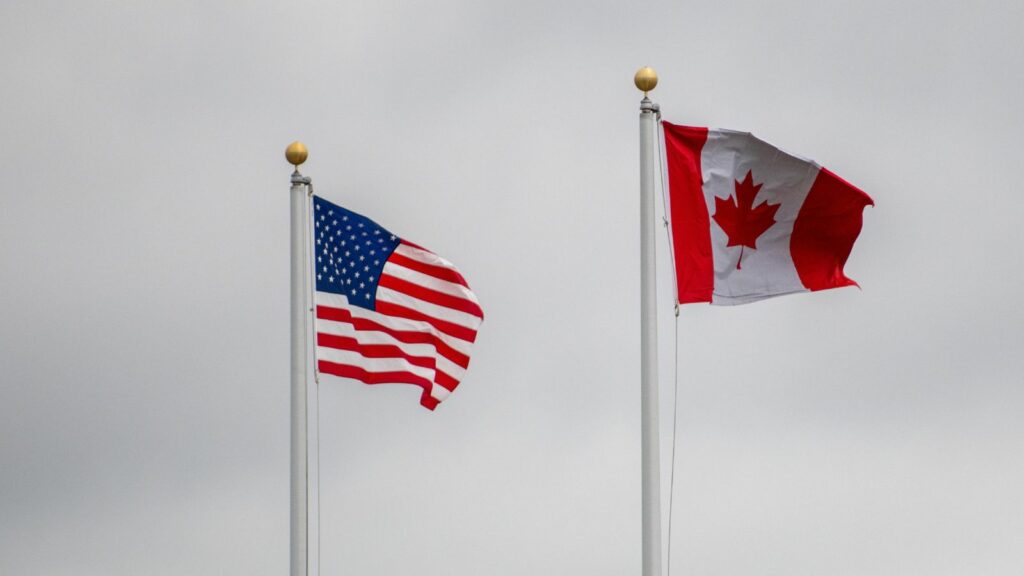
A fresh attempt to push back against President Donald Trump’s escalating tariff dispute with Canada ran into resistance in the U.S. Senate on September 30. According to Sen. Jacky Rosen’s office, Republicans blocked the Nevada Democrat’s effort to pass S.Res. 898, which called on Trump to rescind additional 50% tariffs imposed on certain Canadian goods under Section 338 of the Tariff Act of 1930. No roll-call vote was recorded on the resolution.
The episode matters far beyond one Senate maneuver. The tariffs took effect August 22, Canada retaliated in September, and Washington has since escalated restrictions on some Canadian imports. With hundreds of billions of dollars in annual bilateral trade and CUSMA already entering an uncertain review period, another congressional fight is unfolding over how much tariff authority should remain with the White House.
What Actually Happened in the Senate
Rosen introduced S.Res. 898 on September 24, and the measure was formally referred to the Senate Finance Committee. Six days later, she went to the Senate floor seeking to pass it. Rosen’s office subsequently reported that Senate Republicans blocked the attempt. There was not, however, a recorded Senate roll call on S.Res. 898, an important distinction from legislation defeated through a formal counted vote. Official congressional records still list the resolution as having been referred to Finance.
That procedural detail does not make the confrontation meaningless. Senate business is frequently conducted through unanimous-consent requests, which can fail when a senator objects. But it means the September 30 episode should not be described as, for example, a 51-49 Republican vote against ending the tariffs. What happened instead was a failed attempt to secure Senate passage of Rosen’s resolution without a recorded vote establishing the position of every senator.
The Resolution Would Have Sent a Message, Not Ended the Tariffs by Itself
S.Res. 898 was written as a “sense of the Senate” resolution. Its text said the Section 338 tariffs and tensions surrounding the bilateral relationship were harming American consumers and businesses, urged the president to rescind the Canadian tariffs, and called for an end to rhetoric including references to Canada as a “51st State” and efforts to rename Lake Ontario.
Even if senators had approved it, however, the resolution would not automatically have removed a single tariff. The Senate describes an S.Res. measure as a simple resolution used to express the position of one chamber. It does not require House approval or the president’s signature and does not carry the force of law. Passage therefore would primarily have created a formal statement of Senate sentiment and increased political pressure on the administration. Separate legislation would be needed to repeal the underlying Section 338 authority through Congress.
Why These Canadian Goods Face a 50% Tariff
Trump signed three proclamations on July 20 invoking Section 338 of the Tariff Act of 1930. The administration said Canada discriminated against American commerce in its treatment of automobiles, dairy products and alcoholic beverages. The proclamations authorized additional tariffs of 50% on specified Canadian products, and the White House said the covered goods ranged from wine and hockey equipment to cement and other manufactured products.
The duties were originally scheduled for August 19, but Trump temporarily pushed their implementation back three days while negotiations continued. They ultimately took effect August 22. Unlike some other U.S. tariff measures, the Section 338 duties do not provide a general exemption simply because a product qualifies for preferential treatment under CUSMA. Ottawa says affected categories have included plastics, furniture, electronics, paper, industrial machinery, wood products, clothing and sporting equipment.
Washington and Ottawa Tell Very Different Stories About the Dispute
The Trump administration argues that Section 338 is being used as Congress intended: to respond when another country discriminates against U.S. commerce. Its proclamations accuse Canada of disadvantaging American alcoholic beverages, using discriminatory dairy tariff-rate quota allocations and maintaining automobile measures that treat U.S. commerce less favourably. Section 338 authorizes additional duties of as much as 50% when the president makes the required findings.
Canada rejects important parts of that characterization. The federal Trade Commissioner Service says Canadian restrictions involving U.S. alcohol and vehicles were originally adopted in response to American tariffs imposed in 2025. Ottawa also maintains that its administration of CUSMA dairy tariff-rate quotas complies with the trade agreement. In other words, Washington describes the tariffs as a response to Canadian discrimination, while Ottawa describes key measures cited by Washington as either compliant with CUSMA or retaliatory actions taken after earlier U.S. measures.
Canada’s Retaliation Quickly Raised the Stakes
Ottawa did not leave the August tariffs unanswered. Effective September 8, Canada imposed new duties of 15%, 25% and 50% on C$27.6 billion worth of U.S. imports, with rates generally designed to match corresponding American measures. The Canadian list reaches into steel and aluminum, dairy, appliances, agricultural machinery, pulp and paper, plastics and electronics. Canada described the approach as a dollar-for-dollar response to the Section 338 measures.
Washington then went beyond tariffs on some products. Import restrictions taking effect September 29 excluded certain Canadian alcoholic beverages and other targeted products from the U.S. market altogether. Associated Press estimated the new bans covered nearly US$1 billion in imports, including alcohol, some dairy products and motorcycles. For smaller Canadian producers, the escalation is particularly tangible: firms that once viewed the United States as a natural first export market are now looking for replacement customers while also navigating provincial barriers inside Canada.
The Economic Relationship Is Too Large for the Fight to Stay Narrow
Canada and the United States are not marginal trading partners that can easily separate supply chains. U.S. Trade Representative data put two-way goods and services trade at an estimated US$872.3 billion in 2025. Goods alone accounted for US$715.5 billion, including US$333.6 billion in American exports to Canada and US$381.9 billion in imports from Canada. The United States also recorded a US$27.7 billion services surplus with Canada.
Those numbers help explain why seemingly targeted tariff lists can spread consequences well beyond the companies whose finished products cross the border. Canadian and American factories share suppliers, machinery, materials and customers, particularly in manufacturing-heavy industries. A tariff paid by a U.S. importer may therefore become a higher input cost for an American business, while Canadian retaliation can raise costs or reduce demand for an American exporter. For companies operating on both sides of the border, uncertainty itself can complicate purchasing, investment and inventory decisions.
Tourism Has Become Another Pressure Point
The deterioration in the relationship has coincided with a striking change in Canadian travel patterns. Statistics Canada reported that Canadians made 23.1 million trips that included a U.S. visit in 2025, down 23.5% from 2024 and 26.7% from 2019. Canadian spending on U.S. visits fell 15.1% to C$18.8 billion. At the same time, Canadian travel to overseas destinations increased 10.2%, suggesting the decline was not simply a broad retreat from international travel.
That trend explains why a Nevada senator became one of the most visible congressional voices in the Canada dispute. Rosen told the Senate that nearly 1.5 million Canadians visited Nevada in 2024 and said Canadian tourism to Las Vegas dropped about 17% in 2025. Her office also puts Nevada’s annual goods exports to Canada at roughly US$1.6 billion. Those figures formed the local economic argument behind a resolution aimed at a bilateral issue stretching thousands of kilometres beyond Nevada.
Research Shows How Tariffs Can Move Through Household Budgets
The exact price effect of the new Canadian tariffs will take time to measure, and existing studies should not be treated as precise estimates of the Section 338 measures. Research into earlier U.S. tariffs nevertheless shows how import duties can work their way through the economy. A September 2026 revision of a New York Federal Reserve study estimated that roughly 26% of the tariff increases it examined passed through to consumer prices.
The researchers found that about 64% of the measured consumer-price effect came directly through more expensive foreign varieties, while 36% was indirect, including higher imported-input costs and changes in domestic producers’ markups. The indirect effect could take nine to 12 months to emerge. Separate Federal Reserve research into 2025 tariffs found that lower-income households carried a disproportionate welfare burden and that consumers reduced purchases of affected goods. Those findings offer context for the Senate dispute, but they do not establish exactly how much the new Canada-specific tariffs will raise U.S. prices.
Congress Has Challenged Presidential Canada Tariffs Before
The September confrontation was not Congress’s first attempt to intervene. In April 2025, the Senate passed S.J.Res. 37 by 51-48 to terminate the national emergency then being used to impose tariffs on Canadian goods. Four Republicans—Susan Collins, Mitch McConnell, Lisa Murkowski and Rand Paul—joined Democrats in supporting that measure. That earlier fight involved tariffs imposed under different legal authority from the current Section 338 measures.
The legal landscape has also changed. In February 2026, the Supreme Court ruled in Learning Resources, Inc. v. Trump that the International Emergency Economic Powers Act did not authorize the tariffs challenged in that case. The current Canadian duties rest instead on Section 338, so that ruling did not itself invalidate them. Lawmakers including Rosen have now backed S.5397, the BAD DEAL Act, which would go substantially further than S.Res. 898 by repealing Section 338, nullifying proclamations issued under it and requiring refunds of duties collected under that authority.
The Larger Canada-U.S. Trade Question Remains Unsettled
For now, blocking Rosen’s resolution leaves the Section 338 tariffs untouched. The official record continues to show S.Res. 898 referred to the Senate Finance Committee, while the separate BAD DEAL Act was also referred there after its September 15 introduction. That leaves two distinct congressional approaches on the table: a nonbinding statement urging the president to change course and legislation that would actually remove the statutory authority being used for the tariffs.
The dispute is also unfolding against a much larger question about CUSMA. At the agreement’s July 1 joint review, the United States declined to renew it in its current form, although the agreement remains in force while talks continue. On September 25, U.S. Trade Representative Jamieson Greer said Trump saw no urgent need to reach a new trade accommodation with Canada. That leaves businesses confronting several overlapping uncertainties at once: existing tariffs, retaliation, product bans, congressional challenges and an unresolved future for North America’s central trade framework.
