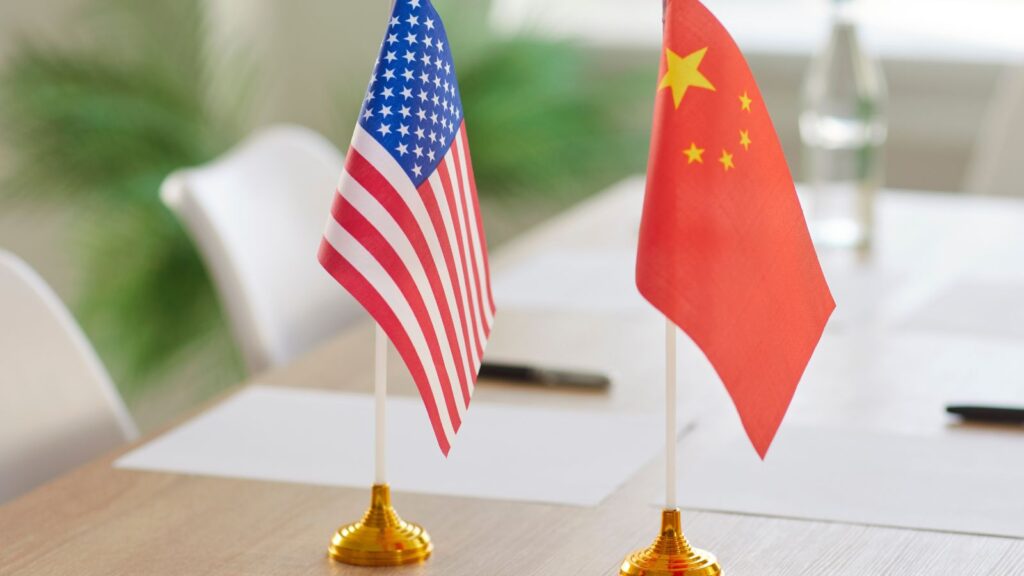
Within weeks, Washington has produced two strikingly different images of how it handles China and Canada. President Donald Trump welcomed Chinese President Xi Jinping to Washington for a high-profile state visit as the two governments extended their fragile trade truce. Canada, meanwhile, has faced tariffs, a stalled CUSMA renewal process and explicit warnings from U.S. officials about becoming a pathway for Chinese investment and vehicles into the American market.
That contrast has intensified accusations of a trade double standard. Yet the dispute is more complicated than warm treatment for Beijing and hostility toward Ottawa. Washington argues that dealing directly with China is different from deciding what kinds of Chinese investment should qualify for preferential access inside an integrated North American market. That distinction has become one of the central fault lines in the Canada-U.S. trade fight.
Washington’s Optics Have Changed Fast
The symbolism surrounding Xi’s September visit was difficult to miss. Trump personally welcomed the Chinese president, hosted an elaborate state program and repeatedly emphasized their relationship even as major economic disputes remained unresolved. The visit represented Xi’s first trip to Washington in more than a decade and his second meeting with Trump in 2026. A state dinner and meetings involving prominent business figures reinforced the impression that the White House wanted to stabilize the relationship rather than allow another uncontrolled escalation in the trade war.
The diplomatic warmth should not be mistaken for a broad U.S.-China reconciliation. Reuters reported that the summit produced no breakthrough on several difficult subjects, including trade, artificial intelligence and geopolitical disputes. Tariffs remain, technology restrictions remain, and American officials continue to challenge China over agricultural purchases, rare-earth access and industrial policy. The significance for Canada is therefore largely about contrast: Washington is showing that it is prepared to negotiate, dine and make temporary accommodations with its largest strategic economic rival while simultaneously demanding tighter conditions from one of its closest trading partners.
The CUSMA Dispute Now Has a China Dimension
The United States declined on July 1 to extend CUSMA for another 16-year period at the agreement’s first joint review. That did not terminate the pact. CUSMA remains in force, and because the three countries did not unanimously extend it, annual reviews can continue while unresolved issues are negotiated. Canadian officials have stressed that the agreement can still be extended later, while Washington has used the review to press for changes involving automotive trade, rules of origin and other longstanding irritants.
China has become increasingly visible in that debate. U.S. Trade Representative Jamieson Greer has said Washington does not want Chinese investment or Chinese-made vehicles using Canada as a route into the American market. He specifically linked Canada’s expanding economic relationship with Beijing to U.S. reluctance to renew CUSMA in its current form. That does not mean China is Washington’s only complaint with Canada; disagreements also involve agricultural access, digital policies, retaliatory tariffs and North American content requirements. But Beijing is no longer a peripheral issue in the negotiations. It is increasingly part of the argument over who should benefit from the continent’s preferential trading system.
The U.S. Is Bargaining With Beijing, Not Walking Away
At the same time that Washington is warning Canada about economic integration with China, the United States itself is conducting extensive negotiations with Beijing. Ahead of Xi’s Washington visit, Treasury Secretary Scott Bessent said the two countries had agreed to extend their current trade arrangement until January 10, 2027. Officials have also discussed agricultural purchases, tariffs, artificial intelligence, energy trade and mechanisms intended to expand commerce in areas considered less sensitive to national security.
The scale of the underlying relationship helps explain why complete economic separation is difficult. U.S. Census Bureau figures show that from January through July 2026, the United States exported roughly US$65.2 billion in goods to China while importing about US$156.4 billion, leaving a goods deficit of approximately US$91.2 billion. Even after years of tariffs, export controls and supply-chain diversification, the two economies remain deeply connected. Washington’s strategy has therefore looked less like abandoning commerce with China and more like separating transactions it considers acceptable from sectors it views as strategically dangerous. That distinction is important because it is also the logic American officials are attempting to apply to North American trade.
Ottawa Reopened the China Door for Economic Reasons
Canada’s renewed engagement with Beijing did not emerge in a vacuum. Prime Minister Mark Carney travelled to China in January 2026 in the first visit by a Canadian prime minister since 2017. The two governments announced a new strategic partnership covering trade, energy and other areas. Canada agreed to permit up to 49,000 Chinese electric vehicles annually at the 6.1% most-favoured-nation tariff rate, a quantity Ottawa said would represent less than 3% of Canada’s new-vehicle market. China, meanwhile, agreed to sharply reduce its tariff on Canadian canola seed and suspend several other agricultural tariffs.
Those concessions mattered far beyond diplomatic symbolism. Canadian farmers had been dealing with punishing Chinese tariffs, while Ottawa was openly trying to reduce the economy’s dependence on a U.S. market made less predictable by renewed tariff disputes. Yet diversification should not be confused with replacing the United States. Statistics Canada reported that 71.7% of Canada’s merchandise exports still went to the U.S. in 2025. China accounted for only about 4.5% of Canadian merchandise exports that year. Even a rapidly expanding relationship with Beijing therefore remains much smaller than the economic connection tying Canada to its southern neighbour.
Chinese EVs Have Become the Most Visible Flashpoint
Few issues illustrate the disagreement better than electric vehicles. Ottawa’s 49,000-vehicle quota is relatively modest compared with Canada’s overall auto market, and the federal government has presented it as a controlled opening that could create competition and potentially encourage Chinese investment in Canadian manufacturing. Washington views the situation through a different lens. Greer has warned specifically about Chinese automakers establishing themselves in Canada and ultimately seeking greater access to the much larger U.S. market. Reuters has also reported that some Chinese manufacturers see Canada as a useful market in which to establish a North American foothold.
That does not mean a Chinese vehicle arriving in Canada can simply cross into the United States tariff-free. CUSMA contains detailed rules of origin governing which automobiles qualify for preferential treatment. The longer-term U.S. concern is what happens if Chinese companies invest in Canadian assembly plants, components or battery supply chains and gradually satisfy enough North American-content requirements to gain preferential access. Washington has similarly raised concerns with Mexico about “non-market” inputs entering regional supply chains. For Canadian policymakers, those rules are meant to manage legitimate investment. For American negotiators, they are becoming a central test of how tightly the North American production system should be insulated from China.
Why Critics See a Double Standard — and Why Washington Disagrees
The timing gives critics an obvious argument. The Trump administration has imposed or threatened substantial trade measures against Canadian goods and has publicly objected to Ottawa’s retaliation against U.S. tariffs. The White House has noted that Canada and China were the two major trading partners that retaliated rather than simply accepting Washington’s tariff demands. Yet the administration has simultaneously extended a tariff truce with Beijing and offered Xi the diplomatic prestige of a state visit in Washington. Viewed purely through those events, the difference in treatment can look difficult to reconcile.
The administration’s stated logic draws a distinction between negotiating directly with China and protecting preferential access within CUSMA. China trades with the United States under tariffs and restrictions specifically designed for the bilateral relationship. Canada, by contrast, receives extensive preferential treatment because it belongs to an integrated regional agreement. U.S. officials argue that this creates a legitimate reason to scrutinize whether investment originating from countries outside the pact could benefit indirectly from North American preferences. The disagreement, therefore, is not simply over whether anyone should trade with China. It is over whether Canada’s choices concerning Chinese investment could eventually change who benefits from the rules governing the continental market.
Canada’s China Strategy Still Comes With Security Guardrails
Ottawa’s push for more commerce with Beijing has not been accompanied by an official claim that China presents no strategic risk. Canada’s intelligence service continues to take a considerably harder view. In its 2026 assessments, the Canadian Security Intelligence Service described the People’s Republic of China as the most active state conducting foreign interference in Canada in both scale and scope. Federal assessments have also identified concerns involving cyber activity, transnational repression, intellectual-property theft and the movement of sensitive technology.
The federal government’s own China policy therefore combines economic engagement with explicit security qualifications. Global Affairs Canada describes the relationship as one in which commercial opportunities exist alongside serious national-security and economic-security risks. The January strategic partnership included new channels for dialogue, but it did not erase Canada’s screening powers or its stated intolerance for foreign interference. This tension helps explain why the Canadian approach cannot accurately be reduced to a straightforward “pivot to China.” Prairie farmers, energy exporters and manufacturers may see expanded access to the world’s second-largest economy as a practical hedge against U.S. disruption, while security agencies are simultaneously urging policymakers to limit vulnerabilities created by that same relationship.
The Trade Numbers Show Why Diversification Has Momentum
The economic incentive to broaden Canada’s customer base has become increasingly visible in the data. Research from the Canada China Business Council and the University of Alberta found that Canadian merchandise exports to China rose 30.1% in the first half of 2026, reaching C$21.74 billion. Energy accounted for roughly 35.8% of Canadian exports to China during the period and increased 81.8%, while metals and minerals represented about 22.6%. Crude-oil exports alone reached approximately C$5.96 billion, helped by Canada’s expanded ability to ship western crude to Pacific markets.
Agriculture has also benefited from the partial easing of trade barriers. The same report found Canadian canola-seed exports to China increased 19.4%, while pea exports climbed 39.6% and beef shipments began recovering after market access improved. Those figures help explain why Chinese access can matter enormously to particular Canadian communities even though China remains a much smaller national market than the United States. An Alberta energy producer, Saskatchewan grain farmer or Atlantic seafood exporter can experience the China relationship very differently from an Ontario auto supplier whose business depends overwhelmingly on uninterrupted access to U.S. customers. Diversification offers opportunity, but Canada’s underlying trade geography remains heavily North American.
CUSMA Already Contains a China-Related Safety Valve
Concerns about one North American partner entering into a much deeper trade relationship with a non-market economy were anticipated when CUSMA was negotiated. Article 32.10 requires a member planning a free-trade agreement with a designated non-market country to notify the other members and provide information about the proposed deal. If such an agreement ultimately enters into force, the other CUSMA partners can terminate the trilateral agreement on six months’ notice and replace it with a bilateral arrangement between themselves. The provision was widely understood when negotiated as particularly relevant to China.
There is an important distinction, however. Canada’s January 2026 strategic partnership with China is not a Canada-China free-trade agreement, so the Article 32.10 mechanism is not automatically triggered by the EV quota, agricultural concessions or investment discussions announced so far. That makes some of the more dramatic claims about Canada already violating CUSMA difficult to sustain on the basis of this clause alone. Nevertheless, Article 32.10 demonstrates that concerns about Chinese economic integration have been embedded in North America’s trade architecture for years. The present fight is less about discovering a new problem than about deciding how broadly those longstanding protections should be interpreted as Chinese companies expand globally.
The Bigger Fight Is Over Who Sets North America’s Economic Rules
The immediate tariff disputes may dominate headlines, but the longer-term argument is about the architecture of North American commerce. Greer has indicated that Washington wants interim arrangements with Canada and Mexico before the end of 2026, followed by more extensive work on automotive rules, labour provisions, environmental commitments and supply-chain protections. CUSMA remains in force while that process continues, meaning businesses are operating inside an agreement whose long-term rules are still being contested.
At the same time, Washington is attempting to manage rather than eliminate its economic relationship with Beijing. The current U.S.-China trade arrangement runs into January 2027, while Canada is developing wider commercial relationships not only with China but also with Europe and Asia. The result is an unusual three-way tension: Ottawa wants more freedom to diversify, Washington wants stronger protection against Chinese penetration of North American supply chains, and Beijing wants greater access to markets that have spent years building barriers against Chinese industrial exports. The “double-standard” debate grows out of that collision. The central disagreement is whether U.S. engagement with China and U.S. restrictions on Canada’s China ties represent inconsistent treatment—or distinct policies for two fundamentally different trading relationships.
