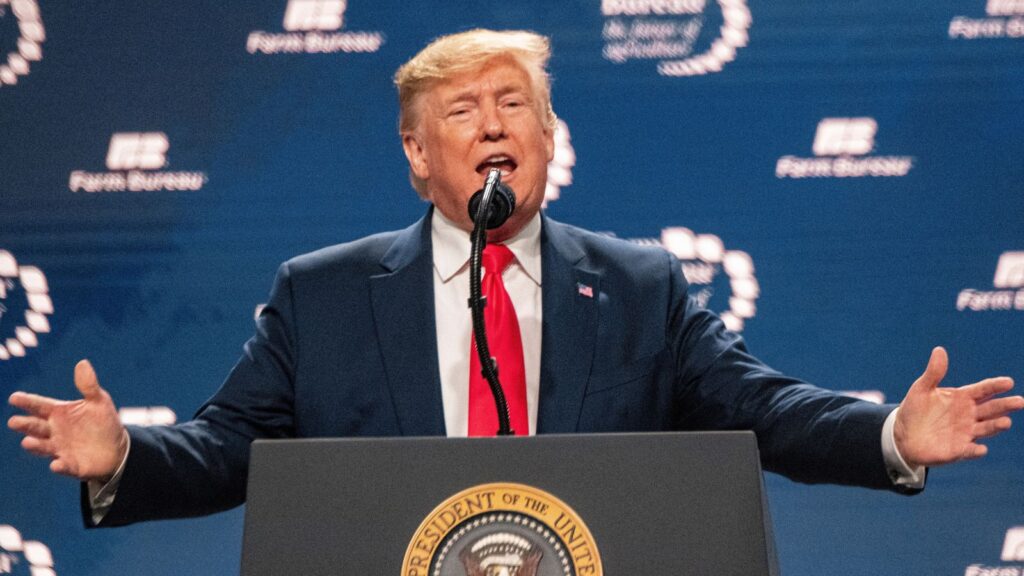
President Donald Trump has unveiled plans for a US$15 billion steel complex in Iowa, presenting the investment as evidence that his tariff-heavy trade strategy is drawing manufacturing back to the United States. Mesabi Metallics plans to build the massive facility in eastern Iowa, with steelmaking targeted to begin in 2030 and at least 1,750 permanent jobs expected once operations are established.
For Canada, the timing is difficult to ignore. Canadian steel producers remain heavily dependent on the U.S. market while navigating tariffs, weaker cross-border demand and increasing competition at home. On the same day the Iowa investment was announced, Stelco confirmed plans to idle finishing operations in Hamilton, Ontario, affecting as many as 500 employees. Together, the developments illustrate how quickly North America’s steel landscape is being reshaped by tariffs, new capacity and increasingly national industrial policies.
A US$15 Billion Bet on American Steel
Mesabi Metallics plans to invest US$15 billion in a new steel complex in Lee County in eastern Iowa. Trump unveiled the project at the White House on September 28 alongside company executives, cabinet officials and Iowa political leaders. The administration says construction could support as many as 6,000 jobs, while the completed operation is expected to employ at least 1,750 people permanently. Production is currently targeted to begin in 2030, meaning the economic effects will develop over several years rather than immediately.
The White House has projected that the project could generate roughly US$95 billion in economic impact during its first decade, although that remains a forecast rather than realized economic activity. Iowa officials have described the investment as potentially transformational for the region. The sheer capital commitment makes the proposal unusual even by heavy-industry standards, but substantial construction, permitting, financing and infrastructure work still separates the announcement from the first shipment of steel.
The Job Numbers Are Significant, but Construction Comes First
The permanent employment figure of at least 1,750 jobs is only part of the workforce story. During construction, the project is expected to support as many as 6,000 jobs as furnaces, processing equipment, transportation links and supporting infrastructure are installed. For a steel project expected to operate for decades, the permanent positions could ultimately matter more to surrounding communities because they would provide an industrial employment base after the construction surge ends.
Those jobs also represent only the Iowa portion of Mesabi’s broader plan. The company is simultaneously developing its iron-ore operations in Minnesota, where hundreds of permanent positions are expected. The White House has said the Iowa jobs could pay an average of about US$49 an hour, although actual compensation will ultimately depend on occupations, hiring arrangements and labour agreements. Much of the employment impact therefore remains prospective, tied to whether construction proceeds on schedule and the mill reaches its planned operating scale.
The Planned Mill Would Add Enormous New Steelmaking Capacity
Mesabi plans to start the Iowa operation with approximately 7.5 million tons of annual steelmaking capacity and eventually expand toward roughly 10 million tons. That would make the complex one of the largest steelmaking facilities in the United States if the full build-out is completed. The plant is expected to use electric-arc furnaces, combining iron products with recycled scrap rather than relying exclusively on the traditional blast-furnace model that has defined much of North American steelmaking history.
The scale becomes clearer beside existing U.S. production. The American Iron and Steel Institute reported approximately 90 million net tons of U.S. raw steel production during 2025. By late September 2026, American mills were operating at roughly 80% capability utilization, with year-to-date production running ahead of 2025 levels. A single new complex capable of producing millions of tons annually would therefore be meaningful additional supply, potentially influencing import requirements, domestic competition and investment decisions elsewhere in the industry after 2030.
Minnesota Iron Ore Is Central to the Iowa Strategy
The Iowa mill is designed as the downstream half of a much larger supply chain. Mesabi Metallics recently began startup activity at its new iron-ore mine and pellet operation near Nashwauk, Minnesota. More than US$2.5 billion has been invested in that project, which is intended to produce approximately seven million metric tons of direct-reduction-grade iron-ore pellets annually. Around 350 permanent positions are expected at the Minnesota operation once it reaches commercial production.
That connection is important because Mesabi’s strategy is not simply to build another finishing facility supplied by global raw materials. Iron ore would move from Minnesota toward Iowa, where it could be combined with recycled scrap and processed into steel. The eastern Iowa location also provides access to major rail and Mississippi River transportation networks. The U.S. Export-Import Bank has announced support of up to US$10 billion for expansion of Mesabi’s Minnesota operation, making federal financing part of the broader effort to establish a domestic mine-to-mill supply chain.
Trump Is Explicitly Linking the Investment to Steel Tariffs
Trump presented the announcement as validation of his tariff strategy, arguing that foreign and domestic companies increasingly have an incentive to manufacture inside the United States rather than pay duties on imported steel. His administration raised Section 232 tariffs on many imported steel and aluminum products to 50% in 2025 and subsequently revised the tariff structure in 2026. Rates vary for certain products and exceptions, but substantial duties continue to affect foreign steel entering the American market.
Whether tariffs alone produced the Iowa investment is more difficult to establish. Mesabi’s Minnesota mining project had been under development for years, and major industrial facilities typically depend on a combination of commodity prices, financing, infrastructure, government policy and expected long-term demand. Tariffs can increase the attractiveness of domestic production by raising the price of competing imports, but they can also raise costs for American companies that consume steel. The Iowa announcement therefore provides evidence of investment under the tariff regime without establishing a simple one-cause explanation for the project’s economics.
Canadian Steel Is Particularly Exposed to Changes in U.S. Demand
Canada has more at stake in American steel policy than most U.S. trading partners because the industries on either side of the border developed around deeply integrated supply chains. Federal Canadian data shows that slightly more than half of Canada’s steel production was exported in 2024, with more than 90% of those exports going to the United States. That concentration leaves Canadian mills particularly vulnerable when access to the American market becomes more expensive or unpredictable.
Statistics Canada has quantified the employment connection as well. In 2024, U.S. demand supported roughly 67% of payroll jobs in Canada’s iron and steel mills and ferro-alloy manufacturing industry, equivalent to approximately 9,800 jobs. The pressure was already visible the next year: Canadian exports of unwrought iron, steel and ferro-alloys to the United States were down 20.2% in 2025 compared with 2024. New American capacity does not automatically eliminate Canadian demand, but it adds another long-term variable to an already difficult trade environment.
Hamilton Is Seeing the Human Impact of the Steel Dispute
The contrast with Iowa became especially stark when Stelco announced plans to indefinitely idle its cold-rolled and coated finishing operations at Hamilton Works beginning around October 9. The decision could affect as many as 500 employees across Hamilton and Lake Erie operations. Stelco said it would concentrate production at its Lake Erie Works facility in Nanticoke and planned to offer employment opportunities there to some affected Hamilton workers.
Stelco has pointed to both U.S. tariffs and difficult Canadian market conditions. The company said demand in markets traditionally served by its cold-rolled and galvanized products had fallen nearly 25% by the second quarter of 2026 compared with the quarterly average in 2024, including an approximately 10% decline in Canadian demand. It also argued that continued steel imports into Canada were preventing domestic producers from fully replacing business disrupted by the trade conflict. Behind those percentages are families in one of Canada’s oldest steelmaking communities confronting another period of industrial uncertainty.
Canada Is Building a Defensive Trade Wall of Its Own
Ottawa has responded by making Canadian steel policy increasingly defensive. Canada currently imposes tariffs on selected U.S. steel and aluminum goods in response to American measures. Beginning September 8, 2026, the federal government expanded its countermeasures, applying tariffs of 15%, 25% or 50% to C$27.6 billion worth of selected U.S. imports, including products in the steel sector, with rates generally designed to correspond to the American measures being answered.
Canada has also tightened restrictions against steel arriving from other countries. Tariff-rate quotas restrict the volumes that can enter from many non-CUSMA trading partners before a 50% surtax applies. Ottawa says those policies are intended partly to prevent steel originally destined for the United States from being redirected into Canada after American tariffs close off or reduce access to that market. The challenge is balancing protection for Canadian mills with the needs of manufacturers that still require competitively priced steel inputs.
Ottawa Is Combining Tariffs With Billions in Industry Support
Trade barriers are only one part of Canada’s response. The federal government has assembled several financing and industrial-support programs aimed at helping steel and other tariff-affected manufacturers adjust. Measures include a Strategic Response Fund worth billions of dollars across affected strategic industries, as well as a C$1 billion Business Development Bank of Canada financing program designed for steel, aluminum and copper producers and exporters facing tariff-related liquidity pressure.
The BDC program allows eligible companies to seek loans ranging from C$2 million to C$50 million, while Ottawa has also expanded its Regional Tariff Response Initiative. Earlier steel-specific measures included funding for modernization, domestic supply-chain development and worker retraining. Canada has simultaneously moved toward greater use of domestically produced metals through federal procurement and Buy Canadian policies. These programs cannot restore tariff-free American market access on their own, but they illustrate Ottawa’s attempt to keep productive capacity and skilled workers in Canada while companies search for customers at home and in other export markets.
The Biggest Competitive Shift Would Come After 2030
The Iowa project’s most important consequences are still years away. First production is not expected until around 2030, and the facility would have to progress through construction, infrastructure development and commissioning before its planned 7.5-million-ton initial capacity becomes available. Details surrounding potential Iowa incentives have also remained a subject of discussion, meaning the announcement should be understood as a major planned investment rather than an operating mill that is already changing steel supply.
Markets nevertheless noticed the scale immediately. Shares of major American steel producers including Cleveland-Cliffs, Nucor and Steel Dynamics fell after the announcement as investors considered what millions of tons of additional capacity could eventually mean for competition and pricing. For Canadian producers, the calculation is broader. Tariffs pose the immediate challenge, while a much larger U.S. domestic steel base could become the longer-term one. The outcome will depend on trade negotiations, demand growth, infrastructure spending and whether Canada succeeds in expanding domestic and overseas markets before the Iowa complex starts producing steel.
