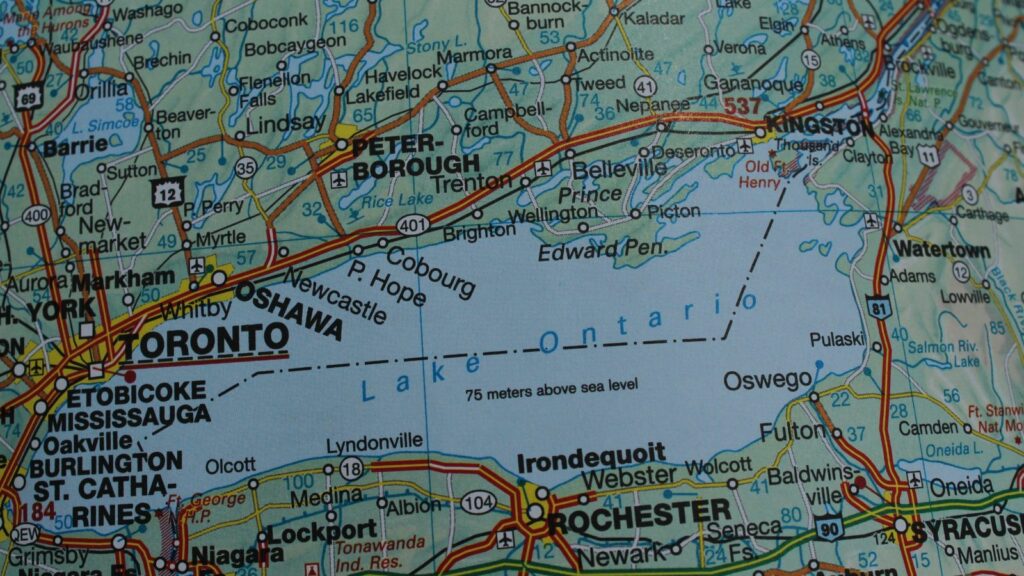
A decades-old mapping brand has unexpectedly found itself at the centre of one of the strangest technology stories in the Canada-U.S. relationship. After President Donald Trump signed an executive order on August 27 directing the U.S. federal government to rename Lake Ontario as “Lake America,” MapQuest took a different approach from some of its much larger competitors: it kept Lake Ontario on its maps.
The response gave the 30-year-old navigation company a surge few would have predicted. By September 25, MapQuest said three million new users, including many Canadians, had downloaded its app since the order. What began as a dispute over a familiar geographic name quickly became a case study in how politics, technology platforms, national identity and consumer behaviour can collide almost overnight.
The Rename Is Official in Washington, but It Is Not Universal
Trump’s August 27 executive order, formally numbered Executive Order 14422, goes considerably further than simply suggesting a new nickname. It directs the U.S. secretary of the interior, working with the U.S. Board on Geographic Names, to take the necessary steps to rename Lake Ontario as Lake America. The order gives officials 30 days to update the federal Geographic Names Information System and directs federal departments and agencies to use the new designation on government maps, contracts, documents and communications. That makes Lake America the name chosen by the U.S. administration for federal purposes. It does not, however, create a universally binding name for everyone who maps, manages or lives around the lake. Private companies remain capable of making their own decisions about what terminology appears on their services.
That distinction matters because Lake Ontario is quite literally an international body of water. The Canada Water Agency describes it as the easternmost Great Lake straddling the Canada-U.S. border, with Ontario on its northern and western shores and New York State to the south and east. Its surface covers roughly 18,960 square kilometres, and the international boundary runs through the lake. Natural Resources Canada continues to list “Ontario, Lake / Lac Ontario” among Canada’s geographical names of pan-Canadian significance. The waterway also exists within a much older framework of cross-border co-operation: the 1909 Boundary Waters Treaty established mechanisms through which Canada and the United States deal with shared-water issues. A U.S. federal naming decision therefore changes American government terminology without automatically rewriting the geographic language used by Canada, international bodies or private mapping companies.
MapQuest’s Two-Word Response Became a Download Machine
MapQuest’s response came almost immediately after Trump signed the order. Rather than produce a lengthy corporate statement, the company posted an image showing Lake Ontario under its existing name along with a short message: “We’re not changing it.” That simplicity helped the post travel quickly across social media. More importantly for the company, the attention translated into actual downloads. System1, MapQuest’s parent company, reported on August 31 that hundreds of thousands of people had installed the app in just a few days and that usage was running at roughly 50 times its normal level. At that point, MapQuest had become the No. 1 navigation app in Apple’s U.S. App Store, while reaching No. 8 among all free U.S. apps and No. 2 overall in Canada.
The momentum kept building. By September 1, System1 said MapQuest had reached the No. 1 overall free-app position in Apple’s App Stores in both Canada and the United States. A week later, the company announced that more than two million new users had installed its iOS and Android apps. The newest figure is even larger. In a Canadian Press interview published September 25, MapQuest general manager Doug Berger said three million new users, including many Canadians, had downloaded the app since the executive order. That progression is important because early stories reported figures closer to 500,000 or 1.5 million. Those numbers were not necessarily contradictory; they were snapshots taken while downloads were still rapidly accumulating. The three-million figure reflects MapQuest’s latest publicly reported total.
An Old Internet Brand Suddenly Has a Second Chance
The episode is particularly striking because MapQuest is hardly a new technology company chasing its first breakthrough. The service launched on the web in 1996 and became one of the defining navigation brands of the early internet. For millions of drivers, the MapQuest experience once meant printing several pages of turn-by-turn directions before leaving home and keeping those sheets within reach during a road trip. Smartphones, built-in GPS systems and services such as Google Maps, Apple Maps and Waze gradually pushed the brand out of everyday conversation. Today MapQuest is owned by California-based System1, and Berger told The Canadian Press that the MapQuest team has roughly 50 employees. That relatively small operation suddenly found itself handling a massive influx of attention that would have seemed unlikely only weeks earlier.
The political environment also helps explain why MapQuest’s decision resonated, although the download numbers alone cannot reveal every individual user’s motivation. A Reuters/Ipsos poll conducted among 1,023 U.S. adults from August 28 to 30 found that 63% opposed renaming Lake Ontario, while 14% supported the move; the poll had a margin of error of four percentage points. MapQuest has since tried to turn the attention into something more durable. The company began selling “We’re Not Changing It” merchandise, while Berger said feedback from the new audience helped encourage additions such as local transit information and Android Auto support. He even visited Toronto’s Lake Ontario waterfront in September, describing the lake as the place that gave MapQuest its unexpected moment. The larger question is whether three million new downloads become long-term users. The available data establishes an extraordinary comeback in attention and installations, but not yet how much of that audience will remain once the naming controversy fades.
