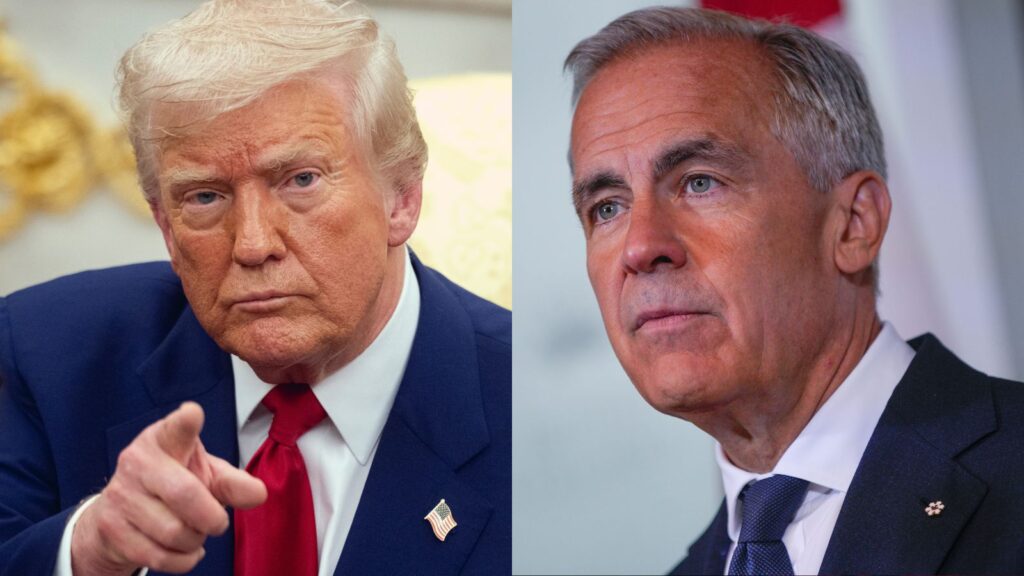
The public confrontation between Washington and Ottawa may be louder than ever, but Canadian diplomats say a quieter conversation is unfolding behind the scenes. Members of Parliament have been told that American contacts are privately expressing concern about some of the Trump administration’s increasingly aggressive actions toward Canada, even as relatively few are prepared to challenge the White House publicly.
The disclosure adds an important wrinkle to a relationship strained by tariffs, collapsed trade negotiations and repeated attacks on Canada’s economic and security credentials. It does not mean a revolt is forming inside Washington, and the people raising concerns were not identified. What it does suggest is that Canada still has sympathetic audiences across American political, business and institutional circles at a moment when the official relationship remains deeply unsettled.
MPs Were Told the Private Message Is Different From the Public One
Niall Cronin, director general of Global Affairs Canada’s North America bureau, told MPs that Canada’s diplomatic network continues to hear considerable support for the bilateral relationship inside the United States. According to his testimony, American contacts understand the economic and security benefits that flow from cooperation with Canada. More significantly, he said some have privately raised concerns about steps taken by the Trump administration. Cronin also acknowledged the obvious limitation: relatively few of those people are willing to make their objections public.
That distinction matters. The testimony does not establish that senior members of Trump’s cabinet are secretly opposing the president, nor did Cronin identify the officials or other contacts involved. The picture is broader and less dramatic: Canadian diplomats are hearing unease among people they deal with across American political, business and institutional networks. For Ottawa, even that is useful. It means the White House’s increasingly confrontational approach should not automatically be interpreted as representing every influential American actor Canada deals with.
Private Concern Should Not Be Mistaken for an Internal U.S. Rebellion
The most important limitation on the testimony is what Canadians were not told. There were no names attached to the private concerns, no indication that they had produced a change in administration policy and no suggestion that a coordinated group inside Washington was preparing to confront Trump. Cronin’s wording was cautious: Canadian diplomats were hearing objections privately, while only a limited number of Americans were prepared to take those concerns into public view.
There are, however, examples of Americans breaking that silence. Republican Senator Susan Collins of Maine publicly warned after the August breakdown in trade negotiations that tariffs on Canada would raise costs and uncertainty for businesses in her state. Democratic senators representing states including Washington, Minnesota, Michigan and New Hampshire have been substantially more confrontational, accusing Trump of pursuing a damaging trade war. Financial Times reporting has also documented criticism from Republicans and retired American military figures after administration officials attacked Canada’s military capabilities and sovereignty. The private unease described to MPs therefore exists alongside a smaller but visible public backlash.
Canada Has Built a Large American Network Specifically for Moments Like This
Canadian diplomacy in the United States reaches far beyond meetings between the prime minister and president. Ambassador Mark Wiseman told MPs earlier in 2026 that Canada’s American operation includes its embassy, 12 consulates general and three trade offices supported by nearly 600 diplomats and other professionals. That network allows Canadian officials to deal directly with governors, members of Congress, state legislators, mayors, businesses, industry groups and regional officials whose interests can differ sharply from those of the White House.
It is essentially the infrastructure behind the strategy Canada has repeatedly used during difficult periods with Trump. During his first presidency, Ottawa relied heavily on premiers, ministers, business leaders and diplomats to explain to Americans how tariffs and disruptions to cross-border supply chains could hurt their own communities. Former deputy prime minister Chrystia Freeland has described that wider outreach as an important element of Canada’s negotiating strategy. The objective is not necessarily to change Trump’s mind directly. It is to create pressure from American constituencies that have their own political or economic reasons to keep trade with Canada functioning.
The Economic Relationship Is Too Large for Washington’s Dispute to Stay Abstract
The size of U.S.-Canada commerce helps explain why Canadian diplomats continue finding receptive audiences. The Office of the United States Trade Representative estimates that goods and services trade between the two countries totalled approximately US$872.3 billion in 2025. U.S. companies exported roughly US$333.6 billion in goods to Canada and another US$92.3 billion in services. That means well over US$400 billion in American exports were connected to the Canadian market in a single year.
Those figures become more tangible at the state and community level. Canadian government briefing material says Canada ranks among the leading export markets for dozens of American states, while Canadian-owned businesses employ hundreds of thousands of people in the United States. Supply chains are particularly intertwined in automobiles, machinery, agriculture and energy. A tariff imposed in Washington can therefore appear at a factory, lumber yard, grocery distributor or manufacturer hundreds of kilometres away. That is why opposition can emerge even among Americans who otherwise support Trump: the political argument over Canada can eventually become a question about their own costs, customers and jobs.
The Relationship Deteriorated Sharply When Trade Negotiations Collapsed
The private concerns emerged against the backdrop of a trade relationship that deteriorated dramatically in August. Prime Minister Mark Carney suspended negotiations with Washington on August 21 after saying last-minute American demands were unfair, uneconomic and raised questions about whether any agreement would remain reliable. The Canadian government said the proposed arrangement failed its tests for protecting important industries, maintaining economic flexibility and preserving Canadian sovereignty.
The breakdown carried immediate consequences. Carney said the United States was moving ahead with a 50 per cent tariff on roughly C$28 billion worth of Canadian goods, and Ottawa announced dollar-for-dollar retaliation. Reporting on the failed negotiations indicated disagreements extended beyond simple tariff percentages to issues involving autos and Canada’s freedom to pursue its own international economic relationships. Carney summarized Ottawa’s conclusion more simply the next day: Washington had asked too much while offering too little. That collapse transformed what had been a difficult negotiation into a much wider confrontation over the terms of the Canada-U.S. economic relationship.
Trump Is Still Publicly Signalling That He Feels Little Pressure to Compromise
Whatever private concerns Canadian diplomats are hearing have not yet softened Trump’s public position. Asked on October 5 whether he would resume trade negotiations with Canada before the U.S. midterm elections, Trump said he did not know and was in no rush. He accused Canada of behaving badly, claimed the country had been dishonest with the United States and again portrayed the commercial relationship as heavily tilted toward Canada.
One of Trump’s comments illustrated the widening gap between political rhetoric and the scale of the actual relationship. He claimed Canada does essentially all of its business with the United States while the United States does very little business with Canada. Canada certainly remains far more dependent on the American market than America is on Canada, but U.S. government figures show the relationship is hardly trivial from the American side. More than US$333 billion in American goods were exported to Canada in 2025, plus more than US$92 billion in services. That commercial reality is precisely what gives Canadian diplomats leverage with American businesses and lawmakers even when access to Trump himself produces little progress.
Some Republicans Are Now Saying Publicly What Others May Be Saying Privately
Senator Susan Collins provides one of the clearest examples of why Ottawa believes pressure can develop below the presidential level. After trade negotiations collapsed, the Maine Republican warned that tariffs create higher costs, risk and uncertainty for companies in her state. She noted that Maine imports around US$2 billion in non-petroleum products from Canada annually and said businesses, farmers and lobstermen had approached her about tariffs, supply problems and the threat of Canadian retaliation.
The political significance is not that Collins has broken broadly with Trump; it is that geography can override party messaging when Canada becomes a local economic issue. Similar tensions are particularly relevant in border states where Canadian tourists, manufacturers, energy suppliers and customers are part of ordinary economic life. Democrats have gone much further, with senators from several northern states openly describing Trump’s Canada policy as a pointless trade war. Against that backdrop, Cronin’s description of additional people objecting in private becomes more credible: public criticism is already visible, but the political risks of directly confronting Trump may keep other objections behind closed doors.
Attacks on Canada’s Military Have Created Another Source of American Pushback
Trade has not been the only source of tension. American criticism intensified after senior Trump administration figures questioned Canada’s military strength and reliability. Transportation Secretary Sean Duffy, for example, drew backlash after saying Canada essentially did not have a military while discussing the trade confrontation. Retired U.S. Army Lieutenant General Ben Hodges responded by pointing to his own service alongside Canadian troops in Kandahar and describing them as skilled, courageous and effective.
The Afghanistan record makes the rhetoric particularly sensitive. More than 40,000 Canadian Armed Forces personnel served in Afghanistan between 2001 and 2014, Canada’s largest military deployment since the Second World War. One hundred and fifty-eight Canadian soldiers were killed. American and Canadian personnel fought alongside each other during some of the most dangerous years of the campaign. That shared history is one reason attacks on Canada’s military can produce a reaction quite separate from disagreements over dairy quotas or auto tariffs. Financial Times reporting found criticism not only from Canadian leaders but also from retired American military figures and Republicans uncomfortable with the administration’s escalating rhetoric.
Day-to-Day Cooperation Has Survived Even as the Political Relationship Has Fractured
One of Cronin’s central messages to MPs was that the headline-level confrontation does not describe every part of the relationship. He pointed to British Columbia officials continuing regular conversations with counterparts in Alaska and Washington state and described those relationships as deep, enduring and positive. That type of cooperation covers issues that cannot simply be suspended whenever the two national governments disagree, including borders, waterways, transportation, emergency management and regional economic ties.
The defence relationship is even more institutionalized. Canada and the United States jointly operate NORAD, one of the world’s most integrated binational military commands. Ambassador Wiseman told MPs earlier this year that close to 1,000 Canadian Armed Forces members were serving in the United States, many of them supporting continental defence. He also said approximately 350,000 people cross the shared border on an average day. These are difficult connections to dismantle quickly. Presidents and prime ministers can change the political temperature, but thousands of officials, military personnel, businesses and communities still have to manage a continent that remains physically, economically and strategically interconnected.
The Private Warnings Matter, but They Have Not Yet Changed Trump’s Policy
The significance of Cronin’s testimony lies somewhere between two extremes. It would be inaccurate to portray the private complaints as proof that Washington is turning against Trump. There is no evidence that the unnamed concerns have forced the White House to change its tariff strategy, moderate its rhetoric or reopen negotiations. Trump was still publicly attacking Canada on October 5 and explicitly signalling that he felt no urgency to resume talks.
At the same time, it would be a mistake to dismiss the testimony as meaningless diplomatic chatter. Canada’s strategy has long depended on recognizing that the United States is much larger than its federal executive branch. Governors, senators, representatives, manufacturers, farmers, military figures and border communities have independent interests in a functioning Canadian relationship. Hundreds of billions of dollars in American exports reinforce those interests. The emerging picture is therefore one of two relationships existing simultaneously: a remarkably hostile political relationship at the top and a dense network underneath it that still sees value in cooperation. Whether that second relationship can eventually constrain the first remains the central question.
