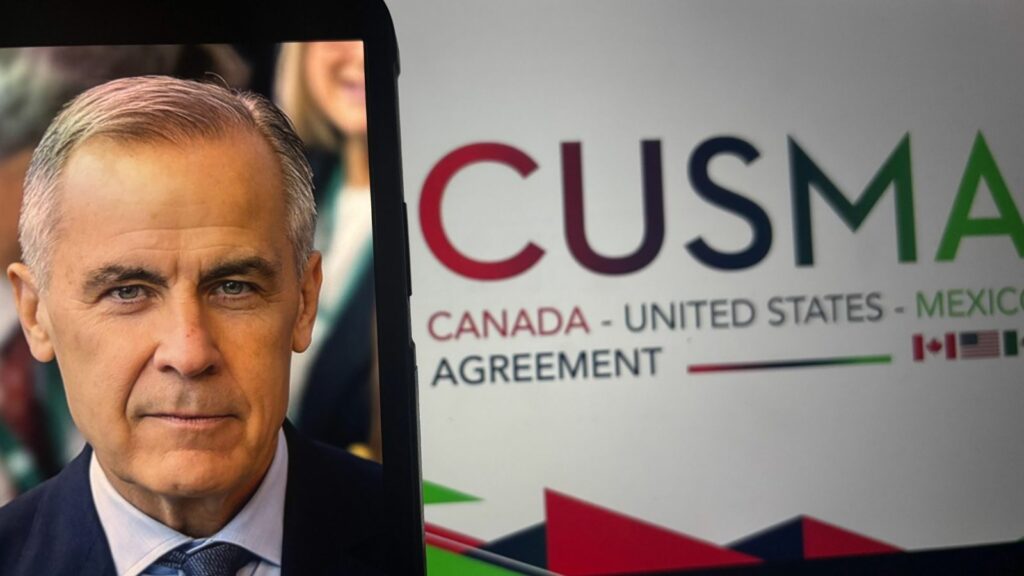
Trade-rule deadlines rarely attract much attention outside government and industry circles, but the September 29 milestone in Washington arrives at an unusually sensitive moment for North American automakers. The deadline for requesting an appearance at the U.S. International Trade Commission’s October 14 hearing on CUSMA automotive rules of origin has now passed, moving the investigation toward its next phase. The proceeding will feed into an independent USITC report due July 1, 2027, examining how the rules affect production, employment, investment, consumers and competitiveness.
The hearing is separate from CUSMA’s broader six-year Joint Review, but the issues increasingly overlap. Washington declined in July to extend the agreement in its current form, while keeping it in force, and has signalled that automotive origin rules are among the provisions it wants examined more closely.
The September Deadline Starts a Faster Countdown
September 29 was the corrected deadline for companies, unions, trade associations and other interested parties to request an appearance before the USITC. That date matters because it helps determine who will testify when the commission holds its public hearing on October 14 at 9:30 a.m. in Washington. The investigation, numbered 332-608, is the third of five congressionally mandated USITC examinations of CUSMA’s automotive rules of origin. The resulting 2027 report will eventually go to the U.S. president, Senate Finance Committee and House Ways and Means Committee.
The timetable becomes considerably tighter from here. Prehearing briefs are due October 1, electronic copies of oral testimony by October 6, and posthearing briefs by October 21. Other written submissions can continue until November 2. In practical terms, that gives manufacturers and suppliers only weeks to turn complicated sourcing, investment and compliance experiences into evidence the commission can assess.
There Are Actually Several Auto Reviews Moving at Once
One reason the current debate can become confusing is that Washington has more than one CUSMA automotive process underway. The USITC investigation leading to the 2027 report is an independent economic fact-finding exercise required by Section 202A(g)(2) of the U.S. implementation law. Separately, USTR completed its own third biennial review of automotive trade in July 2026 under Section 202A(g)(1). Those reports examine similar questions, but they come from different institutions and have different mandates.
Then there is the much broader Article 34.7 Joint Review of CUSMA itself. The United States chose on July 1 not to extend the agreement in its current form. That did not terminate CUSMA: the agreement remains in force, and Article 34.7 provides for annual joint reviews when all three countries do not confirm an extension after the six-year review. The distinction is important because October’s USITC hearing gathers evidence; it does not itself renegotiate or amend CUSMA.
The Rules Determine How Much of a Vehicle Must Come From North America
CUSMA substantially raised the regional-content hurdle from the old NAFTA framework. Passenger vehicles and light trucks generally need 75 per cent regional value content to qualify under the agreement, compared with 62.5 per cent under NAFTA. Seven designated core parts—including engines, transmissions, bodies and chassis, axles, suspension systems, steering systems and advanced batteries—are also subject to specific origin requirements. Heavy trucks and electric light trucks are on a different schedule, with their regional-content threshold set to reach 70 per cent on July 1, 2027.
Regional content is only part of the calculation. Producers must source at least 70 per cent by value of specified steel and aluminum purchases from North America. Passenger vehicles must also satisfy a 40 per cent labour-value-content requirement tied to facilities paying an average base wage of at least US$16 an hour, while the threshold is 45 per cent for light and heavy trucks. A new North American “melt and pour” condition for qualifying steel is scheduled to begin in July 2027.
Washington Has Made Clear What It Wants to Revisit
The U.S. administration has already outlined the direction it wants the automotive discussion to take. USTR’s July 2026 report said the Joint Review creates an opportunity to strengthen origin rules so they encourage additional U.S. and North American content while reducing exposure to inputs from non-market economies. USTR has also identified semiconductors, critical minerals and advanced electronics as technologies where it wants greater localization. At the same time, it has acknowledged calls to simplify the system, particularly for smaller suppliers facing complicated certification requirements.
Washington’s case partly relies on USTR’s own value-added analysis. It estimates that the U.S. share of value embedded in transport-equipment imports from Mexico declined from 23.1 per cent in 2017 to 18.3 per cent in 2024. For Canadian transport-equipment imports, USTR calculates a decline from 26.3 to 23.9 per cent. Those figures form part of the administration’s policy argument rather than an independent conclusion about how the rules should ultimately be changed.
Independent Modeling Shows Benefits Alongside Costs
The USITC’s 2025 assessment provides a more complicated picture than a simple argument for either tighter or looser rules. Its economic model estimated that CUSMA’s auto provisions added about 5,387 U.S. parts-manufacturing jobs and 2,463 steel-production jobs. At the same time, the model estimated a reduction of 302 vehicle-production jobs and roughly 15,037 fewer U.S.-built light vehicles in 2024 than would otherwise have been produced. The commission stressed that these were modeled effects, not a claim that every industry change since 2020 resulted from CUSMA.
Consumers saw a much smaller modeled effect. The USITC estimated that the rules increased the average U.S. light-vehicle price by about US$33, or roughly 0.1 per cent. Economy-wide effects on U.S. GDP and aggregate employment were estimated at less than 0.01 per cent. Those findings illustrate the trade-off October witnesses will be asked to illuminate: stricter sourcing rules can stimulate particular regional industries while simultaneously increasing costs elsewhere in the production chain.
Canada’s Exposure Makes the Technical Debate Highly Consequential
For Canada, origin calculations are closely connected to the future of one of the country’s largest manufacturing industries. Federal figures say the Canadian auto sector supports more than 500,000 workers, contributes over C$16 billion annually to GDP and produced more than 1.2 million passenger vehicles in 2025. The industry is unusually dependent on continental integration: more than 90 per cent of Canadian-made vehicles and approximately 60 per cent of Canadian-made auto parts are exported to the United States.
CUSMA preference data underline that dependence. USTR reports that 99 per cent of U.S. vehicle imports from Canada benefited from CUSMA preferential treatment in 2025, compared with 92.9 per cent of vehicle imports from Mexico. Across both countries, the share benefiting from NAFTA or CUSMA preferences had fallen from 99.5 per cent in 2019 to 91.8 per cent in 2023 before recovering to 94.7 per cent in 2025. For Canadian assembly plants, seemingly technical origin formulas therefore have a direct connection to market access and production planning.
The Long-Running ‘Roll-Up’ Dispute Has Not Disappeared
One unresolved issue predates the current review cycle. Canada and Mexico challenged the United States over how qualifying core parts should be treated when calculating the regional value content of a completed vehicle. The disagreement became known as the “roll-up” dispute. A CUSMA panel issued its final report in December 2022 and concluded that the U.S. interpretation was inconsistent with provisions of the agreement, supporting Canada and Mexico on the central calculation question.
The dispute has nevertheless continued to cast a shadow over the automotive rules. USTR’s 2026 report says the governments had consulted but had not reached a resolution. Washington argues, based partly on confidential automaker information presented during the dispute, that the Canadian-Mexican interpretation could permit 10 to 20 per cent less North American content than the U.S. approach. That remains the U.S. government’s position rather than a finding of the dispute panel. For compliance departments planning vehicles years ahead, the lack of a settled implementation framework adds another layer of uncertainty.
Electric Vehicles Are Exposing Gaps in Rules Written Around Older Technology
One of the strongest technical arguments for revisiting the rules comes from changes in vehicle architecture. The USITC has highlighted electric e-axles, which combine functions traditionally handled by an engine, transmission and axle. Depending on exactly how an e-axle is configured and classified for customs purposes, the commission found that its regional-value-content requirement can be either 50 or 70 per cent. That means two technologically similar drive units can receive different origin treatment because they fall under different tariff classifications.
Battery technology presents similar complications. Nickel-metal hydride batteries still used in some hybrids are outside the Automotive Appendix and face a 50 per cent product-specific regional-content requirement. The broader problem is that technology can evolve faster than tariff nomenclature and trade-agreement schedules. U.S. imports in motor classifications that can include e-axles increased 157.8 per cent between 2019 and 2024, although the USITC cautioned that customs classifications make it impossible to determine precisely how many of those imports were actually e-axles.
Hundreds of Billions in Investment Complicate the Case for Change
The investment record gives both supporters and critics of the existing system material to work with. USTR, citing Center for Automotive Research data, says automakers and suppliers announced US$448.5 billion in North American investments between 2018 and 2025. About US$346.5 billion was associated with U.S. facilities, US$46.8 billion with Canada and US$55.1 billion with Mexico. Announced investment is not the same as completed spending, but the scale illustrates how much capital has been committed while companies adapted to electrification, CUSMA and other policy changes.
The USITC is more cautious about attribution. It found that total U.S. automotive-manufacturing investment climbed from US$27.9 billion in 2019 to US$87.8 billion in 2023 before falling to US$34.1 billion in 2024, with only part of that movement attributable to the origin rules. Compliance also carries costs: supplier association MEMA previously reported that one member increased administrative staffing to cope with an estimated 25 per cent rise in CUSMA-related compliance issues.
The October Hearing Can Shape the Record, but It Cannot Rewrite CUSMA
October 14 will therefore be important without being decisive. The USITC is an independent, nonpartisan fact-finding agency, and its Section 332 reports provide economic analysis rather than policy recommendations. The commission is examining effects on GDP, trade, employment, wages, investment, production, consumers and competitiveness, along with whether the existing origin rules remain appropriate as automotive technology changes. Its completed report is due to the president and congressional committees no later than July 1, 2027.
Changing CUSMA itself requires a different process. Article 34.3 says the three parties may agree in writing to amendments, subject to their respective legal approval procedures. Meanwhile, because the United States did not support an extension at the July 2026 Joint Review, Article 34.7 calls for annual reviews while the agreement remains in force. That makes the October hearing one piece of a much longer process—valuable mainly because the evidence assembled in Washington could help define which automotive rules governments eventually decide deserve another look.
