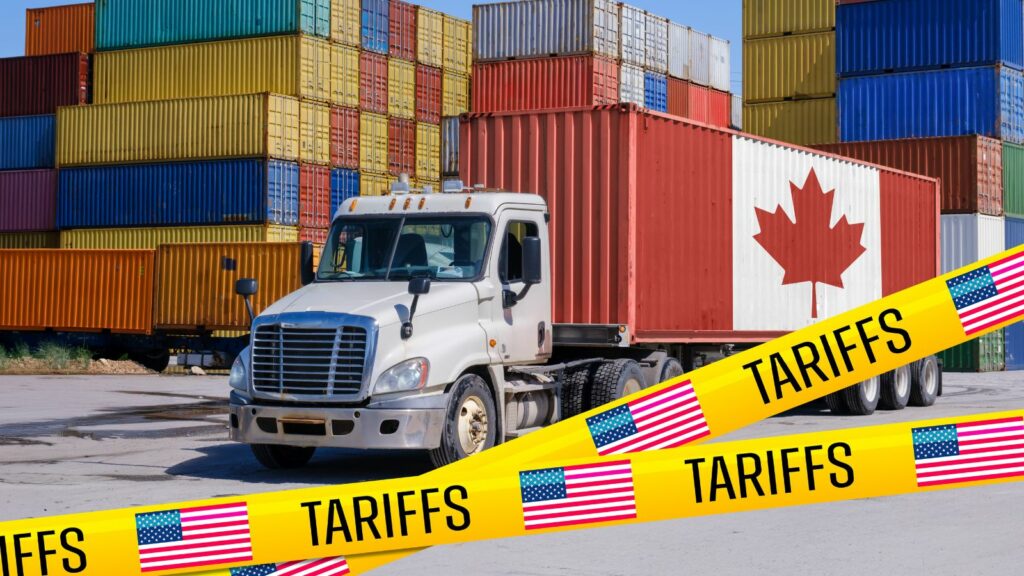
For decades, the Canada-U.S. border often mattered less to manufacturers than efficiency, price and delivery time. That calculation is starting to change. A new round of U.S. tariffs has made some Canadian companies reconsider whether American suppliers remain the safest or cheapest choice, while Ottawa’s retaliation is creating another incentive to find alternatives closer to home.
The result is not a mass migration of factories into Canada. It is something more gradual: soap production moving out of Vermont, food manufacturers replacing American ingredients, new Canadian supplier relationships being created and major industrial investments taking on greater strategic importance. As tariffs alter costs on both sides of the border, businesses are discovering that supply chains built for a largely tariff-free North America now carry a political risk that was once easy to ignore.
Tariffs Are Turning Routine Purchasing Decisions Into Strategic Ones
The latest escalation substantially changes the economics facing companies that move goods across the border. The United States imposed additional tariffs of 50% on a range of Canadian products effective August 22, after briefly delaying their implementation during negotiations. Ottawa responded by announcing matching countermeasures covering $27.6 billion in American imports. Those Canadian tariffs, scheduled to take effect September 8, range from 15% to 50% and cover products including steel, dairy, appliances, agricultural equipment, pulp and paper, and electronics.
The uncertainty extends beyond goods already affected. President Donald Trump has also threatened to raise tariffs on Canadian cars, trucks and automotive parts to 50% beginning January 1, 2027. For purchasing managers, the issue is therefore no longer simply whether an American supplier offers the lowest quote today. Companies increasingly have to consider whether that supplier could suddenly become dramatically more expensive several months from now. That uncertainty gives domestic production something it previously struggled to compete on: predictability.
A Montreal Soap Maker Has Already Brought Work Back From Vermont
The Unscented Company offers one of the clearest examples of the shift. The Montreal-based home and body-care company had been contracting some soap manufacturing to a supplier in Vermont. Founder and CEO Anie Rouleau told Global News that the relationship worked well operationally, but the trade dispute changed the financial calculation. The company stopped outsourcing that production to Vermont and brought the work back across the border into Canada.
Rouleau estimated the current tariff environment could cost the business roughly $150,000 by the end of 2026. That is meaningful for a company that already says approximately 80% of its products undergo their most substantial transformation in Canada. Producing domestically can initially cost more because Canadian suppliers may not yet have the same scale, but Rouleau said the company was prepared to accept lower near-term profitability while increasing local production. The decision illustrates why reshoring can happen even when Canada is not immediately the cheapest option: tariff exposure has become another cost that businesses have to price into long-term supplier relationships.
Chapman’s Is Rebuilding Parts of Its Supply Chain Outside the U.S.
Chapman’s Ice Cream has gone further, turning supplier diversification into a multi-year project. The Ontario manufacturer says it is on track to replace more than 70% of the American ingredients and components it uses with Canadian or other non-U.S. alternatives by mid-2027. The company began the effort after the first tariff battles in 2025 and has accelerated it as the dispute worsened. Chapman’s continues to use Canadian dairy while searching internationally for products Canada cannot efficiently supply.
The changes reach far beyond changing names on purchase orders. Chapman’s has sourced cherries from Chile and almonds from Australia, while working with Canadian companies to establish production for components previously unavailable domestically. One example involves sugar cones: the company worked with Ontario supplier Original Foods on equipment needed to produce them locally. Chapman’s has also said it intends to hold its own prices steady until March 2028. The experience demonstrates an important consequence of the tariff fight: once manufacturers invest money, equipment and time creating new supplier relationships, those relationships may survive even if tariffs later disappear.
GM’s Oshawa Plans Show Why Canadian Production Still Matters to Big Manufacturers
The same debate is playing out at a much larger scale in Ontario’s auto sector. General Motors plans to spend C$144 million to add production of the next-generation heavy-duty GMC Sierra at its Oshawa assembly plant under a tentative agreement reached with Unifor. The proposed commitment comes despite the existing 25% U.S. tariff pressure on Canadian-produced vehicles and Trump’s threat to increase tariffs on Canadian automotive products to 50% next year.
The investment is especially significant because the industry has been operating under extraordinary uncertainty. Unifor represents more than 4,600 GM workers across Ontario facilities, and the union reported before bargaining began that roughly 30% of its GM members in Canada were on layoff. The Oshawa commitment does not prove tariffs caused GM to move production north; the company’s manufacturing decisions involve labour agreements, capacity, model planning and other considerations. What it does demonstrate is that Canadian assembly remains valuable enough to attract new spending even while Washington is explicitly encouraging automakers to build more vehicles in the United States.
Decades of Integration Make a Clean Break Almost Impossible
Reshoring sounds straightforward until the structure of North American manufacturing is examined closely. Statistics Canada estimates Canadian manufacturers shipped about $324 billion worth of goods to the United States in 2024, and more than one-quarter of that value reflected imported American content embedded in those products. The Bank of Canada similarly estimates U.S.-sourced content accounts for roughly one-fifth of the value of Canadian exports to the United States. A component can therefore cross the border before becoming part of another product that crosses it again.
That integration developed because companies spent decades putting each stage of production where it worked most efficiently, rather than duplicating every capability on both sides of the border. The Bank of Canada says businesses have nevertheless started relying less on American inputs, seeking alternatives within Canada and elsewhere. U.S. imports lost share after tariffs began, particularly in sectors targeted by Canadian countermeasures. But those changes frequently increase costs. New suppliers need qualification, transportation networks must be redesigned, production volumes have to become large enough to justify new equipment, and specialized expertise cannot simply be recreated overnight.
Manufacturers Are Feeling the Tariff Pressure More Than Most Businesses
Statistics Canada’s second-quarter business-conditions data show why manufacturing companies are reconsidering their exposure. Across the economy, 34% of businesses expected U.S. tariffs on Canadian imports to negatively affect them over the next 12 months. Among manufacturers, that figure jumped to 54%, making manufacturing one of the most exposed sectors. More than one-quarter of Canadian businesses — 28.3% — also reported that they had already passed at least some tariff-related cost increases to customers during the preceding year.
There are signs that domestic demand is providing some offset. Statistics Canada found 14.2% of businesses had experienced increased sales of Canadian products, while 16.6% had changed marketing practices to promote Canadian goods. Canada’s manufacturing purchasing managers’ index also climbed to 53.5 in July, its strongest level in more than four years, with domestic demand helping drive expansion. Yet the same factory data showed weak international demand and persistent concerns about U.S. tariffs. That combination helps explain the emerging strategy: manufacturers still need international markets, but relying overwhelmingly on one cross-border system increasingly looks risky.
Ottawa Is Deliberately Trying to Change the Economics of Sourcing
Federal policy is reinforcing the move toward Canadian suppliers. Ottawa’s latest response includes $7.5 billion in new and expanded business and worker supports alongside its planned counter-tariffs. The package includes additional regional assistance for small and medium-sized businesses, new liquidity programs and funding intended to help tariff-affected companies diversify. The government says these measures build on nearly $25 billion in support introduced since the current period of U.S. tariff pressure began.
Procurement policy is another lever. Canada’s Buy Canadian policy prioritizes domestic suppliers and requires Canadian steel and aluminum for major federal procurement projects. At the same time, Ottawa has retained tariff-remission mechanisms for businesses that still require American inputs, acknowledging that suddenly cutting off those products could damage Canadian factories rather than help them. Canada’s auto framework similarly offers tariff relief structured to encourage production and investment in Canada. Together, the measures reveal a more nuanced strategy than simply taxing imports: raise the incentive to build domestic capacity while providing temporary escape valves where Canadian alternatives do not yet exist.
The Northward Shift Is Real, but It Is Not a One-Way Exodus
There is an important limit to the reshoring narrative. American industrial policy is pulling investment south at the same time Canadian policy tries to pull supply chains north. Ontario-based Canadian Solar, for example, opened a nearly US$1-billion solar-cell factory in Indiana in July. The company said U.S. tariffs on imported solar products and American manufacturing incentives helped justify the investment. Once fully operational, the facility is expected to produce six gigawatts of cells annually and employ more than 1,200 people.
Automakers are also showing how uncertainty can freeze investment rather than redirect it neatly toward Canada. Honda has warned it may reconsider plans for another North American assembly plant unless the future of CUSMA is secured, while its previously announced C$15-billion-scale Canadian EV and battery strategy — described by Reuters as an $11-billion project in U.S. dollars — remains indefinitely suspended. The emerging picture is therefore more complicated than factories simply moving north. Businesses are redesigning supply chains around political risk, incentives and tariffs. Canada is winning some of that activity, losing some elsewhere, and learning that once companies stop assuming the U.S. will always be the obvious supplier, the old supply-chain map becomes negotiable.
