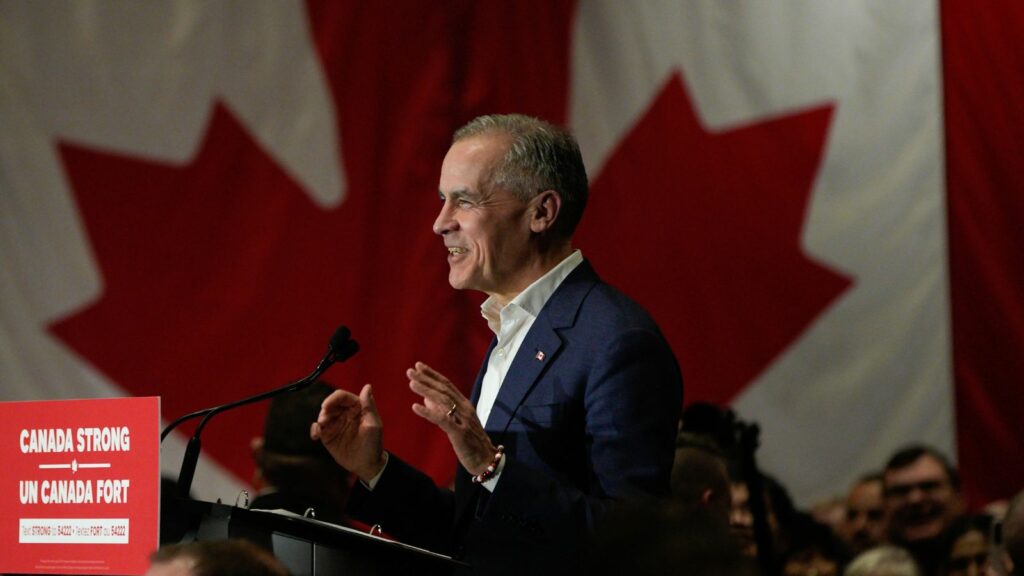
Banff’s mountain setting may offer a dramatic backdrop, but Prime Minister Mark Carney’s cabinet will arrive with little distance from the economic pressures confronting Ottawa. Ministers are being summoned to Alberta for a September 10–11 planning forum just days after Canada’s latest retaliatory tariffs on U.S. goods take effect and after another difficult turn in cross-border trade negotiations.
The Liberal government is framing the gathering as an opportunity to sharpen execution rather than rewrite its strategy. Ottawa says it will continue trying to strengthen the domestic economy, diversify trade beyond the United States and keep affordability at the centre of its agenda. With employment weakening, tariffs spreading through supply chains and businesses reconsidering where they sell and source goods, Banff will test whether staying the course can also mean moving faster.
Banff Is Being Framed as a Planning Session, Not a Policy Reset
Carney’s September 10–11 gathering is formally being called a Cabinet Planning Forum, bringing cabinet ministers and secretaries of state to Banff to assess progress and determine the government’s next steps. The Prime Minister’s Office has been unusually explicit about the intended message: despite what it describes as serious economic headwinds, the government is “not changing course.” Ministers are expected to focus on building domestic economic strength, expanding international partnerships, advancing major infrastructure and implementing recently announced industrial and defence initiatives.
That does not mean the meeting will be ceremonial. Ottawa says ministers will also hear from outside experts on the economy, Indigenous partnerships and global affairs. Separate reporting has indicated that ministers were asked to account for progress against priorities and performance indicators ahead of the gathering. That gives Banff a managerial dimension as well as a political one. Carney, whose career before politics included running major institutions, has repeatedly emphasized implementation and measurable results. The question in Banff will therefore be less about inventing another strategy than determining which parts of the existing one are moving too slowly.
Canada’s Counter-Tariffs Have Moved From Threat to Reality
The timing of the cabinet meeting matters because Ottawa’s newest countermeasures are no longer hypothetical. Beginning September 8, Canada imposed retaliatory tariffs of 15%, 25% or 50% on approximately C$27.6 billion worth of U.S. imports. The measures were designed to respond to Washington’s latest tariffs on Canadian products and cover goods ranging from steel and aluminum products to appliances, dairy products, apparel, agricultural equipment, electronics and pulp and paper. Existing Canadian retaliatory measures affecting U.S. automobiles also remain in place.
For importers, retailers and manufacturers, those percentages can translate into very practical decisions: whether to absorb part of the additional cost, increase prices, find another supplier or delay a purchase altogether. Ottawa has created remission mechanisms for businesses facing exceptional circumstances, while goods already in transit when the new measures took effect can qualify for exemptions. Still, the scale is significant. A 25% or 50% border charge can change the economics of a supply contract almost overnight. Cabinet therefore enters Banff knowing that retaliation may strengthen Canada’s negotiating position while simultaneously creating new pressures at home.
Ottawa Says the U.S. Deal Became Too Costly to Accept
The current confrontation followed roughly 18 months of negotiations aimed at stabilizing Canada’s trading relationship with the United States. Carney suspended those talks in August after saying Washington introduced last-minute demands that Ottawa considered unfair and economically unacceptable. The government has said those demands went beyond tariff levels and touched issues it considers fundamental, including Canada’s freedom to negotiate trade agreements with other countries and protections connected with Canadian culture and the French language.
That distinction is central to the Liberal argument for holding firm. Ottawa insists it was prepared to negotiate reductions in tariffs affecting automobiles, steel and aluminum, but not in exchange for commitments that would constrain Canadian sovereignty or leave businesses exposed to another abrupt change in U.S. policy. Carney has nevertheless continued to say Canada is willing to return to negotiations if the United States is prepared to reach a mutually beneficial and durable agreement. The government is therefore attempting a difficult balance: signalling that the negotiating door remains open while convincing businesses that Canada will not accept an agreement merely for the appearance of ending the dispute.
Diversification Has Become More Than a Long-Term Trade Goal
For decades, Canada’s proximity to the world’s largest economy made the United States its overwhelmingly dominant commercial partner. That relationship remains enormous, but recent data show businesses are increasingly looking elsewhere. Global Affairs Canada reported that Canadian exports to non-U.S. destinations rose 11.1% in 2025, pushing non-U.S. markets to 32.8% of total exports, the highest proportion in four decades when goods and services are combined. More recent merchandise data nevertheless underline the challenge: roughly two-thirds of Canadian goods exports were still heading to the United States this summer.
That gap explains why diversification is prominent in Carney’s strategy. Canada already has trade agreements providing preferential access to markets containing roughly 1.5 billion consumers, and Ottawa wants to expand that reach through additional agreements and partnerships. The shift is also visible at the company level. The Financial Times recently highlighted Canadian businesses reconsidering American suppliers and customers; Ontario-based Chapman’s Ice Cream, for example, has been working to replace a large share of U.S.-sourced inputs with Canadian or other international alternatives. Diversification, in other words, is moving from diplomatic language into purchasing departments and factory supply chains.
“Build Canadian” Is Turning Into an Industrial Policy
The domestic side of the government’s strategy is increasingly visible through procurement and large public investments. One recent example came in passenger rail. Ottawa announced more than C$4.7 billion for VIA Rail to acquire and maintain 313 new passenger rail cars from Alstom Canada. Manufacturing work is expected in Thunder Bay, Ontario, and La Pocatière, Quebec, with engineering and design work in Saint-Bruno. The government says the procurement will support nearly 700 jobs, involve more than 900 Canadian suppliers and generate more than C$1.6 billion in economic benefits.
Defence is being treated similarly. Canada’s new Defence Industrial Strategy emphasizes domestic production, innovation, secure supply chains and closer partnerships with Canadian companies. The approach reflects a broader change in thinking: public purchasing is being used not only to buy equipment or infrastructure, but also to develop productive capacity that Ottawa believes Canada may need in a less predictable world. That makes Banff important for implementation. Announced investments can create headlines immediately, but factories, skilled jobs, export contracts and completed infrastructure are the measures that ultimately determine whether industrial policy has strengthened the economy.
Retaliation Carries a Real Risk of Higher Consumer Prices
Tariffs are often described as charges on foreign countries, but Canadian research shows that at least part of the cost can reach domestic consumers. Bank of Canada researchers studied roughly 110,000 online products sold by seven large retailers during Canada’s 2025 counter-tariff episode. Goods subject to the 25% tariff eventually became about 6% more expensive relative to comparable untariffed products. The researchers estimated that those counter-tariffs added roughly 0.3 percentage points to consumer price inflation at their peak.
There is an important qualification: the earlier episode is not a perfect template for the new measures. The mix of goods is different, tariff rates now vary and companies can change suppliers. The Bank’s research also found that prices responded relatively quickly when most of the earlier counter-tariffs were removed, suggesting businesses’ expectations about how long tariffs will last matter considerably. Even so, the lesson for cabinet is clear. Retaliation imposes costs somewhere in the supply chain. Ottawa’s remission process and efforts to diversify sourcing can soften the effect, but policymakers cannot assume that tariffs of up to 50% will remain invisible at the checkout counter.
Ottawa Is Pairing the Trade Fight With a C$7.5-Billion Support Package
The Liberal strategy does not rely on tariffs alone. When the latest countermeasures were announced, Ottawa also unveiled approximately C$7.5 billion in additional support for companies, workers and communities exposed to trade disruption. The package includes another C$1.5 billion for the Regional Tariff Response Initiative, a C$500-million Business Development Bank of Canada liquidity stream, a C$2-billion diversification fund and roughly C$3.5 billion in measures covering employment support, retraining and workforce retention. The government says those commitments build on nearly C$25 billion in previous tariff-related assistance.
The purpose is to prevent a temporary trade shock from creating permanent economic damage. A manufacturer that loses an American customer may need months rather than weeks to certify a product for another market, install new equipment or replace a supplier. Individual federal programs illustrate that approach. Ottawa has supported firms such as Ontario manufacturer Ideal Roofing as they invest in equipment, productivity and workforce training. The difficult part is determining which businesses are facing a temporary adjustment and which are confronting a lasting loss of competitiveness. Banff gives ministers an opportunity to assess whether existing support is reaching companies quickly enough.
The Economic Data Leave Little Room for Complacency
Canada is not entering this confrontation from a position of economic collapse, but several indicators have softened. Employment fell by about 42,000 in August while the unemployment rate remained at 6.4%. July consumer inflation was 3.0%, with transportation costs rising much faster than the overall index. Trade figures also weakened sharply in July: Canada’s merchandise trade surplus narrowed to about C$769 million from C$4.2 billion in June as exports declined and imports increased. Exports to the United States dropped 6.6% during the month, while exports to non-U.S. destinations increased.
The Bank of Canada added another warning when it held its policy rate at 2.25% on September 2. The Bank said the new tariff confrontation had increased uncertainty and cautioned that Canadian countermeasures could raise business costs and eventually consumer prices. None of those figures by itself proves Ottawa’s strategy is failing. Together, however, they show why implementation matters. For households, trade policy eventually appears as grocery bills, job security and borrowing costs. For businesses, it appears in cancelled orders, slower hiring and decisions about whether the next investment should be made in Canada or somewhere else.
Indigenous Partnerships Are Being Built Into the Growth Strategy
Indigenous economic participation is also formally on the Banff agenda. Ottawa has increasingly argued that large energy, mining, transportation and infrastructure projects can move more effectively when Indigenous communities participate not only through consultation but also through ownership and financing. The federal Indigenous Loan Guarantee Program has been expanded from C$5 billion to C$10 billion, while the Major Projects Office has received additional funding intended to help Indigenous communities participate in reviews and negotiations around major developments.
The model is already being tested on large investments. Seven Williams Treaties First Nations are expected to acquire a significant minority interest in Ontario’s Darlington New Nuclear Project through financing supported by federal and provincial loan-guarantee programs, with roughly C$715 million in financing involved. Ottawa has also stressed that its faster major-projects process does not eliminate constitutional consultation obligations or treaty protections. That balance will be consequential. Canada wants to shorten project timelines at precisely the moment it is seeking new export corridors, energy infrastructure and critical-mineral capacity. Durable Indigenous partnerships can therefore become an economic advantage, while poorly handled consultation could produce the delays the government is trying to avoid.
Political Momentum Gives Carney Space, but Delivery Is the Bigger Test
Carney arrives in Banff with some recent political breathing room. Liberals won all three federal by-elections held on August 31. Their candidates received about 51.6% of the vote in Chicoutimi–Le Fjord, 55.8% in Beaches–East York and 58.7% in North Vancouver–Capilano. The Quebec result was particularly notable because the Conservatives had previously held the riding. The victories do not amount to a nationwide verdict on the trade strategy, but they reduce immediate pressure inside the Liberal caucus to abandon the government’s current direction.
The harder test begins after cabinet leaves Alberta. A fall federal budget is approaching, Parliament will demand explanations for tariff costs and spending commitments, and businesses will want evidence that diversification programs can produce customers rather than just announcements. Reporting ahead of Banff suggests ministers have been asked to demonstrate progress against government priorities, fitting the retreat’s official description as a stock-taking exercise. That may ultimately be the most important meaning of “not changing course.” Staying the course does not guarantee success. Ottawa will have to show that Canadian exports are becoming less vulnerable, major projects are actually being built, support reaches affected workers and a future U.S. agreement can deliver genuine stability without concessions the government considers unacceptable.
