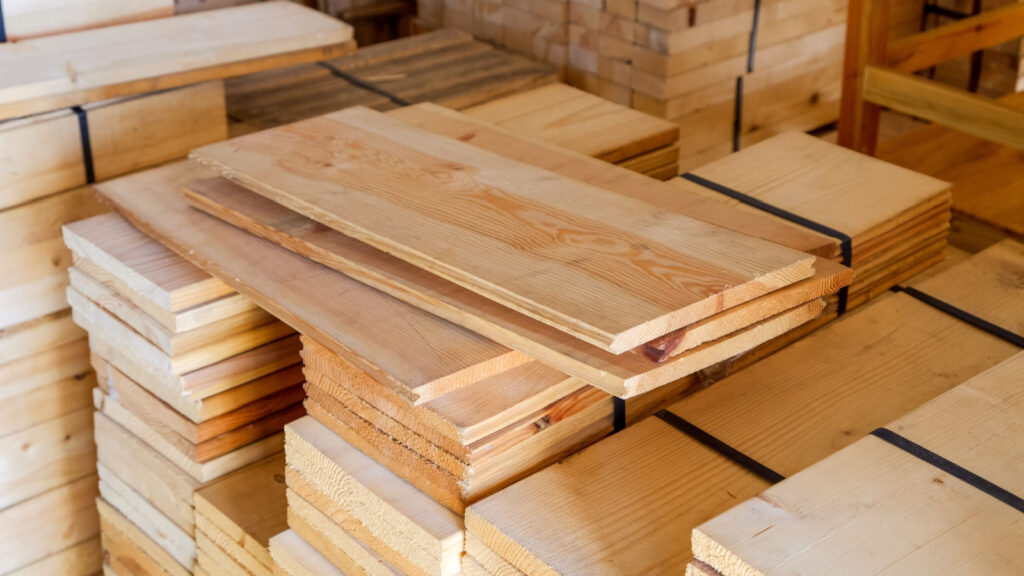
There is an unusual twist emerging from the latest Canada-U.S. trade fight. Tariffs that hurt Canadian lumber producers could, under the right conditions, make certain homes cheaper to build in Canada.
New analysis from Canada Mortgage and Housing Corporation suggests that keeping and using more Canadian wood products domestically could reduce construction costs for ground-oriented housing by as much as 17% in some markets. CMHC estimates the shift could translate into roughly 3.5% more ground-oriented housing starts nationally, or close to 4,000 additional homes a year. The finding does not mean tariffs are good for Canada, nor does it promise an immediate drop in home prices. Instead, it highlights a potentially valuable side effect: lumber that becomes harder to sell south of the border could help ease one of the cost pressures holding back Canadian homebuilding.
The 17% Figure Comes With an Important Condition
CMHC’s headline estimate is substantial, but it is narrower than it may first appear. The agency is not forecasting a 17% drop in the price of the average Canadian home. Its analysis concerns construction costs for ground-oriented housing — particularly detached homes and townhouses — in certain Canadian markets. The scenario depends on Canadian builders making greater and more consistent use of domestically produced wood and related materials.
CMHC modeled what could happen if the cost of wood, plastics and composite construction inputs in major markets had increased at rates comparable with Vancouver and Montréal, where cost growth was relatively subdued. Under that scenario, ground-oriented construction costs could have been as much as 17% lower in some centres. The distinction matters. Land, financing, development charges, labour, municipal fees, taxes and developer margins all contribute to the final cost of delivering a home. A reduction in material-related construction costs therefore does not translate dollar-for-dollar into an equivalent reduction in a buyer’s purchase price.
U.S. Tariffs Could Leave More Canadian Lumber at Home
The economic logic behind CMHC’s analysis begins with Canada’s unusually strong dependence on export markets for forest products. The United States has traditionally been by far the largest foreign buyer. That relationship becomes more difficult when Canadian lumber arriving in the U.S. faces increasingly expensive trade barriers, making some shipments less competitive and reducing the attractiveness of the American market.
Canadian softwood lumber can currently face several layers of U.S. trade measures. Global Affairs Canada lists a 35.16% combined anti-dumping and countervailing duty rate for the “all others” category under the sixth administrative review, although company-specific rates vary considerably. Covered softwood lumber is also subject to a separate 10% Section 232 tariff. That creates an incentive for producers to look for alternative customers. CMHC’s argument is that a stronger Canadian construction market could become one of those outlets. More lumber staying in Canada could increase domestic availability and place downward pressure on certain material costs, particularly if builders can change how and where they use wood.
Detached Homes and Townhouses Have the Most to Gain
Not every type of housing would benefit equally. Wood represents a much larger part of the construction equation for a detached house or townhouse than for a high-rise apartment tower. CMHC estimates that the share of construction costs directly associated with wood, plastics and composites is roughly 16 times larger in ground-oriented housing than in high-rise apartments. That makes lower wood-related costs considerably more important to projects built close to the ground.
Recent history shows how significant that exposure can be. Between the first quarter of 2020 and the first quarter of 2023, input costs for ground-oriented housing across the 15 metropolitan areas studied by CMHC increased by about 59%. High-rise apartment construction costs increased by roughly 37% over the same period. For builders trying to make a new subdivision or townhouse development financially viable, even a moderate reduction in lumber-related expenses can change project economics. That is particularly important because CMHC has also warned that ownership-oriented construction has weakened in several major Canadian housing markets.
The 17% Estimate Is About Building Economics, Not an Instant Housing Discount
For prospective buyers, the obvious question is whether cheaper construction materials eventually mean cheaper homes. They can help, but the relationship is not automatic. A builder that saves money on framing or engineered wood still faces the cost of acquiring land, obtaining permits, paying construction workers, financing a project and installing everything from plumbing and electrical systems to roads and municipal infrastructure.
The more immediate effect could be on whether projects are financially viable at all. Consider a townhouse development sitting just below a builder’s required return because construction expenses have risen faster than expected. Reducing one of its major material costs may not produce a dramatically cheaper asking price, but it could be enough for the project to move from a spreadsheet into construction. That mechanism is central to CMHC’s estimate of nearly 4,000 additional ground-oriented starts annually. Lower costs can encourage additional supply by making projects possible that might otherwise be delayed, redesigned or cancelled.
Calgary Could See One of the Largest Supply Effects
The potential impact varies considerably by city. CMHC estimates that its lower-cost scenario could lift annual ground-oriented housing starts by approximately 8% in Calgary. Edmonton’s modeled increase is about 6.1%, while Ottawa comes in around 4.5% and Toronto at roughly 4.3%. Nationally, the modeled increase is approximately 3.5%, equivalent to close to 4,000 additional starts each year.
Those differences reflect the distinct economics of construction in each market. Calgary is especially interesting because it has already demonstrated that housing supply can respond relatively strongly to demand. CMHC’s Fall 2026 Housing Supply Report says strong construction has nearly halved Calgary’s estimated supply gap, while Edmonton currently has no measurable housing supply gap under CMHC’s methodology. Toronto faces a very different environment, with ground-oriented and condominium ownership construction under pressure. Cheaper wood alone would not erase those differences, but CMHC’s numbers suggest that material costs can influence how strongly builders respond when demand exists.
Construction Costs Have Already Gone Through a Dramatic Shift
The significance of cheaper wood becomes clearer when looking at what happened during the pandemic. CMHC estimates that the cost of building homes across Canada’s largest housing markets has increased by roughly 74% since 2019. Wood, plastics and composites were among the biggest contributors during the pandemic-era surge, increasing by 147% between the first quarter of 2020 and the first quarter of 2023. Metal fabrication costs rose 66% over the same period.
The pattern has since changed. CMHC found essentially no increase in its wood, plastics and composites category between the fourth quarter of 2024 and the second quarter of 2026, while costs climbed much more rapidly for utilities, plumbing, HVAC, metal fabrication and structural steel framing. Statistics Canada’s second-quarter 2026 data similarly showed wood, plastics and composites declining in price during the quarter while metal fabrication and structural steel costs increased. The industry’s biggest cost problem is therefore no longer concentrated in the same materials that caused so much trouble earlier in the decade.
Canada Has More Ways to Build With Wood Than Traditional Framing
A larger domestic market does not necessarily mean simply putting more two-by-fours into conventional suburban houses. CMHC specifically points to mass timber and other advanced wood-building technologies as opportunities to increase Canada’s use of its own forest products. Mass timber uses engineered wood components such as cross-laminated timber and glue-laminated beams to create structural walls, floors, columns and roofs, including in multi-storey projects.
Canada already has a foundation for expanding this kind of construction. Natural Resources Canada’s mass-timber database lists more than 750 completed or under-construction projects and about 20 solid-wood manufacturing facilities in its underlying dataset. The technology can also be combined with concrete and steel rather than replacing them completely. That creates an important bridge between Canada’s forestry sector and its housing challenge. The forest sector directly employed about 194,000 people in 2024 and exported more than $37 billion worth of products. Creating more domestic construction demand could give producers an additional market while builders gain another source of material and building-system capacity.
Moving Lumber Across Canada Is One of the Biggest Obstacles
Having excess Canadian lumber is not the same as having the right lumber available at the right building site. CMHC identifies east-west transportation infrastructure as one of the obstacles to greater domestic use. Canada is geographically enormous, while established forest-product supply chains have often been designed around exports. Redirecting material from an American customer to a growing housing market thousands of kilometres away can involve rail capacity, trucking costs, warehousing, processing and entirely different business relationships.
Regulatory fragmentation can create another layer of difficulty. Federal, provincial and territorial governments have been working on measures intended to reduce internal trade and labour-mobility barriers, including efforts to align approval processes for new construction materials and prefabricated homes. Those changes matter because a lower lumber price has limited value if builders cannot efficiently transport products, obtain approvals or use standardized building systems across multiple provinces. CMHC’s opportunity therefore depends on more than tariffs. It requires a domestic supply chain capable of moving Canadian materials efficiently from producing regions to communities where housing construction is needed.
Nearly 4,000 More Homes Would Help, but Canada Needs Far More
An additional 4,000 ground-oriented homes annually would be meaningful, particularly when ownership-oriented supply is weakening in several major markets. It could support more townhouses, detached homes and other forms of housing that have become increasingly difficult to deliver economically. But the figure also needs to be viewed against the much larger scale of Canada’s housing shortage.
CMHC’s September 2026 housing-supply estimates indicate that Canada would need between roughly 417,000 and 469,000 housing starts annually through 2036 to restore affordability to pre-pandemic levels. Actual national housing starts totalled about 259,000 in 2025. The lumber opportunity therefore represents one piece of a much larger construction challenge rather than a standalone solution. More domestic wood use cannot replace additional labour, financing, land availability, faster approvals or higher construction productivity. What it can do is turn part of an external trade shock into an additional tool. In a housing market where thousands of marginal projects depend on whether the numbers work, even one source of meaningful cost relief can matter.
