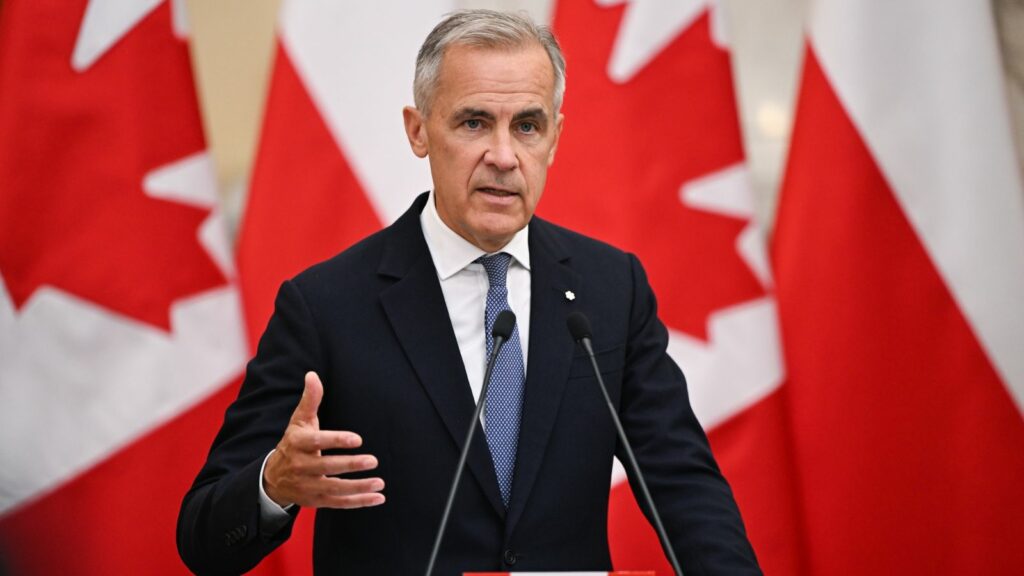
Canada’s push for a major trade agreement with Southeast Asia is moving into a potentially decisive stretch, with Prime Minister Mark Carney pressing for a Canada-ASEAN free trade agreement that Ottawa says could deliver a significant economic payoff at home.
The federal government estimates that the agreement, once in force, could add nearly $2 billion to Canada’s GDP and create close to 14,000 Canadian jobs, including employment in agriculture and manufacturing. The renewed push comes as Canada tries to build deeper commercial relationships outside its traditional North American market. Carney raised the agreement again during talks with Singapore Prime Minister Lawrence Wong on September 28, only days after discussing it with Vietnamese leader Tô Lâm. Negotiators are now targeting a substantive conclusion at the ASEAN Summit in November.
Carney Is Taking the Trade Push Directly to ASEAN Leaders
Carney’s September 28 conversation with Singapore Prime Minister Lawrence Wong showed how prominently the ASEAN agreement has moved onto Ottawa’s economic agenda. According to the Prime Minister’s Office, the two leaders agreed to redouble their focus on concluding the negotiations while also discussing a separate Canada-Singapore Economic Partnership Framework. Canada’s commercial relationship with Singapore is already substantial: merchandise trade reached $4.9 billion in 2025, including $3.2 billion in Canadian exports. Singapore was also the largest Southeast Asian source of foreign direct investment in Canada, with a stock valued at $10.4 billion that year.
The Singapore conversation came only four days after Carney met Vietnamese General Secretary and President Tô Lâm. Vietnam is Canada’s largest merchandise trading partner inside ASEAN, and Ottawa says bilateral merchandise trade has doubled over the past five years. Those back-to-back discussions suggest the government is using bilateral relationships to build political momentum behind the wider regional agreement. Rather than treating ASEAN as one distant negotiating bloc, Ottawa is increasingly working through individual relationships with major regional economies while pushing for a common trade framework covering the broader Southeast Asian market.
Ottawa’s $2 Billion and 14,000-Job Numbers Are Economic Projections
The two figures attracting the most attention are the federal government’s estimate of nearly $2 billion in additional Canadian GDP and almost 14,000 Canadian jobs. The Prime Minister’s Office has repeated those projections in statements involving the Philippines, Vietnam and Singapore, while identifying agriculture and manufacturing as two sectors expected to benefit. They should, however, be understood as projections of what could happen once an agreement is implemented—not as jobs already secured or investment already committed.
Global Affairs Canada generally evaluates proposed trade agreements using computable general equilibrium models, which simulate how tariffs, trade flows, investment and different sectors could respond under an agreement compared with a baseline without it. Earlier Canada-ASEAN modelling illustrates why assumptions matter. A 2018 joint feasibility study produced different Canadian GDP gains depending on what was liberalized: Canada’s model estimated a US$2.54-billion gain under one goods-services-investment scenario, while ASEAN’s separate modelling produced a larger US$5.1-billion Canadian gain under a scenario involving goods, non-tariff measures and trade facilitation. The government’s newer headline estimate therefore represents an economic scenario rather than a guaranteed final result.
ASEAN Is Already a $52.5 Billion Trading Relationship for Canada
The potential agreement is not being built around a small or undeveloped commercial relationship. Global Affairs Canada says merchandise trade between Canada and ASEAN reached approximately CAD$52.5 billion in 2025, up roughly 23.6% from $42.4 billion a year earlier. Collectively, ASEAN’s 11 member states were Canada’s fifth-largest merchandise trading partner. For Canadian companies looking beyond North America, the size of the regional economy makes the negotiations considerably more important than the geographic distance might suggest.
ASEAN’s scale also explains Ottawa’s long-term interest. Global Affairs estimates the bloc had a population of roughly 695 million in 2025 and a combined nominal GDP of about CAD$5.9 trillion. If treated as one economy, ASEAN would rank among the world’s largest. Southeast Asia also continues to post comparatively strong growth, with the region projected to expand by about 4.5% in 2026. That combination—population growth, rising household incomes and expanding industrial supply chains—creates opportunities for exporters ranging from Prairie agricultural producers to Canadian engineering, financial-services, aerospace, energy and technology companies. The agreement is essentially an attempt to give those businesses more predictable access to a market that is already growing quickly.
Negotiators Are Aiming for a November Breakthrough
The negotiations appear closer to completion than at any previous stage. International Trade Minister Maninder Sidhu said on September 22 that the Canada-ASEAN and Canada-Philippines negotiations were more than 90% complete, with Canada hoping to finish them around November. ASEAN’s own account was slightly more cautious, describing the regional negotiations as having made significant progress and remaining on track for a substantive conclusion during 2026.
A joint statement from ASEAN economic ministers and Canada provides an even clearer timetable. Officials were urged to intensify their work with the objective of finalizing negotiations by the ASEAN Summit in November. Importantly, that would not mean tariff changes suddenly appearing the next morning. The same statement anticipates the agreement being signed in 2027. Negotiators have spent years working through subjects including goods, services, investment, rules of origin, financial services, e-commerce, intellectual property, procurement and dispute settlement. A November political breakthrough would therefore be a major milestone, but it would mark the end of one stage of the process rather than the instant arrival of a fully implemented free trade zone.
Agriculture and Manufacturing Could Be Among the Most Visible Winners
Ottawa has repeatedly singled out agriculture and manufacturing when discussing the projected 14,000 Canadian jobs. That makes sense given both Canada’s export strengths and the structure of Southeast Asian demand. Global Affairs Canada identifies agriculture and agri-food, energy, critical minerals, clean technology, information and communications technology, financial services, aerospace, infrastructure and consumer products among the sectors already driving Canada’s expanding economic relationship with ASEAN. Lower tariffs could make some Canadian products more competitive, while clearer customs and regulatory rules could reduce the cost and uncertainty of reaching customers across the region.
The negotiations also go considerably beyond traditional tariffs on goods. Canada is seeking rules covering cross-border services, financial services, investment, temporary entry for business people, telecommunications, digital trade, government procurement and intellectual property. For a grain exporter, the most important provision might be lower border costs or predictable sanitary rules. For a Toronto technology company, digital-trade provisions could matter more. A Canadian engineering or financial-services company may care about licensing, market-access rules and regulatory transparency. That breadth helps explain why Ottawa’s projected employment effects extend beyond workers directly producing physical exports.
The ASEAN Deal Would Add Another Layer to Canada’s Indo-Pacific Trade Network
Canada is not starting from scratch in Southeast Asia. Through the Comprehensive and Progressive Agreement for Trans-Pacific Partnership, Canadian exporters already have preferential access to several ASEAN economies, including Brunei, Malaysia, Singapore and Vietnam. Canada has also signed a separate Comprehensive Economic Partnership Agreement with Indonesia, while bilateral negotiations with countries including the Philippines and Thailand form part of a wider effort to establish overlapping commercial links throughout the region.
That raises an obvious question: why pursue another agreement where some preferential access already exists? The value of a Canada-ASEAN agreement would partly come from creating a more consistent regional framework and extending improved access across markets where Canada’s existing arrangements differ. Companies operating supply chains across multiple Southeast Asian countries can encounter different tariff schedules, origin requirements, customs processes and regulatory systems. A broader ASEAN framework could simplify some of those relationships, depending on the final language. Existing agreements would still matter, particularly where they provide deeper commitments. The regional deal is therefore better viewed as another layer in Canada’s trade architecture rather than a replacement for the CPTPP or bilateral agreements.
The Timing Matters as Canada Tries to Reduce Its U.S. Trade Concentration
The ASEAN negotiations are also advancing during an unusually consequential period for Canadian trade. Statistics Canada reported that the United States’ share of Canadian merchandise exports fell from 75.9% in 2024 to 71.7% in 2025. Canadian exports to countries other than the United States, meanwhile, increased by 17.2% during 2025. Those figures do not mean the U.S. has stopped being Canada’s dominant commercial partner—it remains so by a very wide margin—but they show that Canadian firms have already been sending a larger share of goods elsewhere.
That diversification has become more politically important as Canada and the United States face renewed trade tensions. Reuters reported in September that Ottawa’s ASEAN strategy forms part of a broader effort to develop alternative markets and strengthen supply chains, although Sidhu argued the Southeast Asian push should not be viewed simply as a reaction to U.S. policy. That distinction matters. Canada began exploring a regional ASEAN agreement years before the present dispute with Washington. Current tensions have increased the urgency, but the underlying logic—gaining access to large, faster-growing markets and reducing excessive dependence on one destination—predates the latest Canada-U.S. confrontation.
Even a Completed Deal Would Still Have Several Steps Before Taking Effect
A political announcement that negotiations are finished would not immediately make the agreement Canadian law. Global Affairs Canada explains that once trade negotiations conclude, the draft text normally goes through legal review, translation and domestic approval procedures. Signature comes afterward. In Canada, a signed treaty is generally tabled in the House of Commons for 21 sitting days before the government completes the steps required to become legally bound. Free trade agreements also usually require implementing legislation that must work its way through Parliament and receive royal assent.
That timetable is particularly relevant because Canada and ASEAN are currently targeting a negotiating conclusion in 2026 and a planned signing in 2027. Entry into force would come later, after the necessary domestic procedures have been completed by the participating governments. Even after implementation begins, some tariff reductions may be phased in over a period of years rather than eliminated immediately. For a Canadian manufacturer or farmer deciding whether the agreement changes a business plan, the crucial details will therefore be the final tariff schedules, rules of origin, market-access commitments and implementation dates—not simply the political announcement that negotiators have reached a deal.
The Biggest Test Will Be Whether Canadian Businesses Actually Use the Agreement
Trade agreements can create opportunities, but governments cannot guarantee that companies will take them. Canadian experience with existing agreements shows that utilization varies. A Global Affairs briefing noted that Canadian exporters used available CETA tariff preferences on about 58% of eligible exports in 2023, compared with roughly 88% utilization for Canadian exports to Japan under the CPTPP. Rules of origin, paperwork, awareness of preferences and the size of potential tariff savings can all influence whether a company decides that claiming preferential treatment is worthwhile.
That makes implementation as important as negotiation. OECD research on Southeast Asian supply chains has found that smaller firms can face disproportionately high trade costs and benefit from measures that lower tariffs, streamline trade procedures and make rules of origin easier to navigate. For Canada, therefore, the economic payoff will depend on more than signing a document. Exporters will need customers, distribution networks and local partners; governments will need to explain the rules; and Canadian products and services will still need to compete on price and quality. The nearly $2-billion GDP estimate and 14,000-job projection describe the opportunity Ottawa believes is available. Turning those projections into measurable economic activity will be the harder part.
