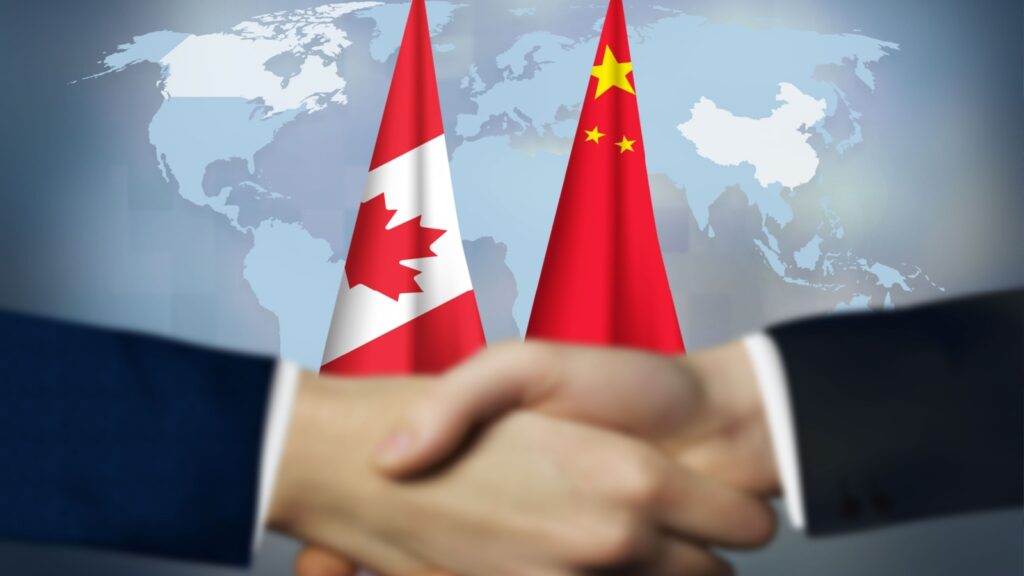
For years, Washington has treated dependence on China for critical minerals as an economic and national-security vulnerability. But building an alternative supply chain may require something increasingly complicated: close cooperation with Canada.
That was the warning delivered September 28 by Edward Fishman, a former U.S. sanctions official and now a senior fellow at the Council on Foreign Relations. Speaking at the Mining Forum Americas in Colorado Springs, Fishman argued that American money and political determination will not be enough without Canadian and Australian mining expertise. His assessment comes as China remains overwhelmingly dominant in several stages of critical-mineral processing, while Canada and the United States navigate unusually difficult trade relations. The result is a strategic contradiction: North America wants to reduce its exposure to China, but doing so requires expensive projects, long investment horizons and deeper cooperation among countries whose economic relationship has become more contentious.
Fishman Says the United States Cannot Do This Alone
Edward Fishman’s warning carries particular weight because his career has been built around the use of economic power as a national-security tool. During the Obama administration, he worked on U.S. sanctions against Iran and later helped develop sanctions targeting Russia after its invasion and annexation of Crimea in 2014. He also served at the Treasury Department and on the State Department’s Policy Planning Staff. Today, he directs the Council on Foreign Relations’ Maurice R. Greenberg Center for Geoeconomics, where his work focuses on the growing intersection between trade, finance, technology and national security.
At the Colorado Springs mining conference, Fishman said American capital and political support can help develop alternative mineral supplies, but the United States lacks everything required to replace China by itself. Canada and Australia bring large resource bases, established mining industries, technical expertise and companies accustomed to developing difficult projects. His message was unusually direct: the United States “cannot do it without the Canadians.” Fishman specifically argued that antagonizing Canada could make escaping Chinese dependence “virtually impossible,” turning the state of the bilateral relationship into more than a traditional trade concern.
China’s Biggest Advantage Is Not Simply What It Mines
China’s mineral leverage is sometimes described as a mining monopoly, but the reality is more complicated. Its strongest position is often farther down the supply chain, where raw material is separated, refined and converted into components manufacturers can actually use. International Energy Agency data show that China accounted for about 60 percent of global mined production of magnet rare earths in 2024. Its share rose to approximately 91 percent at the refining stage and an extraordinary 94 percent of sintered permanent-magnet production.
That distinction matters because digging ore from the ground does not automatically create an alternative supply chain. Rare-earth concentrates still have to pass through chemically and technically demanding separation processes before individual elements such as neodymium, praseodymium, dysprosium and terbium can be used in high-performance magnets. The vulnerabilities became visible after Beijing imposed export controls on seven heavy rare-earth elements in April 2025. The IEA reported that the restrictions contributed to supply disruptions severe enough for some automakers to reduce utilization or temporarily halt production. In other words, China does not need to dominate every mine if much of the material still depends on Chinese processing before reaching a factory.
Canada Is Already Embedded in American Mineral Supply Chains
Canada’s importance to Washington is not theoretical. The country produced more than 60 minerals and metals worth C$64.3 billion in 2024, while Canadian mineral and metal exports reached approximately C$162 billion in 2025. Ottawa currently classifies 34 minerals and metals as critical, covering everything from copper, nickel and lithium to germanium, gallium, graphite, uranium, potash and rare earth elements. Canada is also the world’s largest potash producer and was the second-largest uranium producer based on 2024 government data.
Much of that production already moves through integrated North American markets. The U.S. Geological Survey’s 2026 Mineral Commodity Summaries show that Canada supplied 79 percent of U.S. potash imports measured over 2021–2024, along with 56 percent of aluminum imports, 56 percent of zinc imports and 28 percent of niobium imports. Canada was also an important source of cobalt, germanium and several other critical materials. Nuclear energy provides another example: Natural Resources Canada says Canadian uranium accounted for 33 percent of uranium purchased by American nuclear reactors in 2024. For Washington, expanding Canadian production therefore would not mean creating an unfamiliar supply relationship from scratch. Much of the commercial infrastructure and cross-border trade already exists.
Canada’s Bigger Opportunity May Be in Processing
Having minerals underground is only part of the equation. Canada currently has no commercial mine production of rare earth elements despite possessing an estimated 15.2 million tonnes of rare-earth oxide resources and reserves. That gap helps explain Ottawa’s growing focus on processing capacity. In Saskatoon, the Saskatchewan Research Council is completing a minerals-to-metals facility designed to handle hydrometallurgy, rare-earth separation and metal production within one system. The facility is scheduled to complete commissioning in 2026 and move toward fully integrated operations in 2027.
The project is expected to produce magnet-grade neodymium-praseodymium metal as well as dysprosium and terbium oxides—materials that sit much closer to the technological chokepoints currently dominated by China. SRC says planned output could provide enough rare-earth metals for more than 500,000 electric vehicles annually. Another important project is emerging in British Columbia, where Teck Resources is considering as much as C$850 million in investment at its Trail smelting and refining complex. Ottawa says the expansion could double Trail’s existing germanium and antimony production capacity and potentially add gallium production. Those are precisely the specialized processing capabilities Western governments are trying to expand.
The Trade Fight Creates an Awkward Strategic Contradiction
The difficulty is that mineral-security policy is unfolding while broader Canada-U.S. trade relations remain strained. In January 2026, the Trump administration declared that U.S. dependence on imported processed critical minerals could threaten national security and directed officials to negotiate agreements with trading partners. The proclamation specifically contemplated tools including negotiated arrangements, minimum prices and price floors designed to encourage alternative processing capacity. That approach implicitly recognizes that reliable foreign partners will remain part of the American mineral strategy even as domestic production expands.
At the same time, Washington and Ottawa have been exchanging new tariff measures across several industries. Canada introduced counter-tariffs on C$27.6 billion of U.S. goods effective September 8, 2026, after another round of American trade measures. Critical minerals themselves have received different treatment depending on the product and U.S. trade authority involved, and some were previously exempted from broader tariffs. The larger problem Fishman identified is uncertainty. A refinery, mine or processing complex can take years to finance and build. Companies making those decisions must predict whether material will be able to cross the border competitively long after the political dispute that existed when construction began has changed.
Rare Earths Are a Defence Problem as Much as an EV Problem
Much public attention around critical minerals has centred on electric vehicles and batteries, but the security implications extend deep into aerospace and defence. The U.S. Department of Defense has identified rare-earth magnets as important components in aircraft, missiles, submarines, radar systems and unmanned vehicles. The department previously estimated that an F-35 fighter contains more than 900 pounds of rare-earth materials, while Virginia-class submarines require thousands of pounds. Rare earths are also used in guidance equipment, lasers, communications systems, radar and sonar.
The U.S. Government Accountability Office has repeatedly identified concentrated mineral sourcing as a defence-industrial vulnerability. It noted that many rare earths and other critical materials either lack equivalent substitutes or cannot easily be replaced without sacrificing performance. The challenge is particularly unusual because defence consumption represents only a small share of the overall global rare-earth market. The Pentagon therefore cannot single-handedly determine prices or compel enough new mining and processing capacity simply through defence purchases. Commercial demand from automobiles, electronics, energy systems, robotics and other industries must help support the same supply chain. That strengthens the case for a larger allied market rather than a defence-only solution.
Governments Are Discovering That Free Markets Alone May Not Build the Alternative
Creating a competing mineral supply chain is expensive partly because Chinese producers already benefit from enormous scale, established infrastructure, specialized equipment and decades of technical experience. The IEA estimates that capital costs for new refining projects outside dominant supplier countries can be anywhere from 20 percent to more than 150 percent higher. Operating costs average roughly 50 percent more in many cases. Skilled labour shortages, permitting timelines, technology gaps and limited processing-equipment suppliers create additional hurdles.
That is why both Canada and the United States are experimenting with policies that go beyond ordinary grants. Washington’s January critical-minerals proclamation explicitly raised the possibility of international price floors. Canada has increasingly used government-supported offtake arrangements, equity-like investments and strategic partnerships to give producers greater certainty. Through the G7 Critical Minerals Production Alliance, Ottawa said in March that two rounds of partnerships and investments were helping mobilize approximately C$18.5 billion in Canadian projects. The Canada Critical Minerals Accelerator has also begun backing processing investments such as the proposed Trail expansion. The basic financial problem is straightforward: companies are reluctant to spend billions developing non-Chinese capacity if a future surge of inexpensive supply can make their facilities uneconomic before investors recover their capital.
Canada Has Leverage, but Replacing China Will Still Take Years
None of this means Canada can quickly substitute for China. The country possesses enormous geological potential, but a deposit is not the same thing as operating production, and an operating mine is not the same thing as a fully integrated magnet, battery or semiconductor supply chain. Canada is still working to expand roads, electricity, processing plants and transportation links around many prospective deposits. New projects also require financing, regulatory approvals and meaningful partnerships with Indigenous communities. The IEA has similarly warned that technical expertise, specialized equipment and downstream manufacturing capacity remain major constraints across mineral markets outside China.
What Canada can offer is a starting platform that already includes mines, major smelters, engineering expertise, reliable electricity systems and decades of integration with U.S. industry. Ottawa is also developing a critical-mineral stockpiling mechanism and pursuing partnerships through the G7, NATO-linked supply chains and bilateral agreements. Fishman’s warning therefore points to a broader reality. Washington may succeed in reducing its mineral exposure to China, but independence does not necessarily mean producing everything inside the United States. A more realistic model could be a diversified North American and allied supply chain in which Canada becomes increasingly important not merely as a source of ore, but as a producer, processor and strategic industrial partner.
