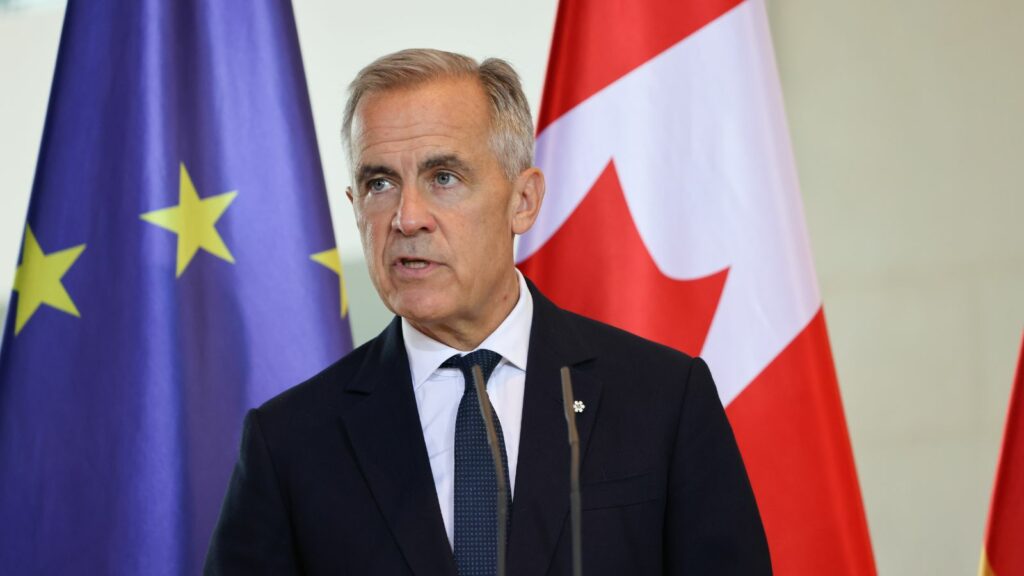
Canada’s economic geography has always pointed south, but its strategic thinking is increasingly looking east. As the trade confrontation with U.S. President Donald Trump deepens, Prime Minister Mark Carney’s government is exploring a much closer relationship with the European Union—one potentially extending well beyond the tariff reductions already provided by CETA.
Reported discussions include easier movement of goods, services and workers in strategic industries such as defence, energy, artificial intelligence and critical minerals. That does not mean Canada is preparing to join the EU, nor would Canadians automatically gain the same unrestricted mobility rights enjoyed by EU citizens. Still, even a narrower arrangement could mark a significant shift. Ottawa is not trying to replace the United States geographically or economically. It is trying to ensure that access to one market no longer determines so much of Canada’s economic future.
A “Unique Alliance,” Not a Bid to Join the EU
The most important distinction is between membership and integration. Carney has publicly rejected the suggestion that Canada is seeking to become an EU member, instead describing the objective as a “unique alliance.” Reports about an “associate member” concept have captured attention because officials have discussed arrangements that could bring Canada closer to parts of the European single market without placing the country inside the EU’s political institutions. No established EU category currently matches exactly what Ottawa appears to be pursuing.
That leaves considerable room for negotiation. Canada could seek deeper economic privileges without representation in the European Parliament, adoption of the euro or the full legal obligations imposed on EU members. Existing European arrangements demonstrate that substantial integration can occur outside membership, although none provides a simple template for Canada. Norway participates deeply in the European Economic Area, while Switzerland relies on bilateral agreements. Canadian officials and their European counterparts are instead signalling that the transatlantic relationship may require a structure designed specifically for Canada’s circumstances.
What EU-Style Free Movement Could Actually Mean
The phrase “free movement” needs careful qualification. Inside the EU, citizens generally have treaty-based rights to live, seek employment and work in another member state without obtaining a conventional work permit. Canadians do not have those rights. Canadian passport holders can already visit Schengen countries without a visa for short stays of up to 90 days within a 180-day period, but longer residence and most forms of employment remain governed by immigration, work-permit and professional-licensing requirements.
The negotiations being reported therefore matter less for tourism than for economic mobility. A deeper agreement could make it easier for Canadian engineers, researchers, executives, AI specialists, energy professionals or defence-sector workers to relocate temporarily for projects in Europe, while giving comparable access to Europeans working in Canada. CETA already creates temporary-entry pathways for defined categories such as intra-company transferees, investors and independent professionals, but explicitly excludes general access to the labour market and permanent employment. Expanding that framework would be significant without resembling unrestricted migration.
Trump’s Tariff Escalation Has Changed Ottawa’s Risk Calculation
The urgency behind the European push becomes clearer when measured against the deterioration in Canada-U.S. trade relations. Washington imposed 50 per cent tariffs on roughly $27.6 billion of Canadian goods effective August 22, prompting Ottawa to match the measures dollar for dollar. Canada’s counter-tariffs of 15, 25 and 50 per cent took effect September 8 on products including steel, dairy, appliances, agricultural equipment, pulp and paper, electronics and other American goods.
The dispute has continued beyond conventional tariffs. The Trump administration has announced import restrictions on selected Canadian products, including certain alcoholic beverages and dairy goods, scheduled to take effect September 29. Canada suspended negotiations after concluding that the terms being requested by Washington were not economically acceptable. CUSMA continues to provide preferential treatment for many qualifying goods, but the growing use of measures outside those traditional protections has made predictability itself a concern. For manufacturers planning factories or multibillion-dollar projects, uncertainty over future market access can become almost as consequential as the tariff rate charged today.
Europe Is Big Enough to Matter, but Not Big Enough to Replace the U.S.
Diversification cannot erase geography. Statistics Canada reported that 71.7 per cent of Canadian merchandise exports still went to the United States in 2025, although that was down sharply from 75.9 per cent in 2024. Canada’s merchandise exports to non-U.S. destinations increased 17.2 per cent during the year. Broader goods-and-services figures have also shown the American share declining, underscoring how companies have begun looking harder at customers beyond the continent as U.S. trade conditions become less predictable.
Europe nevertheless offers a scale few alternatives can match. The EU is Canada’s second-largest trading partner in goods and services, with bilateral trade reaching approximately $178.6 billion in 2025. It is also a major source and destination for investment, giving the relationship considerably more substance than a diplomatic pivot built from scratch. Yet the numerical gap with the United States remains enormous. That means Carney’s European strategy is best understood as risk reduction: creating enough additional markets, investors and supply chains that a disruption in Washington hurts Canada less than it otherwise would.
CETA Provides a Ready-Made Foundation
Canada and Europe do not need to begin with a blank sheet of paper. CETA has been provisionally applied since September 2017 and has already eliminated virtually all tariff lines between the two economies. By 2024, approximately 99 per cent of tariff lines had been abolished. The agreement also reaches beyond physical goods into services, investment, government procurement, professional qualifications and temporary entry for selected categories of businesspeople.
One concrete example arrived this year. A mutual recognition agreement for architects entered into application, making it easier for qualified Canadian and European architects to have their credentials recognized across the Atlantic. CETA also permits certain intra-company transferees, investors, contractual service suppliers and independent professionals to enter temporarily under defined conditions. Those arrangements are narrower than free movement, but they demonstrate how regulatory barriers can be lowered profession by profession. A more ambitious Canada-EU deal could effectively scale that logic into additional fields such as engineering, advanced manufacturing, defence technology, research and energy infrastructure.
Defence, Critical Minerals and Digital Trade May Move First
Some of the deepest integration is already occurring in sectors once considered largely separate from ordinary trade policy. Canada became the first non-European country to participate in the EU’s Security Action for Europe program, known as SAFE, opening European defence procurement opportunities to Canadian companies. One early example involves Montréal-based Marconi Technologies supplying Canadian-made tactical radios for Poland, with the project expected to draw on a network of nearly 100 Canadian suppliers.
The economic relationship is broadening elsewhere as well. Canada and the EU launched negotiations on a Digital Trade Agreement in March 2026, with multiple negotiating rounds taking place during the year. Cooperation on critical minerals is expanding as Europe looks for secure alternatives to concentrated global supply chains, while Canada is already associated with Horizon Europe, the EU’s flagship research and innovation program. Reports about the proposed new alliance also point to AI, energy infrastructure, data centres and transatlantic digital connections. In practice, these strategic sectors may become laboratories for deeper integration before governments attempt anything resembling broad labour mobility.
The Legal and Political Obstacles Are Real
Ambition does not guarantee a quick agreement. CETA itself illustrates how slowly deep European agreements can progress. Although most of the trade deal has operated provisionally since 2017, only 17 EU member states have completed national ratification. Ten—including France, Italy, Belgium, Ireland and Poland—still have not done so. Negotiating an additional arrangement involving workers, regulatory standards or access to strategic markets could therefore raise complicated questions both in Brussels and in national capitals.
Mobility is particularly sensitive because genuine EU free movement is tied to EU citizenship and specific European treaties. Non-EU nationals normally remain subject to immigration and work rules, while regulated professions add another layer of complexity. In Canada, professional licensing frequently falls under provincial or territorial jurisdiction; in Europe, national rules remain important even within common EU frameworks. That helps explain why a targeted model may be more achievable than a sweeping one. Governments could liberalize access for researchers, engineers or defence specialists without immediately creating an unrestricted Canada-EU labour market.
Strasbourg and the October Summit Are the Next Tests
The next stage will move rapidly from speculation toward diplomacy. Carney is scheduled to travel to Strasbourg and Liverpool from September 15 to 17. In Strasbourg, he will address the European Parliament, attend European Commission President Ursula von der Leyen’s State of the European Union address and meet European lawmakers on trade, investment and security. Canada is then scheduled to host the next Canada-EU leaders’ summit on October 29 and 30.
Those meetings should help reveal whether the idea remains a broad political aspiration or begins turning into a defined negotiating structure. Important signals would include an official mandate to negotiate, a list of sectors receiving preferential treatment, expanded rules for temporary workers, further recognition of professional credentials, or plans for regulatory alignment and joint investment. Whatever emerges, Canada’s direction is already notable. For decades, deeper North American integration appeared almost irreversible. The Trump-era trade conflict has forced Ottawa to consider a different model—one in which geography still ties Canada to the United States, but economic strategy is deliberately becoming more transatlantic.
