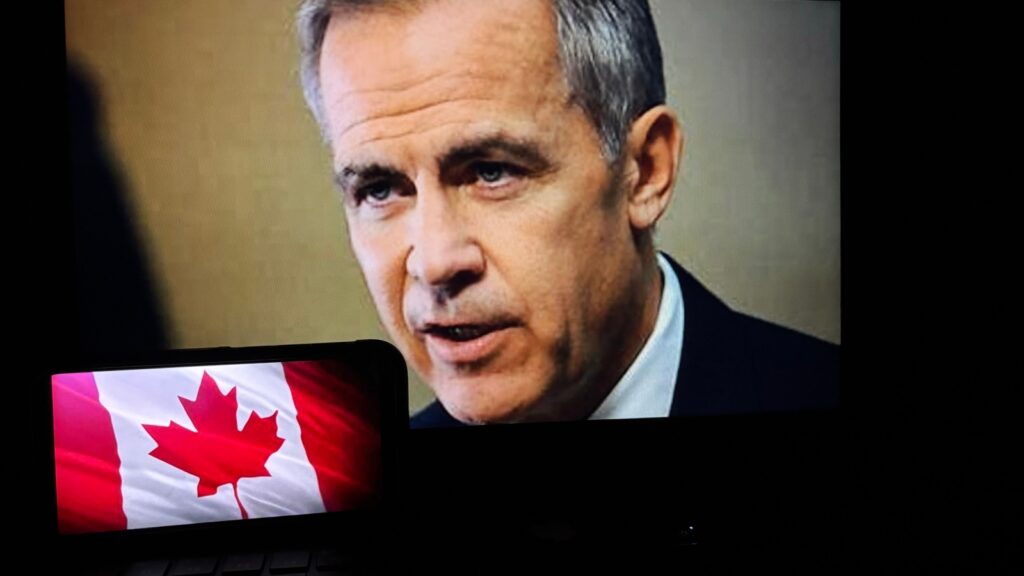
Canada is making an unusually ambitious pitch to the people who decide where the world’s biggest pools of money go next. Prime Minister Mark Carney’s government wants to catalyze $1 trillion in total investment over five years, and the first Canada Investment Summit in Toronto is designed to turn that target into projects, financing relationships and eventually construction.
The timing gives the gathering a sharper geopolitical edge. Donald Trump’s tariffs and pressure to shift manufacturing into the United States have weakened one of Canada’s traditional selling points: dependable access to the American market. Carney’s answer is to sell something different—political stability, rule of law, abundant energy and minerals, skilled workers, and trade access reaching far beyond the United States. The opportunity is enormous. So is the test of whether investors believe Canada can actually build fast enough to deserve their money.
Carney Is Putting a $1 Trillion Number on Canada’s Investment Ambition
The headline figure is enormous even by government-strategy standards. Ottawa’s goal is to catalyze $1 trillion in total Canadian investment over five years, combining public spending, private capital and institutional money rather than expecting the federal government to write anything resembling a trillion-dollar cheque. The government has said roughly $280 billion in capital investments and incentives can help mobilize much larger commitments from businesses, pension funds and other investors. It is a deliberate attempt to make investment—not simply government spending—the measure of whether the economic strategy succeeds.
That helps explain why Carney is spending political capital on a room full of financiers rather than unveiling another conventional subsidy program. The September 14–15 Canada Investment Summit in Toronto is being hosted with CPP Investments and PSP Investments, organizations accustomed to deploying money around the world. For Carney, the challenge is convincing global capital that Canada should receive a substantially larger share of it. The $1 trillion target therefore works as both an economic objective and a public benchmark against which the government can eventually be judged.
The Summit Gives Canada Access to an Extraordinary Pool of Capital
The gathering itself illustrates the scale of Carney’s strategy. Around 300 chief executives and senior investment figures are expected in Toronto, with the institutions represented collectively managing more than $120 trillion in assets. BlackRock chief executive Larry Fink and Blackstone president Jon Gray are among the major global financial figures on the program. Rather than simply promoting Canada in speeches abroad, Ottawa has brought a remarkable concentration of capital allocators into one place and paired them with Canadian companies seeking money for real projects.
That does not mean Toronto will produce hundreds of billions of dollars in signed deals by the time participants go home. Officials have cautioned that the summit should be viewed as the beginning of investment relationships, with major results potentially taking 12 to 18 months to emerge. That distinction matters. Infrastructure financing involves due diligence, permits, revenue forecasts and negotiations that rarely happen over a two-day conference. The more realistic measure of success will be whether projects that investors encounter in Toronto begin reaching financing decisions, construction sites and commercial operation over the next several years.
Trump Has Changed the Investment Pitch Canada Has to Make
For decades, proximity to the United States was one of Canada’s simplest investment arguments. A company could build in Ontario, Quebec or another province, benefit from Canadian talent and resources, and still participate in an integrated North American market. Trump’s tariff campaign has made that proposition less predictable. After trade negotiations broke down in August, the United States imposed 50% tariffs on $27.6 billion worth of Canadian goods, prompting Canada to answer with matching counter-tariffs on an equivalent value of U.S. imports beginning September 8.
The uncertainty creates a complicated opening for Carney. Washington is openly trying to encourage factories and capital to locate in the United States, so Canada cannot compete merely by promising easy access to American customers. Instead, Ottawa is emphasizing reliability. Carney has described Canada as a country where investors can depend on the rule of law and stable institutions, contrasting that environment with abrupt tariff changes and shifting U.S. trade policy. In that sense, Canada is not arguing that Trump makes America economically irrelevant. It is arguing that geopolitical unpredictability makes Canadian stability more valuable.
Canada’s Strongest Evidence Is That Foreign Capital Is Already Arriving
Ottawa is not making its investment pitch from a standing start. Statistics Canada reported that foreign direct investment into Canada reached $96.8 billion in 2025, the strongest annual result since 2007. Manufacturing attracted $11.2 billion, while trade and transportation received $23.6 billion. Those numbers give the government something more persuasive than a promotional slogan: international investors have recently been willing to commit large amounts of long-term capital to Canadian businesses and assets.
There is an important qualification. More than half of that 2025 foreign direct investment still originated in the United States, demonstrating how deeply the two economies remain connected even while Ottawa talks about diversification. Canada is not replacing the U.S. investment relationship; it is trying to build more alternatives around it. That distinction can get lost in the politics of a trade war. For a factory manager, pension fund or infrastructure investor, diversification does not necessarily mean abandoning America. It means reducing the risk that one government, one border or one tariff dispute can determine the economics of an entire project.
Energy and Critical Minerals Are at the Centre of the Sales Pitch
Carney’s government repeatedly argues that Canada “has what the world wants,” and the most tangible part of that claim sits underground or inside the country’s energy system. Canada possesses major reserves of minerals needed for batteries, power grids, defence equipment and advanced manufacturing, alongside large oil, natural-gas, hydroelectric and nuclear industries. Those assets fit a world in which governments increasingly view energy and mineral supply chains as matters of national security rather than ordinary commodity trading.
The investment pipeline is becoming more concrete. Canada’s Major Projects Office lists 18 major projects and nine transformative strategies representing roughly $192 billion in new investment and an estimated 337,000 jobs, while the government says they could help enable as much as $500 billion in future private-sector capital. Projects range from new nuclear development and critical-mineral mines to ports and LNG facilities. LNG Canada’s proposed second phase alone is expected to require about $33 billion in private capital. These are precisely the kinds of long-lived assets that suit pension funds and infrastructure investors seeking predictable returns over decades.
Canada Is Also Selling Access to Markets Beyond the United States
One of Carney’s strongest arguments is that building in Canada does not have to mean selling primarily to Canadians. Ottawa says the country’s 16 free-trade agreements cover 51 countries and provide preferential access to roughly 1.5 billion consumers representing about two-thirds of global GDP. That network becomes more valuable politically as Canada tries to reduce its vulnerability to Washington. A mine, manufacturing plant or technology company located in Canada can theoretically use the country as a platform for reaching Europe and Asia as well as North America.
Trade patterns have already begun moving in that direction. The U.S. share of Canadian merchandise exports fell from 75.9% in 2024 to 71.7% in 2025, while exports to countries other than the United States jumped 17.2%. By July 2026, Canadian merchandise exports to China were 51.7% higher than a year earlier, while exports to the United Kingdom had more than doubled. Monthly trade data can be volatile, so those increases should not be treated as a permanent realignment. They nevertheless illustrate why ports, LNG terminals, railways and other export infrastructure have become central to Carney’s economic agenda.
Canadian Institutions Are Starting to Put Their Own Money Behind the Strategy
A global investment campaign looks much more credible when domestic institutions are also willing to commit capital. In the days leading into the Toronto summit, BMO announced plans to mobilize as much as $70 billion over 10 years for sectors including electricity, pipelines, transportation, mining, artificial-intelligence computing, defence and oil and gas. Sun Life separately announced a $5 billion, five-year Canadian infrastructure commitment covering areas such as digital technology, energy, transportation and logistics.
Power Sustainable, part of the Power Corporation group, has also outlined plans to invest and mobilize more than $10 billion for Canadian infrastructure and related businesses. Taken together, the announcements send a useful signal to foreign investors: Canadian financial institutions themselves see investable opportunities at home. They also demonstrate what Ottawa means by “catalyzing” investment. The federal government does not need to finance every mine, transmission line, port or data centre directly. Its larger task is to establish conditions in which banks, insurers, pension managers and private funds decide that committing their own money produces competitive returns.
Faster Project Approvals May Matter More Than the Summit Speeches
Global investors do not commit billions simply because a prime minister makes a persuasive presentation. They study how long approvals take, whether regulations change midway through a project, how infrastructure connects to customers and whether political disputes can delay construction for years. Ottawa appears to recognize the problem. The Major Projects Office was created as a single federal point of contact for large projects, while the government has pursued a “one project, one review” approach with provinces to reduce duplicated assessment processes.
The proposed reforms are particularly important because the investment summit is filled with long-horizon capital. A pension fund financing a port or electricity network may be comfortable waiting decades for its returns, but it still wants reasonable certainty about when construction can start. Ottawa has been consulting on federal reforms intended to shorten review and decision-making timelines once project proponents provide complete information. That effort must still reconcile speed with environmental obligations and Indigenous rights. Canada’s pitch therefore depends on proving that faster does not simply mean weaker oversight—it means more predictable, coordinated decision-making.
Canada Still Has an Investment and Productivity Problem to Solve
The bullish presentation in Toronto cannot obscure Canada’s longstanding economic weaknesses. The Bank of Canada estimates potential-output growth will slow to about 1.2% in 2026, reflecting slower population growth, U.S. tariffs and trade-policy uncertainty. Business investment is expected to strengthen, particularly in energy, but the central bank still expects investment outside oil and gas to remain on a lower track than before the latest U.S. tariffs were introduced. That makes the summit less a celebration of a solved problem than an attempt to change the country’s trajectory.
There are encouraging signs. The Bank’s second-quarter Business Outlook Survey found that firms’ investment intentions remained strong, with companies increasingly interested in productivity-enhancing equipment and artificial intelligence. But attracting capital is only the first step. Canada must turn that investment into higher output per worker, more efficient transportation networks, lower infrastructure bottlenecks and globally competitive businesses. A trillion dollars of poorly executed spending would not fix weak productivity. The economic payoff depends on whether the capital creates assets and technologies that allow Canadian workers and companies to produce more value.
The Real Test Comes After the Investors Leave Toronto
The easiest part of a $1 trillion strategy is announcing the number. The difficult part is converting dozens of meetings into financing agreements, permits, engineering contracts and workers arriving at construction sites. Ottawa says the Major Projects Office now has 27 projects and strategies in its broader pipeline, worth more than $192 billion. That gives investors something tangible to examine, from the Contrecœur container terminal in Quebec to nuclear, critical-mineral, LNG, hydro and northern transportation developments elsewhere in the country.
Carney’s larger bet is that a period of American unpredictability can become a Canadian opportunity. Trump’s tariffs may push some businesses toward the United States, but they also remind investors of the value of geographic and political diversification. Canada offers resources, institutional stability and unusually broad trade relationships, yet those advantages will mean little if projects remain stuck for years or returns are uncompetitive. The Toronto summit is therefore not the finish line. It is a high-profile test of whether Canada can transform the idea of being a safer alternative into something investors value more concretely: profitable assets that actually get built.
