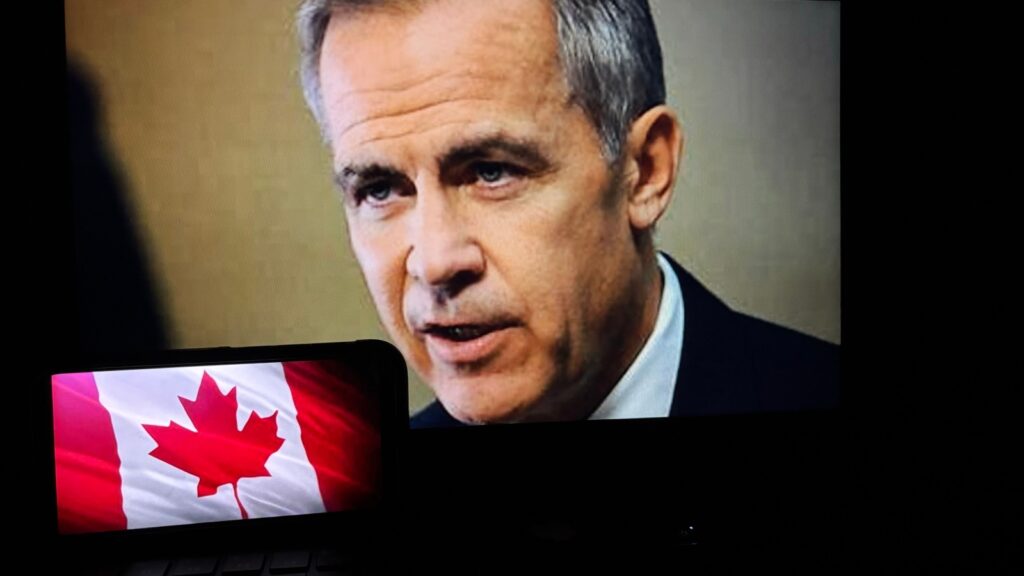
Prime Minister Mark Carney left the ASEAN summit in Manila before U.S. President Donald Trump’s scheduled arrival, creating a notable diplomatic contrast as Canada and the United States continue struggling to finalize a bilateral trade agreement.
Carney attended the summit’s opening events on November 15, 2026, before departing for Cambodia, while Trump was expected to arrive in the Philippines on November 17. Although their schedules did not overlap, Carney reported progress in trade discussions following a recent conversation with the American president.
The timing underscores the challenges facing Ottawa. Canada remains deeply connected to the American economy, yet uncertainty surrounding tariffs and trade negotiations is pushing the federal government to strengthen relationships elsewhere. In Southeast Asia, Carney announced major progress toward new trade agreements, signalling that Canada’s economic strategy increasingly extends beyond its traditional relationship with Washington.
The Departure Was Part of a Published Schedule
Carney’s visit to Manila was brief by design. On Sunday, November 15, the prime minister was scheduled to attend the 49th ASEAN Summit’s opening ceremony at 9 a.m., participate in a plenary session at 10:15 a.m., and meet Brazilian President Luiz Inácio Lula da Silva at 11 a.m. His official itinerary then listed a 1:15 p.m. departure for Phnom Penh, Cambodia. The Canadian Press reported that his Philippines visit lasted only one night, with the Cambodian portion of his diplomatic tour already planned.
Trump, by contrast, was not expected in Manila until Tuesday, November 17, after the main ASEAN leaders’ meetings. Philippine officials outlined a later program involving a special ASEAN–U.S. gathering and discussions with Philippine President Ferdinand Marcos Jr. The schedules meant Carney and Trump were not expected to cross paths in Manila, but they do not establish that either leader deliberately avoided the other. While the timing attracted attention because of their unresolved trade negotiations, it also reflected two different diplomatic itineraries.
Carney Reports Progress After a Direct Conversation With Trump
Despite the absence of a planned face-to-face meeting in Manila, Carney confirmed that communication with the White House was continuing. Speaking to reporters on November 14, he described a lengthy and substantive telephone conversation with Trump shortly before departing for Europe and Asia. U.S. Trade Representative Jamieson Greer and White House chief of staff Stephen Miller also participated in the discussion, according to Carney. The prime minister acknowledged that a bilateral trade agreement remained possible, emphasizing that negotiations were advancing without suggesting a breakthrough had been secured.
That distinction matters for Canadian businesses waiting for clarity on tariffs and cross-border commerce. A promising conversation cannot immediately reduce the duties imposed on Canadian exports or resolve disagreements over market access. The two governments have resumed discussions following an earlier breakdown, but no finalized agreement had emerged from the Manila visit. Carney’s message was therefore cautiously optimistic rather than celebratory. For manufacturers, exporters and workers whose livelihoods depend on predictable access to the American market, continued negotiations provide some reassurance, but they cannot replace the certainty of a signed agreement.
August’s Failed Negotiations Continue to Complicate a Deal
The latest discussions follow a particularly difficult period in Canada–U.S. relations. Negotiations collapsed in August 2026 after the two countries failed to resolve several outstanding disagreements. Reuters reported that a proposal under consideration would have reduced American tariffs on Canadian cars and light-duty trucks from 25% to 15%, while cutting tariffs on steel and aluminum from 50% to 25%. However, disagreements remained over whether the proposed relief would extend to medium- and heavy-duty trucks, among other issues.
The breakdown triggered further escalation. Trump threatened to raise tariffs on Canadian automobiles, trucks and automotive parts to 50% beginning January 1, 2027. Washington also imposed 50% tariffs on approximately $20 billion worth of Canadian goods, prompting retaliatory Canadian measures in September. Those developments help explain why renewed optimism has not immediately produced an agreement. Negotiators still face questions about which products would receive tariff relief, what conditions would apply and whether Canada would retain sufficient control over its domestic economic decisions. For Ottawa, securing reduced tariffs is important, but accepting restrictions that could undermine Canadian industries presents a different risk.
Canada’s Auto Industry Remains a Major Sticking Point
Automotive manufacturing has become one of the most sensitive elements of the trade dispute. Canadian and American factories operate within deeply integrated supply chains, with vehicle parts and components frequently moving between the two countries before final assembly. Higher tariffs threaten to increase production costs, discourage investment and create uncertainty about where future vehicles will be manufactured. Reuters warned in August that further escalation could disrupt the North American automotive industry and potentially raise costs for manufacturers and consumers. Carney has emphasized that Canada will not accept an agreement that damages its domestic automotive sector.
The consequences are already visible in Ontario. Stellantis abandoned plans to manufacture the Jeep Compass at its Brampton assembly plant and shifted production to Illinois, leaving more than 2,000 Canadian workers without jobs, according to the Associated Press. The automaker subsequently agreed to sell the idled factory to Canadian defence manufacturer Roshel, prompting Ottawa to threaten legal action over government funding commitments. Although those developments are separate from Carney’s ASEAN schedule, they illustrate why automotive protections remain central to negotiations. For affected workers and communities, the dispute is ultimately about securing future production, employment and investment.
ASEAN Trade Agreement Could Open a Market of Nearly 700 Million People
One of Carney’s most significant announcements in Manila concerned Canada’s relationship with the 11-member Association of Southeast Asian Nations. Ottawa confirmed that negotiations for an ASEAN–Canada free trade agreement were substantially complete, with both sides aiming to sign the agreement in 2027. The regional bloc represents nearly 700 million people and an economy valued by the Canadian government at almost $6 trillion. Canada already has considerable commercial ties with the region, with two-way merchandise trade reaching $52.5 billion in 2025, making ASEAN Canada’s fifth-largest merchandise trading partner.
The federal government estimates that the proposed agreement could eventually add nearly $2 billion to Canada’s GDP and support approximately 14,000 Canadian jobs, particularly in agriculture and manufacturing. Ottawa also announced $5 million in technical assistance to help ASEAN countries prepare to implement the agreement. For Canadian exporters, the attraction extends beyond additional customers to the possibility of more consistent trading rules across multiple countries. However, those economic projections are conditional on implementation and should not be confused with benefits already delivered. The agreement must still complete its remaining steps before businesses can fully take advantage of its provisions.
Canada and the Philippines Complete Separate Trade Negotiations
Carney’s visit also produced significant progress in Canada’s bilateral relationship with the Philippines. Following discussions with President Ferdinand Marcos Jr., the two governments announced that negotiations for a separate free trade agreement had concluded. Carney said the negotiating process had taken approximately nine months, representing relatively rapid progress compared with the broader ASEAN negotiations, which began in 2021. Both countries are working toward signing the agreement in 2027. The Philippines has more than 110 million residents, while merchandise trade between Canada and the country reached approximately $3.4 billion in 2025.
The Canadian government projects that the agreement could help Canadian exports to the Philippines triple by 2035, opening additional opportunities for agricultural producers, forestry companies and other businesses. Carney also identified aerospace, artificial intelligence, mining and energy services as sectors that could benefit from stronger commercial relationships. For Canadian companies seeking customers outside North America, the prospect of improved access to a large Southeast Asian market is particularly attractive. Nevertheless, completing negotiations does not mean the agreement is already in force. Finalization, signature and implementation remain necessary, and Canadian exporters will still need to navigate transportation costs, local distribution networks and competitive conditions.
Defence and Technology Cooperation Were Also Major Priorities
Although trade dominated Canada’s announcements, Carney’s Manila discussions extended into defence, security and technological cooperation. Ottawa announced measures to strengthen coordination between Canadian and Philippine armed forces, establish a new cybersecurity dialogue and extend Canada’s Dark Vessel Detection program until 2033. That satellite-based initiative helps identify vessels operating without active location-transmitting systems, supporting efforts to combat illegal fishing. Canada also committed $26 million toward initiatives involving nuclear safety, climate-resilient agriculture, food security, community resilience and infrastructure development in the Philippines.
Canada separately announced more than $15.9 million in investments to strengthen its relationship with ASEAN partners, including trade-related technical assistance, law-enforcement training and energy cooperation. Among the initiatives was $3 million over five years to support the ASEAN Power Grid, an ambitious regional project intended to improve electricity connections between Southeast Asian countries. These commitments illustrate how Ottawa is building relationships that extend beyond tariff reductions. Stronger security coordination, infrastructure development and technological collaboration can create opportunities for Canadian expertise while addressing practical challenges facing regional partners. The potential benefits are substantial, although the projects will require time and implementation before their longer-term impact can be assessed.
Carney’s Meeting With Brazil Expanded the Diplomatic Mission
Before leaving Manila, Carney also met Brazilian President Luiz Inácio Lula da Silva, discussing opportunities to expand bilateral trade and cooperation in critical minerals, energy and environmental protection. During their meeting, Canada announced an initial commitment of up to $560 million over four years toward the Tropical Forests Forever Facility, an international financing initiative led by Brazil and Norway. The program aims to attract investment for tropical forest conservation and support communities that depend on these ecosystems. Brazil is Canada’s largest merchandise trading partner in South America, with bilateral merchandise trade reaching $14.7 billion in 2025.
Following the ASEAN gathering, Carney travelled to Cambodia for activities connected with the Francophonie, including the FrancoTech 2026 event focused on technology and economic cooperation. His broader itinerary also included a planned visit to Shenzhen, China, for the Asia-Pacific Economic Cooperation summit. Ottawa had announced the November 11–19 diplomatic tour well before the Manila meetings began. These engagements demonstrate that Canada’s international priorities extend beyond its immediate trade disputes with Washington. While none of these initiatives can independently resolve American tariffs, they support Ottawa’s broader ambition to build stronger economic and diplomatic relationships across different regions.
The Unfinished Bilateral Deal Is Separate From the CUSMA Review
One important distinction in the ongoing negotiations involves the future of the Canada–United States–Mexico Agreement, commonly known as CUSMA. The agreement entered into force on July 1, 2020, replacing the North American Free Trade Agreement. Its first mandatory joint review was scheduled for July 1, 2026, creating an opportunity for the three countries to assess existing trading rules and consider possible changes. However, the review did not automatically terminate CUSMA. Under its existing terms, the agreement remains in force until 2036 unless the participating governments take further action.
The distinction matters because a bilateral agreement between Canada and the United States could reduce certain tariffs without settling broader questions surrounding North American trade. A September 2026 report from the U.S. Congressional Research Service noted that Canada and Mexico favoured renewing CUSMA during the review process, while Washington had declined to renew it. That decision did not mean the agreement had immediately expired. Instead, it added uncertainty about its long-term future. For Canadian businesses, resolving immediate disputes over automotive products, steel and aluminum is important, but preserving predictable rules governing the wider continental economy remains another major priority.
Canada’s Economic Dependence on the United States Raises the Stakes
Canada’s push toward greater trade diversification reflects the continuing importance of its largest export market. Statistics Canada reported that 71.7% of Canadian merchandise exports went to the United States in 2025, down from 75.9% in 2024. Meanwhile, Canadian exports to countries outside the United States increased by 17.2% during 2025, demonstrating that businesses were finding additional opportunities beyond North America. Carney has made doubling Canadian exports to non-U.S. markets by 2035 a central economic objective, with new trade agreements in Southeast Asia forming part of that strategy.
However, expanding relationships with Asian economies cannot immediately replace the deeply integrated manufacturing and supply chains connecting Canada with the United States. Different regulatory environments, transportation distances and competitive conditions mean that developing alternative markets requires sustained investment and time. Ottawa consequently faces two simultaneous challenges: negotiating an acceptable arrangement with Washington while creating additional commercial opportunities elsewhere. The next developments will depend on whether Canada and the United States resolve their tariff disagreements and whether the announced Asian agreements advance toward implementation. For Canadian workers and businesses, those outcomes will ultimately carry greater economic significance than the two leaders’ overlapping—or non-overlapping—diplomatic schedules.
