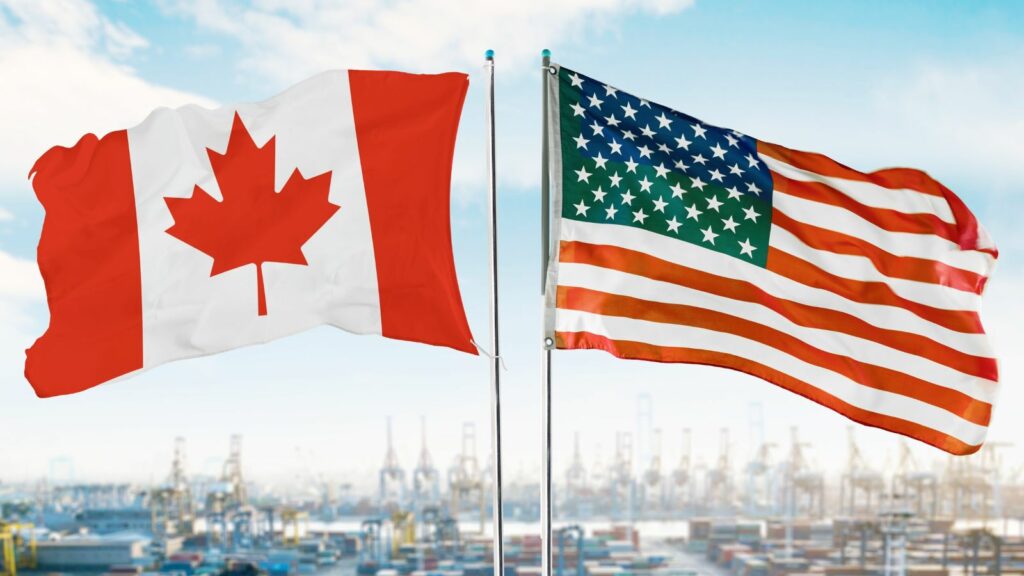
A political shift in Washington has opened a new front in the Canada–U.S. trade dispute, raising hopes that some of President Donald Trump’s tariffs could finally be rolled back. Following sweeping Democratic victories in the November 2026 midterm elections, lawmakers are preparing to challenge the administration’s trade policies, particularly the controversial 50% duties imposed on certain Canadian goods.
However, removing those tariffs will be far more complicated than winning control of Congress. Trump’s presidential veto powers remain a significant obstacle, while separate tariffs on steel, aluminum, automobiles and other industries operate under different legal authorities. For Canadian businesses already struggling with higher costs and uncertain market access, the outcome could determine whether the coming year brings meaningful relief or another prolonged period of economic uncertainty.
Democratic Election Victories Put Canada’s Tariffs Back in the Spotlight
The November 2026 midterm elections dramatically changed the political landscape in Washington, with Democrats winning control of both the House of Representatives and the Senate. The results have given the party an opportunity to challenge Trump’s trade agenda after months of escalating disputes with major trading partners. Among the priorities emerging from Democratic leaders is the removal of tariffs affecting Canadian imports, which critics argue have increased costs for American businesses and consumers.
Senator Ron Wyden, a leading Democrat on the Senate Finance Committee, has identified reversing Trump’s tariffs on Canada as an important priority when the new Congress takes office in January 2027. The issue connects directly to Democrats’ broader campaign emphasis on affordability and economic stability. However, winning legislative majorities does not automatically give the party authority to dismantle existing tariffs. Democrats must navigate presidential powers, complicated trade laws and disagreements within their own ranks before their election victory can translate into meaningful changes at the border.
Trump’s 50% Canada Tariffs Have Become a Major Legislative Target
One of the most controversial measures facing congressional scrutiny is Trump’s use of Section 338 of the Tariff Act of 1930. The administration invoked the rarely used provision to impose additional tariffs of 50% on selected Canadian imports, arguing that Canadian trade policies unfairly discriminated against American businesses. The duties took effect on August 22, 2026, following unsuccessful negotiations between Ottawa and Washington. The affected products include furniture, paper, wood products, plastics, electronics, industrial machinery and various consumer goods.
The measure stands apart from earlier tariffs because Section 338 had never previously been expressly invoked by a U.S. president to impose import duties. Its origins in Depression-era trade legislation have made it a particularly attractive target for lawmakers seeking to restrict presidential tariff powers. Unlike many other U.S. tariff measures, the Section 338 duties also offer no automatic exemption for goods meeting Canada–United States–Mexico Agreement rules. Consequently, products that would ordinarily qualify for preferential trade treatment can still face substantial additional costs when entering the American market.
Canada’s Retaliation Has Expanded the Economic Conflict
The escalating tariff dispute has already produced significant consequences on both sides of the border. In response to Washington’s Section 338 measures, Canada introduced retaliatory tariffs on approximately C$27.6 billion worth of American goods beginning September 8, 2026. The countermeasures included rates of 15%, 25% and 50%, affecting products associated with industries already under pressure from American trade restrictions. Steel, dairy, agricultural equipment, appliances, electronics and paper products were among the sectors targeted. Ottawa presented the response as an attempt to match American trade penalties rather than allow Canadian exporters to bear the consequences alone.
Washington subsequently expanded its restrictions by prohibiting imports of selected Canadian products beginning September 29. Those measures included certain alcoholic beverages, motorcycles, dairy ingredients and other goods. Import bans are particularly disruptive because affected products cannot simply enter the market after payment of a higher duty. The administration also modified the products covered by Section 338 tariffs in September and October. For importers and exporters, these repeated adjustments have made planning purchases, negotiating contracts and managing inventories considerably more complicated.
Washington and Ottawa Disagree Over What Started the Dispute
The White House maintains that its latest tariffs are a response to discriminatory Canadian trade practices. American officials have criticized provincial restrictions on U.S. alcoholic beverages, Canada’s dairy import arrangements and retaliatory duties affecting American vehicles. In the dairy sector, Washington argues that Canadian rules treat certain American cheese importers less favourably than comparable European importers. The administration contends that these policies disadvantage American exporters and justify measures designed to restore more balanced commercial treatment.
Canada disputes that characterization. Ottawa maintains that restrictions involving American vehicles and alcohol were introduced in response to earlier U.S. tariffs, while its dairy tariff-rate quota system complies with CUSMA obligations. The disagreement also has a complicated legal history. Previous dairy disputes produced different outcomes, with a 2021 trade panel ruling against certain Canadian allocation practices and another panel siding with Canada in 2023. Those conflicting results illustrate why neither government considers the underlying arguments settled. Removing tariffs through Congress could reduce immediate commercial tensions, but it would not automatically resolve the longstanding disputes over dairy access, industrial protection and cross-border automotive trade.
Democratic Legislation Could Eliminate Tariffs and Require Refunds
Democrats already have legislative proposals that could form the foundation of their challenge. Senate Democratic leader Chuck Schumer introduced the End Trump’s Tariff Tax Act, designated S. 5390, in September 2026. The proposal would repeal Section 338 tariff authority, terminate certain other presidential duties and require refunds of covered tariffs previously collected from importers. Under the bill, U.S. Customs and Border Protection would have 30 days after enactment to issue automatic refunds with interest, prioritizing smaller businesses where practicable.
Another proposal, Senator Ron Wyden’s Congressional Trade Powers Reform Act of 2026, takes a broader approach. It would restore greater congressional control over trade decisions, including requiring congressional approval for actions under several existing tariff authorities. Both measures reflect growing concern about the power presidents have accumulated over international commerce. However, neither proposal has become law, and their eventual impact depends on congressional negotiations and the president’s response. Even a successful refund program would principally compensate the importers who paid the duties, rather than automatically returning money to consumers who experienced higher retail prices.
Trump’s Veto Powers Remain the Biggest Obstacle
Despite their election victories, Democrats face a substantial constitutional obstacle: Trump can veto legislation intended to eliminate his tariffs. Overriding a presidential veto requires support from two-thirds of the members voting in both chambers of Congress. If every seat is filled and every lawmaker votes, that means securing 290 votes in the House and 67 in the Senate. Democrats have not won majorities large enough to accomplish that without Republican support. Most ordinary legislation also faces the Senate’s 60-vote threshold for ending debate.
That reality leaves the party facing difficult political choices. Democrats could advance tariff-repeal legislation and force Republicans to publicly defend or oppose the president’s trade policies. They could also seek compromises involving particular industries or tariff exemptions. Congressional committees would have opportunities to investigate how tariffs affect businesses and consumers, while negotiations over federal spending could provide additional leverage. Nevertheless, none of these approaches guarantees immediate relief. The Trump administration retains considerable authority over trade enforcement, making bipartisan cooperation or negotiated concessions essential to any durable legislative solution.
Steel and Aluminum Tariffs Face a Different Legal Battle
Canadian steel and aluminum producers face a separate challenge because their American tariffs are imposed primarily under Section 232 of the Trade Expansion Act of 1962. Unlike Section 338, which addresses alleged discrimination against American commerce, Section 232 authorizes trade restrictions based on national security concerns. The Trump administration has used that authority to maintain tariffs reaching 50% on many steel and aluminum products, although reduced rates and exclusions apply to certain goods. These measures remain in place independently of the controversial 1930 legislation Democrats are targeting.
The economic significance is considerable. According to Congressional Research Service figures, Canada supplied approximately US$7.53 billion in aluminum articles to the United States in 2025, representing 43% of American aluminum imports in that category. Canadian steel shipments were worth approximately US$4.54 billion. Some American metal producers support the restrictions because they believe tariffs protect domestic production, while manufacturers relying on imported materials have raised concerns about higher costs. For Canadian producers, eliminating Section 338 tariffs would therefore leave substantial barriers to accessing their most important export market.
Canada’s Auto Industry Remains Exposed to 25% Duties
The automotive industry presents another significant challenge because its tariff structure operates separately from the measures Democrats are most likely to repeal. Under Section 232, the United States maintains a 25% tariff on many imported vehicles. However, the rules distinguish between vehicles meeting CUSMA requirements and those that do not. For qualifying Canadian vehicles, the American-made portion of the vehicle’s value is exempt from the additional duty, while qualifying auto parts are currently exempt from the Section 232 automotive tariff altogether.
Those distinctions are critically important for an industry built around cross-border production. Congressional Research Service data show that approximately US$61 billion in American automotive exports went to Canada in 2025, representing 38% of the total. Meanwhile, Canadian automotive shipments to the United States were worth approximately US$53 billion. Trump has also threatened to increase automotive tariffs to 50% beginning January 1, 2027, although that increase has not taken effect. The continuing uncertainty threatens investment decisions and complicates long-term production planning for manufacturers operating facilities on both sides of the border.
Overlapping Tariff Rules Make Relief More Complicated
A major complication for Canadian exporters is that multiple American tariff authorities can apply to the same products. In September 2026, the Trump administration modified its Section 338 measures to allow the additional duties to be imposed alongside certain Section 232 tariffs. This means selected Canadian products can face more than one additional import duty, with combined rates potentially reaching 100% in specific circumstances. The rules are product-dependent, however, and such rates should not be interpreted as applying broadly to all Canadian exports.
Another layer comes from Section 301 of the Trade Act of 1974, which the administration used to impose a separate 10% tariff on many imports following investigations concerning alleged failures to prevent trade in goods produced with forced labour. CUSMA-qualifying goods generally receive exemptions from that measure, but not necessarily from the sectoral tariffs. Consequently, the amount owed on a shipment depends on its classification, origin, content and applicable trade restrictions. Repealing one tariff authority would simplify part of this system without necessarily eliminating the costs associated with the others.
Democrats Are Not United Against Every Tariff
Although Democrats have sharply criticized Trump’s trade policies, the party does not uniformly oppose tariffs. Many Democratic lawmakers have historically supported trade restrictions intended to protect American manufacturing, industrial employment and national security. Former President Joe Biden retained several tariffs originally introduced during Trump’s first administration and increased duties on selected Chinese products, including electric vehicles. That history helps explain why the party’s challenge to the Canadian tariffs is unlikely to translate into an effort to eliminate every import restriction currently enforced by Washington.
The distinction matters for Canadian steelworkers and automotive employees. A Democrat who opposes the use of Section 338 against Canada might still support Section 232 restrictions intended to protect American mills or manufacturing facilities. Lawmakers representing industrial communities may also face pressure from unions and local employers to maintain certain protections. As a result, Canada could gain political allies in Washington on one set of tariffs while encountering resistance from some of those same legislators on another. The legal obstacles are substantial, but the political divisions could prove equally important.
Businesses and Families Are Paying for the Standoff
Tariffs may be announced as penalties against foreign countries, but the immediate payment is generally made by the American importer bringing goods across the border. Companies can absorb the expense, negotiate lower prices with suppliers or pass some of the increase to customers. The consequences can spread through supply chains long before shoppers see a higher price tag. For Canadian exporters, the pressure can mean lower margins, lost orders or difficult decisions about where to invest. The Parliamentary Budget Officer estimated in October that the average effective U.S. tariff rate on Canadian imports had increased from 5.3% to 7.7%.
The longer-term projections are more troubling. The Parliamentary Budget Officer estimated that trade measures introduced since early 2025 could leave Canada’s real GDP 1.4% below its pre-tariff baseline after five years. If the tariffs remained permanent, employment could be as much as 185,000 jobs lower than otherwise expected. Those figures are projections, not job losses that have already occurred. Public opinion adds another dimension: a November Reuters/Ipsos survey found that 62% of Americans supported congressional legislation eliminating tariffs imposed by the Trump administration. The political demand for relief is evident, even if achieving it remains difficult.
Canada’s Next Breakthrough May Come From Negotiations
For Prime Minister Mark Carney, the Democratic election victories create new opportunities but do not replace the need to negotiate directly with the White House. Speaking in Montreal after the midterms, Carney emphasized that Trump’s administration remains the central decision-maker on trade agreements. The prime minister also confirmed that the two leaders remained in contact, even as difficult issues continued to complicate negotiations. Earlier talks had broken down in August amid disagreements involving Canadian sovereignty, cultural protections and other American demands. Those disputes cannot necessarily be resolved through congressional action alone.
Canadian and American officials have also explored a more narrowly focused agreement addressing Section 232 duties on steel and automobiles. Such a deal could offer relief to major Canadian industries without requiring Congress to eliminate every tariff authority. However, negotiations have yet to produce a comprehensive settlement, and the possibility of further tariff increases remains a concern. For Canadian manufacturers, exporters and workers, the distinction is crucial. Democratic efforts could weaken one part of Trump’s tariff strategy, but meaningful stability will require progress on the separate sectoral measures and a more predictable long-term trading relationship between the two countries.
