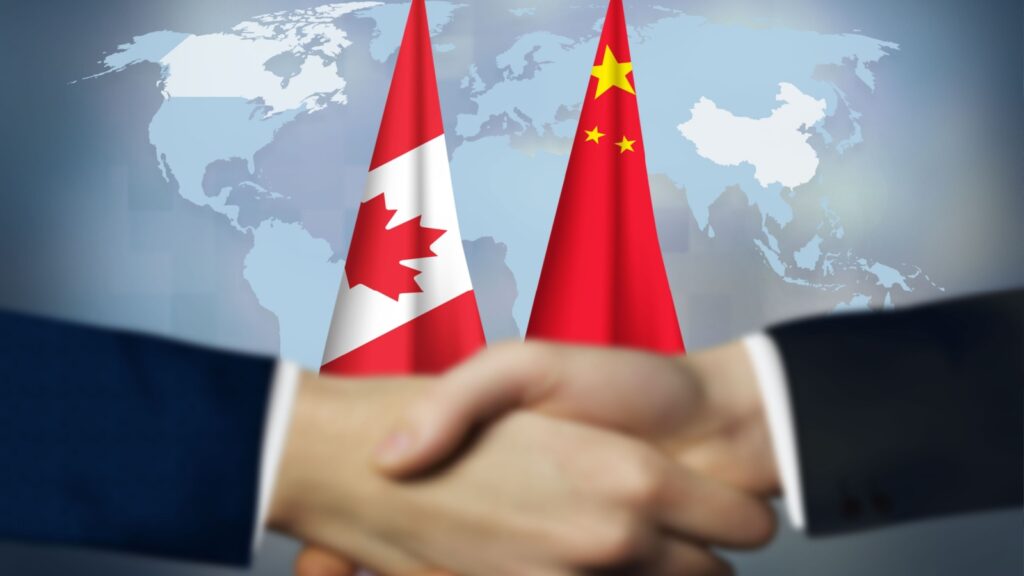
Canada’s effort to reduce its dependence on the United States is gaining momentum as Ottawa launches a new round of high-level trade talks with China. With American tariffs creating uncertainty for Canadian manufacturers, farmers, and exporters, the federal government is turning to the world’s second-largest economy in search of new business opportunities.
International Trade Minister Maninder Sidhu is visiting China from November 3 to 6, 2026, while Agriculture Minister Heath MacDonald is pursuing discussions focused on agricultural exports and market access. Their visits build on Prime Minister Mark Carney’s efforts to rebuild economic relations with Beijing earlier this year. For Canadian businesses, the stakes extend beyond diplomatic cooperation. Ottawa is seeking more reliable customers, fewer trade barriers, and greater economic flexibility at a time when its traditionally close trading relationship with Washington faces significant pressure.
A High-Level Trade Push Begins in Beijing and Shanghai
Ottawa’s latest initiative represents a significant diplomatic effort to strengthen its commercial relationship with China. According to Global Affairs Canada, International Trade Minister Maninder Sidhu is scheduled to co-chair a meeting of the Canada-China Joint Economic and Trade Commission alongside Chinese Commerce Minister Wang Wentao. The meeting is especially significant because it will be the first time the commission has convened at the ministerial level. That creates an opportunity for both governments to address trade disagreements directly rather than leaving individual exporters to navigate regulatory and political obstacles on their own. For Canadian companies seeking customers overseas, predictability can be as important as tariff reductions. Businesses need confidence that products will reach buyers, contracts will be honoured, and market conditions will not change unexpectedly. Ottawa hopes these discussions can help establish a more stable foundation for bilateral trade.
The second major destination is Shanghai, where Sidhu will participate in activities surrounding the China International Import Expo. Canada has been designated the Guest Country of Honour at the event, scheduled for November 5 to 10, giving Canadian businesses additional visibility among Chinese buyers, investors, and government representatives. Agriculture Minister Heath MacDonald is also participating in the broader trade effort, alongside provincial representatives. The Canadian government has identified agriculture, agri-food, energy, clean technology, and consumer products as important commercial priorities. Bringing these industries together creates opportunities for exporters ranging from food processors to energy companies. However, the mission remains an early step rather than a completed trade breakthrough. Its success will depend on whether discussions produce meaningful commitments, new commercial agreements, and improvements in access to China’s market.
Trump’s Tariff Pressure Is Reshaping Canada’s Trade Strategy
For decades, Canadian businesses have benefited from selling into the world’s largest consumer economy without having to ship products across an ocean. That proximity helped create deeply integrated supply chains, particularly in automobiles, manufacturing, energy, and agriculture. However, the advantages of geographic closeness have become more complicated under President Donald Trump’s trade policies. Statistics Canada reported that the United States accounted for 71.7% of Canadian merchandise exports in 2025, down from 75.9% in 2024. The Bank of Canada’s October 2026 monetary policy report estimated that the average American tariff on Canadian goods had increased from 5% in July to 7.5% in October. Although approximately 80% of Canadian merchandise exports to the United States remain tariff-free, some industries face significantly higher duties. Those restrictions create uncertainty for businesses deciding where to invest, hire workers, or expand production.
The dispute has also complicated the future of the Canada-United States-Mexico Agreement. During the agreement’s July 2026 joint review, Washington declined to renew it in its existing form, although the agreement remains in force. That uncertainty has encouraged Ottawa to pursue additional economic partnerships rather than depend entirely on negotiations with Washington. There are signs that the immediate confrontation could ease. On November 3, Trump suggested that a new agreement with Canada could be reached soon, following discussions with Prime Minister Carney. Nevertheless, no finalized deal had been announced at that point. Ottawa’s outreach to China therefore reflects a broader strategy rather than a complete departure from North American trade. Even if Canada reaches a favourable arrangement with Washington, additional export destinations could help Canadian businesses withstand future political disagreements, economic disruptions, and unexpected changes in American trade policy.
Carney’s January Agreement Created the Foundation for New Talks
The renewed diplomatic relationship did not begin with the November visit. In January 2026, Prime Minister Mark Carney travelled to Beijing for meetings with Chinese President Xi Jinping and other senior officials, becoming the first Canadian prime minister to make an official visit to China since 2017. The two governments announced a new strategic partnership covering trade, energy, agriculture, and several other areas of cooperation. They also established an economic and trade roadmap designed to improve communication and resolve commercial disputes. One important commitment was to elevate the Joint Economic and Trade Commission to the ministerial level, creating a more direct channel for addressing disagreements. The November meetings are therefore part of an established diplomatic process rather than an isolated visit. For Canadian exporters, these arrangements could help address problems involving customs procedures, product approvals, and technical regulations that often determine whether international sales are commercially practical.
The January negotiations have already produced measurable changes. Effective March 1, China reduced its combined tariff on Canadian canola seed to 14.9%, down from almost 85%, while suspending additional tariffs on Canadian canola meal, peas, lobster, and crab until the end of 2026. China also restored beef market access for 20 registered Canadian meat establishments earlier in the year. Canada, meanwhile, introduced an annual import quota allowing an initial 49,000 Chinese electric vehicles to enter at a 6.1% tariff, replacing the previous 100% surtax for eligible vehicles within the quota. These concessions demonstrate how Ottawa and Beijing are attempting to resolve longstanding commercial disagreements through negotiated compromises. They also illustrate the political sensitivity of closer economic cooperation. Expanded agricultural exports may benefit Canadian farmers, while greater access for Chinese electric vehicles raises separate questions about competition and investment in Canada’s domestic automotive industry.
Canadian Farmers and Seafood Exporters Have Major Stakes in the Mission
Agriculture is emerging as one of the most important areas of Canada’s renewed engagement with China. Agriculture Minister Heath MacDonald’s visit includes planned meetings with Chinese Agriculture and Rural Affairs Minister Zhang Zhu, customs authorities, and importers of Canadian agricultural products. These discussions are intended to improve commercial relationships while addressing barriers that can prevent Canadian food from entering the Chinese market. According to Agriculture and Agri-Food Canada, Canadian agriculture, agri-food, and fish and seafood exports to China were valued at approximately $6.7 billion in 2025, representing 6.4% of Canada’s total exports in those sectors. For farmers and processors, reliable access to international markets has consequences that extend beyond annual sales figures. Grain producers must decide how much to plant, food processors must secure transportation capacity, and exporters need confidence that their shipments will clear customs. Unexpected restrictions can disrupt all three activities.
The potential benefits are particularly visible in Canada’s seafood industry. Fisheries Minister Joanne Thompson recently completed a separate visit to China, attending the China Fisheries and Seafood Expo in Qingdao from October 26 to 30. Fisheries and Oceans Canada reported that Canadian seafood exports to China averaged approximately $1.3 billion annually between 2022 and 2025, adjusted for inflation. During the visit, Thompson also examined how Canadian products, including live Nova Scotia lobster, reach Chinese consumers through supermarkets and delivery services. Despite earlier tariff reductions, important trade barriers remain. Additional Chinese duties continue to affect products such as canola oil, pork, and certain fish and seafood products, while several existing tariff suspensions are scheduled to expire at the end of 2026. Resolving those outstanding issues could create opportunities for agricultural communities across the Prairies and fishing communities on Canada’s Atlantic and Pacific coasts. Maintaining dependable market access will be equally important.
Canada’s Trade With China Is Growing, but the Numbers Reveal an Imbalance
China already represents a substantial part of Canada’s international trading network. Global Affairs Canada reports that bilateral merchandise trade reached approximately $125.7 billion in 2025, making China Canada’s second-largest single-country merchandise trading partner after the United States. However, the relationship is far from evenly balanced. Canadian merchandise exports to China totalled $35 billion, while imports from China reached approximately $90.6 billion. These figures illustrate both the enormous commercial opportunities available and the challenge Canada faces in expanding its share of the Chinese market. Ottawa has established a goal of increasing Canadian exports to China by 50% by 2030. There are encouraging signs of progress. In announcing the November mission, Trade Minister Sidhu stated that Canadian merchandise exports to China increased by 31.4% during the first half of 2026, reaching $21.5 billion. Sustaining that growth across more industries will be important.
A closer examination of the export figures reveals why diversification is more complicated than securing a handful of large deals. Research published by the University of Alberta’s China Institute in September 2026 found that energy products and mineral commodities accounted for approximately 58.4% of Canadian domestic merchandise exports to China during the first half of the year. Crude petroleum exports more than doubled to approximately $5.96 billion, while copper ore and concentrate exports reached $2.64 billion. Agricultural products also recorded gains, but the strongest improvements were concentrated in resource-producing industries. That means rising bilateral exports do not necessarily translate into immediate benefits for every Canadian business. A large energy shipment can significantly increase national trade figures without creating opportunities for a smaller manufacturer or consumer goods company. Expanding beyond commodities and building stronger commercial relationships across additional industries would make Canada’s economic diversification more meaningful.
Shanghai’s Import Expo Could Open Doors for Smaller Canadian Businesses
While government negotiations in Beijing are intended to address larger trade issues, the China International Import Expo offers a more immediate opportunity for Canadian businesses to connect with potential customers. The event is scheduled to take place at Shanghai’s National Exhibition and Convention Center from November 5 to 10. According to Canada’s Trade Commissioner Service, the 2025 expo attracted more than 460,000 professional visitors, including buyers, investors, distributors, and representatives from major companies. Canada’s role as Guest Country of Honour in 2026 provides additional promotional exposure. Canadian pavilions are being organized around agri-food, natural health products, and consumer goods, including fashion, personal care, and household products. For smaller Canadian companies, these opportunities can be valuable because entering a foreign market involves considerable expense. Identifying a dependable distributor, understanding local product requirements, and establishing customer relationships can be difficult without direct commercial introductions.
Recent Canadian trade activity provides an example of what those introductions can accomplish. In October 2026, Canadian Heritage reported that a separate creative industries trade mission to China, involving representatives from 36 Canadian companies and organizations, produced more than 370 business-to-business meetings. That mission resulted in seven commercial agreements valued at more than $4.2 million, with additional negotiations continuing afterward. Although those results came from a different delegation, they demonstrate how organized trade missions can move beyond promotional appearances toward actual business transactions. The November mission could provide similar opportunities for companies selling Canadian food, consumer products, and specialized technologies. However, international trade exhibitions are only starting points. Businesses must still negotiate pricing, comply with Chinese regulations, establish logistics arrangements, and convince customers to place repeat orders. The most meaningful results may become visible months after the official delegation returns to Canada.
Expanding Trade With China Also Creates Economic and Political Risks
Despite the opportunities, closer commercial cooperation with China carries important risks that Ottawa cannot ignore. Global Affairs Canada has identified market-access restrictions, opaque regulations, inconsistent enforcement, intellectual property theft, and concerns about sensitive technologies as challenges for Canadian businesses. The government’s Trade Commissioner Service also cautions exporters that entering China requires careful due diligence, reliable commercial partners, and an understanding of local legal and regulatory requirements. These issues are particularly important for businesses developing advanced manufacturing technologies, clean-energy equipment, and proprietary products. A company could gain access to millions of potential customers while simultaneously exposing valuable technology or commercial information to new risks. The government’s broader China strategy therefore involves balancing economic opportunities against national security and competitive considerations. Trade diversification is intended to reduce Canada’s exposure to external shocks, not simply replace dependence on one large foreign market with dependence on another.
The success of Ottawa’s latest initiative will ultimately depend on results that extend beyond diplomatic meetings and promotional announcements. Important indicators will include whether China extends agricultural tariff relief beyond December 2026, removes outstanding restrictions on Canadian products, and provides more predictable customs and regulatory procedures. New export contracts, investment commitments, and stronger sales across a wider variety of industries would offer additional evidence of progress. Canada’s objective of increasing exports to China by 50% by 2030 provides a longer-term benchmark, but achieving it will require sustained commercial development. At the same time, improving relations with China does not eliminate the importance of maintaining access to the United States. For Canadian workers, farmers, manufacturers, and business owners, the real benefit would be having more dependable customers and greater protection against sudden disruptions. Ottawa’s China mission represents an opportunity to build that flexibility, but whether it delivers lasting economic security remains to be seen.
