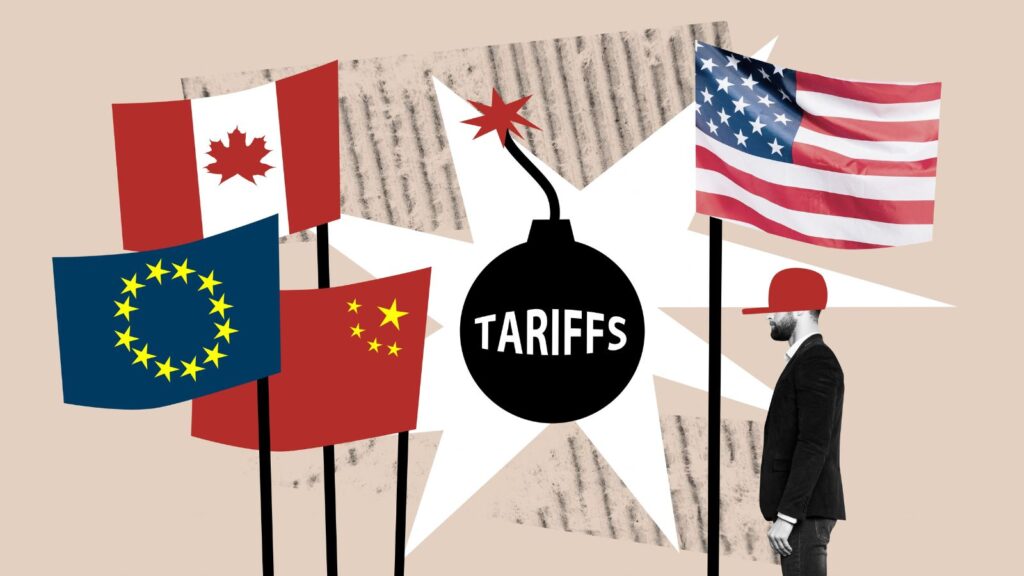
For generations of Canadian companies, international expansion often started with a simple assumption: look south first. The United States offered proximity, familiar consumer habits and a trade agreement designed to make cross-border commerce relatively straightforward. In 2026, that calculation has become more complicated.
A new round of U.S. tariffs has pushed costs sharply higher for selected Canadian products, including goods sold by smaller consumer brands. Laneway Distillers, Bonjou Beauty and Hillberg & Berk illustrate how businesses are responding. Rather than abandoning growth, they are strengthening Canadian sales while exploring markets farther from home, including China and Europe. Their experience reflects a broader shift already visible in Canadian trade data: businesses are increasingly treating diversification as a practical way to reduce dependence on one dominant export market.
Laneway Distillers Is Turning China Into a Real Sales Channel
Toronto-based Laneway Distillers offers perhaps the clearest example of what market diversification can look like when it moves beyond planning and into actual shipments. Founded by Jessica Chester and Reagan Soucie, the women-led spirits company launched in 2020 and built its identity around Canadian ingredients and Canadian-made gin, vodka and whisky. That domestic identity is becoming part of its pitch overseas. In 2026, Laneway participated in the Canada Pavilion at the China Food & Drinks Fair in Chengdu, where the company met importers, distributors and customers. Chester subsequently said the company had secured landed approval in China, had its first shipment on the way and was already operating through cross-border channels. Products identified for the Chinese market included Laneway No. 11 Gin, No. 12 Vodka, No. 33 and Ever Gin, while its Far & Wide Canadian whisky was being prepared for sale through Tmall’s cross-border platform. For a small Ontario producer, that represents substantially more than simply testing consumer interest at a trade show.
The timing matters because the U.S. market has become more difficult for Canadian alcohol producers to evaluate. Washington imposed additional 50% duties on selected Canadian products in August 2026 under Section 338 of the Tariff Act of 1930, part of a dispute that included alcoholic beverages. Those measures arrived after Canadian provinces had restricted U.S. alcohol sales during the earlier phase of the trade dispute. The result is an unusually complicated environment for a producer deciding where its next export dollar should go. China is hardly frictionless: Chester has publicly noted that different Chinese sales channels come with different tax structures, pricing models and consumer expectations. Yet the company has done the work needed to establish an actual route to market there. Laneway also faces obstacles at home, where Chester has criticized Canada’s fragmented provincial alcohol systems for creating separate fees, listing rules and administrative requirements. That combination helps explain why diversification is becoming more strategic. If both the domestic and American routes carry significant friction, putting resources into a large Asian market can become a reasonable part of a long-term growth plan rather than merely a reaction to the latest tariff announcement.
Bonjou Beauty Has More Reason to Build Beyond the U.S.
Bonjou Beauty faces the tariff dispute at a very different scale but in a way that can be immediately visible to an individual customer. The Toronto-based company, founded by Samantha Wharton in 2023, sells Canadian-made skincare and makeup produced in small batches in Ontario. After the latest U.S. measures took effect, Bonjou issued a notice telling American customers that its shipments would be subject to a 50% tariff. The company said the charge would be calculated by U.S. Customs and collected from customers, while Bonjou itself would keep its listed product prices unchanged and continue absorbing certain shipping costs. That creates an awkward problem for a growing consumer brand. A lipstick, foundation stick or skincare product may still have exactly the same Canadian retail price, but its effective cost to an American buyer can rise substantially once duties and cross-border costs enter the transaction. For smaller beauty brands competing against enormous multinational companies, such a sudden price disadvantage can make customer acquisition considerably harder.
Europe therefore offers a different kind of opportunity. Bonjou already operates as an international e-commerce business, saying it ships worldwide, and its product information states that relevant products meet EU requirements. The Peak reported that Bonjou was among the Canadian businesses looking beyond the United States as the tariff dispute complicated cross-border growth, with the group of companies pursuing markets including Europe and China. Europe also comes with an important structural advantage for Canadian exporters: the Canada-European Union Comprehensive Economic and Trade Agreement has eliminated tariffs on 99% of tariff lines, provided products satisfy the applicable rules of origin and other requirements. That does not make European expansion effortless. Cosmetics face extensive labelling, safety and regulatory obligations, while shipping costs and consumer preferences vary widely across 27 EU countries. But it changes the calculation. A company that already produces in Canada, ships internationally and has positioned its products for global customers has alternatives when the American market becomes more expensive. In that environment, building European demand is less about turning away from U.S. consumers than about ensuring one policy change cannot determine the brand’s entire international growth trajectory.
Hillberg & Berk Shows Why Building at Home Can Be Part of Diversification
Hillberg & Berk brings another dimension to the story because its response is not simply to replace American expansion with a single new foreign market. The Regina jewellery company, founded by Rachel Mielke in 2007, has spent years building a substantial Canadian retail presence. It opened its 17th store in British Columbia in 2026 and has outlined a plan to reach roughly 30 Canadian locations by the end of 2027, with significant expansion focused on Ontario and British Columbia. Its profile has also moved well beyond Saskatchewan. Hillberg & Berk became the official jewellery partner of the Canadian Olympic Committee under a four-year agreement covering Milano Cortina 2026 and Los Angeles 2028, putting a prairie-born brand alongside Team Canada on an international stage. Mielke has previously described the strategy as concentrating first on building an exceptionally strong Canadian business. That philosophy has become especially relevant as tariffs make some categories of Canadian jewellery significantly more expensive when sold south of the border.
The latest U.S. measures reach covered jewellery classifications with an additional 50% duty, a level capable of transforming the economics of an otherwise routine online order or wholesale shipment. The Peak included Hillberg & Berk alongside Laneway and Bonjou in its examination of Canadian companies expanding into non-U.S. opportunities, including markets such as China and Europe. Publicly available information is more detailed about Hillberg & Berk’s Canadian expansion than about the precise timetable of any European or Chinese retail rollout, an important distinction when assessing the company’s strategy. What is clear is that management has not made American expansion the only route to scale. A larger Canadian store network, international visibility through Team Canada and selective opportunities outside the United States create several potential growth channels instead of one. That approach mirrors what is happening more broadly across Canadian business. Export Development Canada found that 72% of exporters surveyed planned to pursue new markets over the next two years, while federal trade data showed non-U.S. exports rising 11.1% in 2025 and reaching their largest share of Canadian exports since 1981. For these three companies, diversification is becoming less of a slogan and more of an operating strategy.
