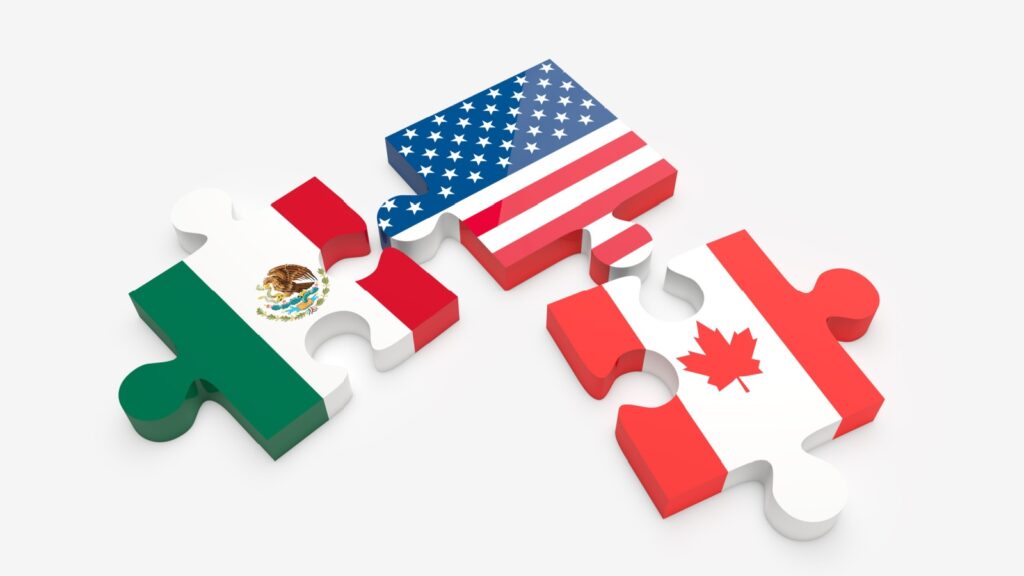
North America’s trade talks are moving at different speeds, and that gap could matter as much as the terms being discussed. The United States and Mexico have completed three formal negotiating rounds connected to their shared trade agreement with Canada, while Ottawa has not returned to formal U.S. negotiations since an August breakdown. Mexican officials describe progress, although another negotiating round has been delayed and no final deal has been announced.
For Prime Minister Mark Carney’s government, the concern is not that Mexico can legally sign away Canadian rights. It is that Washington may strike a preliminary bargain with Mexico and then treat its terms as the starting point for Canada. With tariffs already biting and automakers making long-term decisions, the order in which agreements are reached could shape who has the most leverage.
Mexico Has a Head Start, but No Deal Is Finished
Mexico’s lead is measurable. U.S. and Mexican teams completed a first formal round in May, a second in Washington in June, and a third in Mexico City from July 21 to 23. Their published agenda has ranged from autos, steel and aluminum to agriculture, labor, economic security and electronic payments. At the July meeting, U.S. Trade Representative Jamieson Greer also met President Claudia Sheinbaum, giving the process visibility at the highest political level. The governments originally directed negotiators to meet again in Washington in September.
That fourth round has not taken place on the announced schedule, and no confirmed new date had been made public by October 12. Still, the diplomatic channel remains active. Mexico’s Economy Secretary Marcelo Ebrard met Greer during the G20 trade gathering in Milwaukee on October 1 and spoke optimistically about narrowing differences. For manufacturers deciding where to locate the next production line, even that dialogue has value: it offers a clearer view of potential rules than a negotiation with no formal meetings scheduled. Progress, however, should not be confused with signed tariff relief.
Canada’s Negotiations Are Suspended, Not Its Contacts
Canada did not arrive at this position simply because Washington declined to pick up the phone. On August 21, Carney suspended bilateral trade negotiations and recalled his team, saying late changes to the U.S. proposal were unfair, economically damaging and inconsistent with Canadian sovereignty. His government had been seeking both relief from sectoral tariffs and more predictable U.S. market access. The decision meant walking away from a potential agreement rather than accepting its final conditions, even as new tariffs were about to take effect.
The absence of formal talks since then is nevertheless significant. Trade Minister Dominic LeBlanc has continued to communicate with Greer, and Greer said on October 8 that contact takes place frequently, including at senior levels. But the U.S. representative also said Washington was holding firm and would be ready when Canada wanted to reach agreement. Those statements point to a standoff, not a complete diplomatic rupture. For a Canadian supplier with contracts on both sides of the border, the distinction offers little immediate certainty: officials are talking, but the negotiating machinery is not yet moving again.
The Fear Is a Benchmark Canada Did Not Help Set
The most consequential risk is a smaller U.S.–Mexico arrangement reached before Canada gets back to the negotiating table. Trade specialists have described the possible outcome as an interim bargain: tariff relief or market access in exchange for concessions on economic security, domestic policy or enforcement. A deal of that kind would not settle the full future of CUSMA. It could, however, provide Washington with a ready-made negotiating script for Ottawa, particularly if Mexico accepts a tariff rate or compliance requirement the United States then calls reasonable.
That is why experts have warned that Mexico’s concessions could become the opening benchmark for Canada. A hypothetical reduction of an auto tariff to 15%, for example, might look like progress for Mexico while leaving Canadian exporters facing pressure to accept similar terms. Yet the danger is not inevitable. Analysts also note that Canada and the United States made substantial progress before August, and conversations outside public view may continue. The fear concerns bargaining leverage, not evidence that Ottawa has already been presented with an agreement it must accept.
CUSMA Remains in Force, and Canada Still Has a Vote
The legal picture is less dramatic than the political one. CUSMA, called USMCA in the United States, entered into force on July 1, 2020. At its first mandatory joint review on July 1, 2026, Washington declined to extend it for a fresh 16-year term. That decision did not terminate the pact. Under Article 34.7, the existing agreement remains in force through July 2036 unless circumstances change, and the three governments must return to annual reviews until they all agree to extend it or the term runs out.
Just as importantly, Article 34.3 provides for the parties to agree in writing to amendments and complete their respective approval procedures. A separate Washington–Mexico trade understanding therefore cannot, by itself, rewrite Canada’s CUSMA obligations. There is a distinction between a bilateral measure that changes the commercial environment and a formal amendment binding all three partners. Ottawa retains legal rights within the pact, but legal rights do not eliminate commercial pressure. Companies can shift investment long before a treaty is formally rewritten, especially if future tariff treatment looks more favorable across another border.
Automotive Content Rules Could Redraw the Map
Nowhere is that tension clearer than in auto manufacturing. Under current CUSMA rules, passenger vehicles and light trucks generally need 75% North American regional value content to receive preferential treatment. Manufacturers must also satisfy requirements involving high-wage production and the sourcing of steel and aluminum. These rules recognize the industry’s reality: a vehicle assembled in Michigan may contain parts made in Ontario and Mexico, with components crossing borders more than once before the finished car reaches a dealer.
Washington has considered substantially tougher terms. Reuters reported in May that U.S. negotiators proposed raising regional content to 82% and requiring 50% of vehicle value to originate specifically in the United States. Those figures were a reported negotiating proposal, not an adopted CUSMA rule. If that model gained traction, Canadian-produced parts could satisfy a North American content calculation yet fail to help a producer reach a new U.S.-only threshold. The resulting pressure would extend beyond big automakers to toolmakers, parts suppliers and workers whose livelihoods depend on a factory winning its next vehicle program.
Tariffs Make the Negotiating Gap Costly Now
The trade fight is already more than an argument about rules for 2027. Following the August collapse, the United States imposed additional 50% tariffs under Section 338 on roughly C$27.6 billion in Canadian goods, according to Ottawa. Canada retaliated on September 8 with targeted duties of 15%, 25% and 50% on a comparable value of U.S. imports. The countermeasures cover selected products across sectors including steel, dairy, appliances, agricultural equipment and electronics. Separate U.S. sectoral duties, including those affecting steel, aluminum and autos, add another layer of difficulty.
For businesses, these overlapping measures mean prices can change sharply even when a long-standing customer relationship has not. Importers must decide whether to absorb the duty, pass it along or seek another supplier; smaller firms often have less room to maneuver. That is why a Mexican deal offering relief from sectoral tariffs would matter beyond Mexico. It could create a comparison point for U.S. customers placing orders across North America, and for Washington negotiators deciding what concessions to demand from Canada in exchange for relief.
Energy and Labor Complicate Mexico’s Bargain
Mexico’s negotiations are not limited to vehicle parts. The Financial Times reported in October that Trump had pressed Sheinbaum for greater cooperation between U.S. and Mexican energy companies, as well as potentially larger Mexican purchases of American natural gas. Reuters, reporting the FT account, noted that U.S. gas already meets roughly three-quarters of Mexico’s demand. Such proposals run into politically sensitive questions over Mexico’s energy sector and its state-backed firms. They also show why a seemingly straightforward tariff agreement can involve decisions far beyond customs offices.
Labor enforcement is another live issue. On October 8, the U.S. government asked Mexico to review allegations that workers at an auto-parts facility in Puebla were denied collective-bargaining rights under CUSMA’s rapid-response mechanism. Those were allegations under review, not a final finding against the company. The episode illustrates how Washington can link access to its market with workplace practices and enforcement. Canada faces its own negotiations over dairy, tariffs and industrial policy, but it is not negotiating Mexico’s energy system or labor disputes. An identical package for both countries would ignore those substantial differences.
Mexico’s Exporters Are Feeling the Pain, Too
Mexico’s earlier start has not protected its factories from U.S. tariffs. Official Mexican data recorded 277,369 light-vehicle exports in September and production of 301,803 vehicles. Compared with September 2025, vehicle exports fell about 12% and production about 15%, while domestic sales rose roughly 8%. Reuters reported that Mexican cars continued to face a headline U.S. tariff of 25%, with effective burdens estimated by Mexican officials at 10% to 12% for qualifying vehicles using regional content. Negotiations were therefore moving while the industry was already absorbing costs.
The uneven results across manufacturers made the strain visible. Reuters reported export declines at General Motors, Ford and Nissan, alongside stronger performances by Kia, BMW and Mazda. One month cannot establish that tariffs caused every lost shipment; model cycles, demand and production plans also affect results. But the broader point is difficult to miss: Mexico has a strong incentive to secure relief, not merely to gain an advantage over Canada. Its negotiators face pressure from employers and workers who need present-day orders while they wait for a longer-term framework.
Ottawa Can Work With Mexico Without Matching Every Concession
Canada and Mexico are not strangers looking at each other across Washington’s negotiating table. Their governments launched a broader strategic partnership in September 2025, and a Mexican trade mission visited Toronto and Montréal in May 2026. According to Global Affairs Canada, the visit produced more than ten memorandums and agreements, including a planned C$200 million investment by Grupo Bimbo to modernize Canadian operations. LeBlanc and Ebrard also discussed strengthening CUSMA and North American competitiveness. Those channels offer a practical way to compare priorities and explain where national interests overlap.
Cooperation does not mean that Sheinbaum’s government will sacrifice a favorable bilateral outcome for Ottawa. Mexico must answer to its own manufacturers, farmers and voters, just as Canada must. There are areas of agreement, however. On October 7, both countries joined a U.S.-led international statement addressing excess industrial capacity and market-distorting practices. Coordinated positions on supply-chain resilience could help keep the pact trilateral, even while the countries negotiate different immediate problems. Dialogue between Ottawa and Mexico City is valuable precisely because it reduces the chance that separate deals drift in incompatible directions.
Integrated Supply Chains Cannot Be Rebuilt Overnight
The scale of North American commerce explains why all three governments have something to lose. Canadian government figures put the combined CUSMA market at 517 million consumers in 2025 and Canada–U.S. goods and services trade at nearly C$3.5 billion a day. Behind those numbers are everyday economic links: a parts plant sending components south, a U.S. machinery maker selling equipment to a Canadian manufacturer, or a Mexican assembler relying on supplies from both neighbors. A change in border costs can ripple through more than one country before a finished product reaches a consumer.
Recent trade figures also require careful reading. Statistics Canada reported that exports to the United States rose 8.1% in August and Canada’s merchandise trade surplus with its neighbor widened to C$11.2 billion. That might sound like a reassuring picture in the middle of a trade war. But the agency cautioned that companies could have accelerated shipments ahead of new tariffs. A rush to beat a deadline is not the same as sustainable growth. For investors and workers, uncertainty about the next set of rules can be as disruptive as today’s rate.
The Next Moves Will Reveal Whether Canada Can Catch Up
Two milestones now deserve attention. The U.S. and Mexico have indicated that a fourth formal negotiating round should happen, but a firm date had not been publicly confirmed by October 12. Separately, the U.S. Trade Representative opened consultations for the 2027 joint review of CUSMA, with written comments and requests to appear at a public hearing due January 12, 2027. The first joint review already occurred in July 2026; the coming process is another stage in continuing talks, not the moment when the agreement suddenly expires.
For Ottawa, the immediate choices are political and practical. Reopening formal negotiations could help Canada influence the assumptions used in any North American bargain. Refusing an unfavorable deal could protect long-term interests but leave exporters facing tariffs in the meantime. Closer coordination with Mexico may provide intelligence and common ground, though not a veto over bilateral diplomacy. The clearest signals will be concrete: a scheduled Canadian negotiating round, published tariff relief, clarity on proposed auto rules and evidence that Washington still intends to preserve a workable three-country agreement. Until then, the real danger is not an inherited treaty but an inherited starting position.
