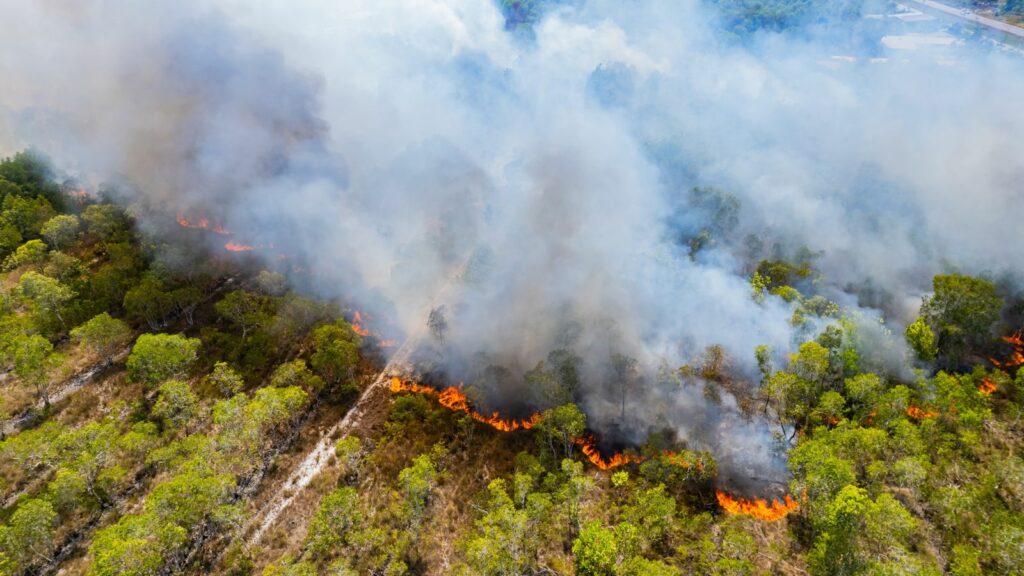
Smoke does not stop at a border checkpoint, and neither does the anger it creates. After another wave of Canadian wildfire smoke spread across Michigan and much of the U.S. Midwest and Northeast, four Republican members of Michigan’s congressional delegation accused Ottawa of failing to prevent a recurring cross-border health threat. Their July 15 letter demanded more forest thinning, fuel reduction, prescribed burning and enforcement against deliberately set fires.
The criticism lands during a rapidly worsening Canadian fire season, but it also simplifies a problem shaped by remote lightning strikes, limited firefighting capacity, decades of fire suppression and a warming climate. Canada’s record shows both significant new spending and serious remaining gaps, leaving the central question less about whether action exists than whether it is fast, broad and effective enough.
The Accusation Has Returned With Sharper Language
Michigan Republicans Jack Bergman, John James, Lisa McClain and John Moolenaar framed the latest smoke emergency as the result of Canadian inaction. In a joint letter to Prime Minister Mark Carney, they argued that earlier warnings had produced too little progress and blamed what they described as chronic underinvestment in forest thinning, fuel reduction and prescribed burns. They also questioned enforcement against arson and suggested U.S. agencies could explore a more direct role in cross-border fuel reduction and firefighting capacity.
The intervention was unusually blunt, but it was not isolated. Republican officials from several northern states made similar complaints in 2025, when smoke repeatedly disrupted outdoor life and triggered health advisories. Some urged the International Joint Commission to examine Canadian practices, while others floated wildfire smoke as a possible issue in wider trade discussions. The political appeal is clear: families see orange skies, cancelled activities and air-quality warnings, then demand accountability. Still, the claim that Canada has done nothing is not supported by the public record. The more defensible argument is that existing measures have not yet prevented repeated smoke emergencies.
Smoke Turned a Canadian Emergency Into a U.S. Political Crisis
By July 16, Canada had 859 active wildfires, including 113 classified as out of control, while approximately 2.384 million hectares had burned. Many of the most significant fires were in Manitoba, Saskatchewan and Ontario. Ontario requested federal help for evacuations in remote northern communities, and roughly 1,600 people had been evacuated from First Nations communities by July 15. Near Armstrong, Ontario, Canadian National Railway suspended operations after fire surrounded a train and forced employees and residents from the area.
The smoke rapidly transformed those distant fires into an urban emergency hundreds of kilometres away. Detroit recorded an IQAir reading of 600, while federal monitoring showed dangerous smoke across parts of Minnesota, Michigan, Illinois, Ohio and other states. New York City distributed KN95 masks and urged residents to reduce outdoor exposure days before the World Cup final in nearby New Jersey. The speed of the escalation was striking: a July 9 federal update said national activity remained below the five-year average, yet a week later Canada had more active fires than at the same point in either of the previous two years.
Republicans Are Pointing to Real, but Limited, Fire-Management Tools
Forest thinning, community fire guards and prescribed burns are not invented political talking points. Fire specialists use them to remove vegetation that can feed an intense blaze, slow fire spread and improve the odds that crews can hold a fire near homes or infrastructure. Parks Canada reported conducting 15 prescribed fires across 1,988 hectares in nine parks or sites during 2025. It also uses FireSmart standards, mechanical tree removal and targeted fuel breaks in places where people, buildings and transportation corridors face elevated risk.
The limitation is scale and timing. A prescribed burn is a complex operation that can take years to plan and can proceed only when wind, fuel moisture, drought conditions, air quality and staffing all fall within a safe window. Those windows may be brief or may not appear at all in a particular season. Fuel treatments are also most practical around communities and strategic corridors, not across every remote forest where lightning may strike. These tools can reduce damage and improve suppression, but they cannot guarantee a smoke-free summer or prevent every large fire across Canada’s vast northern landscapes.
Canada’s Geography Makes a Simple Prevention Promise Impossible
Lightning starts roughly 45% to 46% of Canadian wildfires but accounts for about 81% to 83% of the area burned. Those fires often occur in remote locations and may ignite in clusters, making rapid access difficult. Research on the 2023 season found that fires larger than 200 hectares represented only a small share of incidents but accounted for approximately 97% of the total area burned. Once a fire survives initial attack and enters a stretch of hot, dry and windy weather, its growth can outpace even a major suppression effort.
Fire is also a natural process in boreal ecosystems, which complicates demands that every ignition be extinguished immediately. Where no community or critical asset is threatened, agencies may monitor or manage a fire rather than commit scarce crews to dangerous terrain. That does not mean prevention is irrelevant. Human-caused ignitions can be reduced through bans, enforcement and public compliance, while fuel treatments can protect populated areas. However, the national data do not support treating arson as the principal explanation for Canada’s burned area. Lightning and extreme fire weather remain central to the problem.
Climate Conditions Are Expanding the Window for Extreme Fire
The strongest evidence against a purely management-based explanation comes from the fire-weather record. During Canada’s record 2023 season, the average temperature from May through October was 2.2°C above the 1991–2020 average. More than 14.6 million hectares burned, about four times the recent 10-year average. Peer-reviewed research concluded that human-caused climate change enabled sustained extreme fire-weather conditions, with widespread heat, dryness and long periods in which fires could continue growing.
That does not mean climate change determines every ignition or fully explains the size of every 2026 fire. Local precipitation, wind, vegetation, lightning and human behaviour still matter. It does mean hotter conditions can dry fuels faster, lengthen the season and create simultaneous emergencies across several provinces, stretching aircraft and crews at the same time. Natural Resources Canada says the country’s wildfire season has already become longer, while projections indicate some regions could face seasons more than a month longer by 2100. Any diagnosis that focuses only on thinning and enforcement leaves out a force that is making fires harder to control.
Canada Has Increased Spending, Though Capacity Gaps Remain
Ottawa has announced substantial investments since the record 2023 season. For 2026 through 2031, the federal government committed $316.7 million to lease and manage national aerial firefighting capacity, including 10 aircraft and two support assets secured for this season. Other commitments include $285 million for wildfire resilience and FireSmart expansion, $256 million for specialized provincial and territorial equipment, $28 million intended to train 1,000 additional firefighters, and $47.8 million for Parks Canada preparedness and risk reduction.
The federal government says its wildfire-resilience commitments since 2019 total close to $1 billion, including research, Indigenous fire knowledge, satellite monitoring and community mitigation. Those figures directly challenge the idea that Canadian governments have simply ignored the problem. They do not prove the response is sufficient. Aircraft must be positioned, firefighters trained and retained, and provincial systems coordinated during periods when several regions need help at once. Canada’s decentralized emergency system also means provinces and territories lead the initial response before requesting federal support. The fairer criticism is that rising risk may be moving faster than institutions can expand.
Communities on Both Sides Are Paying the Price
The Republicans’ anger resonates because wildfire smoke is not merely an inconvenience. Fine particulate matter, known as PM2.5, can penetrate deep into the lungs and is associated with coughing, breathing difficulty, worsened asthma and other respiratory and cardiovascular effects. During the July 16 smoke event, dangerous readings affected major U.S. cities far from the flames. For a child with asthma, an outdoor worker or an older adult with heart disease, the border offers no protection from exposure.
Canadians living near the fires face the smoke plus evacuation, disrupted transportation and the possibility of losing homes or community infrastructure. First Nations are especially exposed because many communities are remote and surrounded by fire-prone landscapes. Federal data estimate that First Nations account for 42% of wildfire-related evacuations despite representing about 5% of Canada’s population; in 2025, 44,920 people from 61 on-reserve First Nations were displaced. That reality makes the suggestion that Canadian officials are indifferent difficult to sustain. American health concerns are legitimate, but Canada is not exporting a problem it escapes at home.
Cooperation Offers More Leverage Than a Cross-Border Blame Fight
Canada and the United States already have a framework designed for this challenge. A 2023 memorandum expanded bilateral wildfire cooperation beyond emergency suppression to include prevention, research, innovation, technical coordination and risk mitigation. Firefighting support has historically moved in both directions. When destructive fires struck Southern California in January 2025, Canada prepared personnel and other assistance in coordination with U.S. agencies, describing that support as reciprocal.
That framework offers more practical leverage than threats of unilateral involvement. The two countries can improve joint smoke forecasting, pre-position crews and aircraft, coordinate fuel treatments near communities and the border, share satellite intelligence, and expand Indigenous-led cultural burning where appropriate. They can also address the longer-term warming trend that is increasing fire danger across North America, including in the United States. Republican lawmakers have drawn attention to a real cross-border health problem and to prevention tools that deserve greater use. But reducing the dispute to Canadian negligence risks turning a shared emergency into a nationalist argument when the smoke itself demonstrates how little room there is for one-country solutions.
