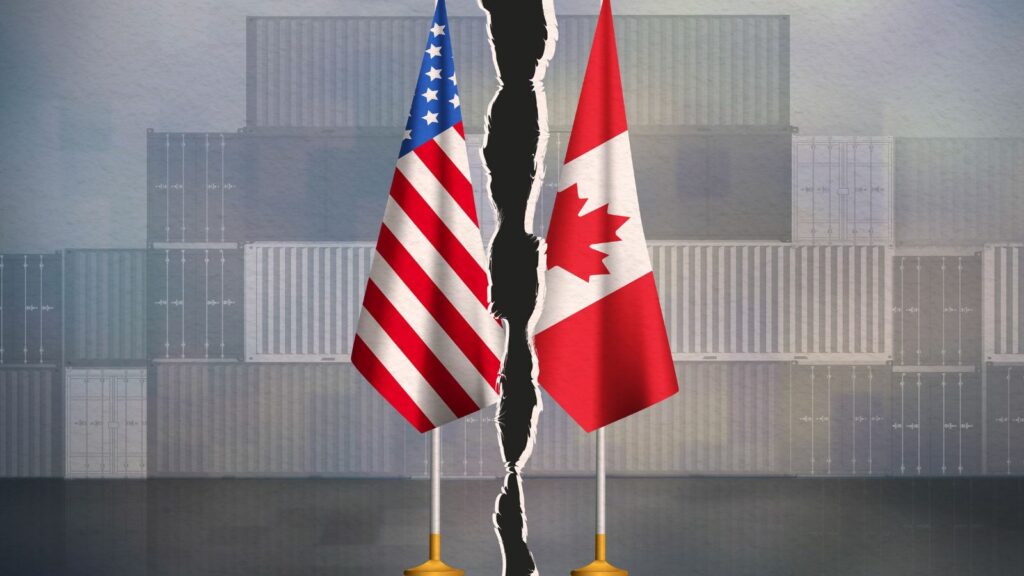
A tariff dispute that once sounded like an argument over trade rules is increasingly being felt as a household-cost issue in the United States. A newly released Cato Institute/Morning Consult poll found that 74% of registered voters believe President Donald Trump’s tariffs have increased prices on things they buy, including majorities of Republicans, Democrats and independents. The finding arrives as Washington and Ottawa exchange new trade barriers covering roughly US$20 billion in goods on each side, adding another layer of uncertainty to one of the world’s largest trading relationships. At the same time, inflation remains elevated and businesses on both sides of the border are reporting higher costs, lost orders and disrupted supply chains. The poll does not prove that tariffs caused every recent price increase, but it shows that a broad share of American voters now connects trade policy directly with the cost of living.
Price Concerns Cross Party Lines
The headline number comes from the Cato Institute’s 2026 Fall Trade and Populism National Poll, conducted with Morning Consult from August 13 through August 16. Among 4,150 registered voters, 74% said Trump’s tariffs had increased the prices of things they purchase at stores. That view was hardly confined to the president’s political opponents. The poll found that 66% of Republican voters agreed, along with 73% of independents and 84% of Democrats. Nearly half of respondents, 49%, also said the tariffs had worsened their personal quality of life. Only 23% overall said tariffs had improved it.
Those numbers are important partly because of the breadth of the sample and partly because Americans are increasingly thinking about tariffs through everyday expenses rather than abstract trade statistics. The poll had a modeled margin of error of plus or minus two percentage points. Respondents came from online opt-in panels and the results were weighted using demographic characteristics and 2024 presidential vote choice to approximate the U.S. registered-voter population. That methodology means the 74% figure should be understood as a measured public perception, not an economic calculation of how much individual families have paid because of tariffs.
Americans Like Some Tariff Goals More Than Their Costs
The poll reveals a more complicated picture than simple opposition to protectionism. Many respondents still supported objectives commonly associated with tariffs, including encouraging companies to manufacture more goods in the United States. Cato’s earlier March polling found that 70% believed the country would be better off with more factory workers, while the August results showed 45% initially favoured tariffs on most imports if the policy encouraged domestic job creation and production. At the same time, only 38% said they would personally accept even $100 a year in additional household costs to achieve that goal.
That gap between supporting an industrial objective and accepting higher personal costs helps explain why tariff politics have become closely connected with affordability. Fifty-seven per cent of respondents described tariffs as at least partly a tax increase on Americans, while 21% said they were solely a tax on other countries. The White House takes a different view of its trade strategy, arguing that tariffs can counter discriminatory treatment of U.S. exporters, encourage domestic production and create leverage in negotiations. In its July action against Canada, the administration specifically cited Canadian policies affecting U.S. automobiles, alcoholic beverages and dairy products as justification for additional duties.
Inflation Data Suggests Tariffs Are Part of a Bigger Price Story
The poll captures what voters believe, but official inflation data require a more careful interpretation. The U.S. Consumer Price Index rose 0.4% in August and was 3.4% higher than a year earlier, according to the Bureau of Labor Statistics. Gasoline prices climbed 3.9% during the month and accounted for more than one-third of the overall monthly CPI increase. That matters because households experiencing higher prices at the grocery store, gas station and elsewhere may encounter several overlapping causes at once, including energy shocks, tariffs, wages, transportation costs and changes in supply and demand.
The Federal Reserve has nevertheless found evidence that tariffs have contributed to goods inflation. Its July Monetary Policy Report said price increases had been stronger relative to earlier trends in categories with greater exposure to higher import tariffs, including household appliances and consumer electronics. The Fed also cautioned that tariff effects cannot be directly isolated in official consumer-price statistics because businesses, foreign exporters and consumers can absorb or shift the costs in different ways. In other words, the poll’s 74% figure reflects a public judgment that has some backing in economic evidence, but tariffs should not be treated as the sole explanation for the current inflation rate.
New Research Shows How Tariffs Reach Store Shelves
Recent academic research helps explain why tariffs can eventually appear in retail prices even when the imported product itself is not sitting on a store shelf. A July 2026 National Bureau of Economic Research paper by Mary Amiti, Sebastian Heise and David Weinstein examined the effects of the 2025 U.S. tariff increases. The researchers estimated that roughly 26% of the tariff increase passed through to consumer prices when comparing more-exposed and less-exposed goods. Their analysis also found that price effects were not limited to imported finished products.
According to the study, about 64% of the measured consumer-price effect came directly from higher prices for foreign varieties, while roughly 36% came through indirect channels. American producers using imported components faced higher input costs, while some domestic manufacturers gained room to raise markups when competing imports became more expensive. The timing also differed. Direct import-price effects appeared relatively quickly, while indirect supply-chain effects generally required nine to 12 months to work through the economy. That lag helps explain why the consequences of a tariff imposed today may not become fully visible to shoppers immediately—and why businesses often warn about future costs before consumers see them.
Canada’s Retaliation Has Turned the Fight Into a Two-Way Shock
The latest Canada dispute adds another layer to those pressures. The Trump administration imposed additional tariffs of up to 50% on approximately US$20 billion, or C$27.6 billion, of Canadian goods after accusing Canada of discriminatory trade practices. Canada responded with counter-tariffs of 15%, 25% and 50%, effective September 8, on C$27.6 billion in American imports. Ottawa said the rates were designed to match corresponding U.S. measures, with targeted sectors including steel, dairy, appliances, agricultural equipment, pulp and paper, plastics and electronics.
The dispute has continued to escalate beyond those duties. Reuters reported that Washington announced plans to ban imports of certain Canadian alcoholic beverages, motorcycles and whey beginning September 29 after Canada’s retaliation took effect. Some strategically important Canadian exports, including energy and potash, were exempted from the original July Section 338 action, limiting the immediate scope of the tariffs. Even so, the new barriers matter because Canada and the United States have deeply integrated manufacturing, agricultural and retail supply chains. A tariff charged at the border can therefore affect a distributor, factory or retailer well before the finished product reaches an American household.
An $872 Billion Relationship Leaves Businesses Exposed
Canada is not a minor supplier that American companies can simply replace overnight. U.S. goods and services trade with Canada totaled an estimated US$872.3 billion in 2025, according to the Office of the U.S. Trade Representative. Goods trade alone reached about US$715.5 billion. American companies exported US$333.6 billion in merchandise to Canada while importing US$381.9 billion. Those numbers help explain why trade restrictions quickly attract attention in states with automotive factories, timber companies, farms and other industries linked to Canadian customers and suppliers.
The latest tariff measures cover only a fraction of that enormous relationship. The Associated Press estimated that the reciprocal tariffs involve roughly 5.5% of bilateral goods trade, meaning their economy-wide impact can be smaller than the headline tariff rates suggest. For companies concentrated in the affected products, however, the exposure can be dramatic. A firm operating with narrow profit margins may have difficulty absorbing a 25% or 50% border charge, while passing it through can make its product uncompetitive. The burden therefore varies sharply by sector: some households may barely notice a particular tariff, while a specialized manufacturer or importer can have its business model altered almost overnight.
Small Companies Are Already Putting Names and Faces to the Costs
The pressure is particularly visible among smaller cross-border businesses. The Associated Press reported that Vermont cheesemaker Jasper Hill Farm saw Canadian holiday orders canceled as relations deteriorated. Co-founder Mateo Kehler said the company was also paying more for some Canadian materials and equipment while higher fuel expenses added another cost. On Vancouver Island, Revival Stillworks, which builds equipment for craft distilleries, said equipment that previously entered the United States tariff-free under the North American trade agreement was now facing duties of 50%. Its machines can cost between $250,000 and $2 million, making that tariff difficult for prospective customers to overlook.
Similar effects can arise even when a product is not directly tariffed. Nashville-based AmpRx told AP that Canadian demand for its guitar-amplifier equipment had weakened even though its bestselling product was not covered by the new measures. The company could not determine whether buyers feared unexpected charges or were reacting more broadly to deteriorating U.S.–Canada relations. These examples illustrate why trade wars can produce costs beyond customs receipts. Companies may delay investment, buyers may postpone purchases, suppliers may add surcharges and customers may switch countries. Those behavioural changes are difficult to capture immediately in official inflation figures but can still influence employment, business investment and prices over time.
Tariffs Are Becoming a Bigger Pocketbook Issue for Voters
The new Cato/Morning Consult findings suggest trade policy has gained unusual prominence ahead of the November 3 midterm elections. Seventy-five per cent of registered voters said tariffs would be important to their vote, including 35% who called the issue “very important.” The same poll found 57% had an unfavorable view of Trump’s handling of trade policy and 43% had a favorable view. Those figures describe attitudes at the time the poll was taken; they do not establish how people will ultimately vote or what other issues might take priority before Election Day.
Separate polling specifically on Canada points in a similar direction. A Reuters/Ipsos poll of 1,023 U.S. adults conducted at the end of August found 20% supported higher tariffs on Canadian goods, while 57% opposed them and 21% were unsure. The poll had a margin of error of about four percentage points. For the administration, the trade strategy continues to rest on the argument that tariffs can protect American industry and challenge policies it considers unfair. For many households, however, the debate is increasingly being measured in a simpler way: what things cost. The 74% finding does not settle the economic argument over tariffs, but it shows that their perceived effect on prices has become widespread across the American electorate.
